Fungie was part of life in Dingle Town for almost four decades. From his arrival in 1983 until his disappearance in October 2020, the bottlenose dolphin became so closely associated with Dingle Harbour that for many people it was difficult to imagine the town without him.
We knew a remarkable amount about Fungie’s life in Dingle. He was watched from boats, photographed, filmed and even swum with over many years. What we knew far less about was where he fitted into the wider populations of bottlenose dolphins living around Ireland.
Now, years after Fungie disappeared, scientific research has added something genuinely new to his story.
A study published in the scientific journal Ecology and Evolution has investigated the population genetics of bottlenose dolphins in Irish waters, combining conventional biological samples with less invasive ways of recovering DNA. Among the individual dolphins included in that research was Dingle’s own Fungie.
The finding is fascinating. Fungie’s genetic ancestry showed connections with both the resident bottlenose dolphin population of the Shannon Estuary and the much larger offshore population. Among the well-known solitary dolphins examined by the researchers, Fungie stood out.
Perhaps even more remarkable is how scientists managed to obtain useful genetic material associated with him after he had disappeared.
How Could Scientists Study Fungie After He Disappeared?
Studying the genetics of wild dolphins presents an obvious difficulty. Obtaining biological material from a free-ranging marine mammal is considerably more complicated than collecting a sample from an animal on land.
The research therefore investigated whether less invasive techniques could supplement conventional sampling. The wider study combined samples obtained directly, including biopsies from free-ranging dolphins and tissue from dead animals, with genetic material collected indirectly from sources including seawater, blows, faeces and naturally shed skin.
Fungie presented a particular challenge.
By the time research into Ireland’s solitary dolphins was developing, he had disappeared from Dingle. There was no longer an opportunity to collect a conventional sample from him.
But there was another possibility.
Denis O’Regan, a member of the Irish Whale and Dolphin Group who had regularly swum with Fungie, still had a wetsuit he had worn during those encounters. Areas of that wetsuit were swabbed so researchers could investigate whether useful genetic material remained.
Laboratory analysis identified dolphin DNA among the material recovered.
I think that is one of the most extraordinary parts of this entire story. Fungie had disappeared years earlier, yet traces associated with those encounters in Dingle could still contribute to scientific research and tell us something new about him.
What Did Fungie’s DNA Reveal?
The research was much broader than the story of one dolphin. It examined the population genetics of bottlenose dolphins in Irish waters and confirmed distinct genetic groupings, including the offshore population and coastal resident populations.
Fungie did not fit neatly into a single population.
His genetic ancestry showed a mixture associated with the Shannon Estuary bottlenose dolphins and the larger offshore population.
That does not mean scientists can now identify the particular bay where Fungie was born or reconstruct his movements before he appeared in Dingle. Genetics does not provide that kind of simple geographical answer.
What it does provide is evidence about the populations to which his ancestry was connected.
For a dolphin whose origins were largely unknown during the 37 years he lived around Dingle Harbour, that is an important addition to his story.
Fungie Stood Out Among Ireland’s Solitary Dolphins
The research becomes even more interesting when Fungie is compared with other well-known solitary bottlenose dolphins recorded around Ireland.
The dolphins examined included Fungie in West Kerry, Nick in Cork Harbour, Finn in Carlingford Lough, Dusty in north Clare and Nimmo in Galway.
Nick, Finn, Dusty and Nimmo were genetically assigned to the offshore population.
Fungie was different.
His results showed the mixed ancestry involving both the offshore population and the Shannon Estuary dolphins.
It is tempting to connect that unusual genetic background with Fungie’s unusual behaviour, but this is where we have to be careful. The research does not demonstrate that Fungie’s mixed ancestry caused him to become solitary. It does not explain why he remained around Dingle for decades or why he developed such extensive interactions with people.
Those remain separate and largely unanswered questions.
Why Do Some Dolphins Become Solitary?
Bottlenose dolphins are normally highly social animals, which makes the lives of long-term solitary dolphins particularly interesting to researchers.
Fungie was described as solitary because he did not permanently live as part of a normal dolphin group. That certainly did not mean he avoided company. Quite the opposite.
His willingness to approach boats and interact with swimmers became one of the defining features of his life in Dingle. It is a central part of the wider story of Fungie the Dolphin and explains why his relationship with the town became so unusual.
Why some bottlenose dolphins leave or remain apart from other dolphins and subsequently develop prolonged interactions with humans is still not properly understood.
Researchers have considered possibilities involving ecology and communication between dolphin groups, but the new genetic findings do not provide a definitive explanation.
We now know something more about Fungie’s ancestry. We still do not know why he chose the extraordinary life that people observed in Dingle.
The Shannon Connection and the Waters Around Kerry
Fungie’s genetic connection with the Shannon Estuary population is particularly interesting when we consider the geography of the waters surrounding the Dingle Peninsula.
To somebody travelling through Kerry by road, Dingle Harbour, the northern side of the peninsula and the Shannon Estuary can seem like quite separate places. For dolphins, of course, our roads, touring routes and land boundaries are irrelevant.
They occupy a much larger marine environment.
This is worth remembering when travelling around the peninsula. The Atlantic isn’t simply the backdrop to the landscape. It has shaped the communities, economy, wildlife and history of West Kerry for generations. My guide to the Wild Atlantic Way around Dingle explores that relationship from the visitor’s point of view, while the wider history of the Dingle Peninsula shows just how deeply life here has been connected with the sea.
Fungie belonged to that much larger Atlantic world.
Fungie Arrived in Dingle in 1983
Fungie was first recorded around Dingle in 1983.
Nobody watching him during those early years could have known that his association with the harbour would eventually last for approximately 37 years.
During that time he became one of Ireland’s most recognisable wild animals. Boat trips went out to see him, swimmers entered the water hoping for an encounter, and visitors returned home with photographs and stories about Dingle’s dolphin.
Children who saw Fungie could return to Dingle years later as adults and find the same dolphin still occupying the waters around the harbour.
That longevity is an important part of understanding what Fungie eventually meant to Dingle. He wasn’t a dolphin that appeared for a summer or remained for a few seasons. He became a constant presence through decades of change in the town.
Eventually, Fungie became much more than a wildlife attraction. He became part of Dingle’s identity.
What Happened to Fungie?
In October 2020, Fungie disappeared.
After decades of such a consistent presence, his absence was immediately noticeable. Searches took place, but Fungie was never conclusively located.
There has naturally been speculation about what happened to him, but the most accurate answer remains very simple: we do not know for certain what happened to Fungie after October 2020.
The new DNA research does not change that. It tells us something about his genetic ancestry, not his eventual fate.
That uncertainty is an important part of telling Fungie’s story properly. Despite the remarkable familiarity people developed with him, Fungie remained a wild animal. There were parts of his life that people never observed and questions about him that may never be answered.
A Story That Continued After Fungie Disappeared
This is what I find particularly interesting about the new research.
When Fungie disappeared, it seemed reasonable to think that our opportunity to learn anything genuinely new about him had largely disappeared as well. There could be no new observations of his behaviour and no opportunity to collect a conventional biological sample.
Yet years later, genetic material associated with an old wetsuit has allowed researchers to add another piece to his story.
It means Fungie’s scientific story did not end when he disappeared from Dingle Harbour.
The dolphin people knew through sightings, swimming encounters, photographs and stories can now contribute to a wider understanding of bottlenose dolphins around Ireland and to research into the unusual phenomenon of solitary dolphins.
There is something quite fitting about that.
Fungie spent decades making people ask questions. Where did he come from? Why did he stay? Why Dingle? Why did a social animal apparently choose a largely solitary existence while simultaneously developing such a remarkable interest in people?
More than forty years after he first appeared in Dingle, science has answered part of one of those questions while leaving plenty more unanswered.
The Science Behind the Discovery
The study was published in the international scientific journal Ecology and Evolution under the title Enhancing Intra-Specific Population Genetic Studies of Bottlenose Dolphins (Tursiops truncatus) in Irish Waters by Integrating Least Invasive Sampling and Environmental DNA (eDNA).
An important part of the work was examining whether useful genetic information could be obtained through less invasive techniques.
Environmental DNA is particularly interesting in marine research because animals leave biological traces behind as they move through their environment. Water and other material collected near an animal can potentially contain genetic information without requiring researchers to obtain a conventional tissue sample directly from it.
For Fungie, that approach provided an opportunity that otherwise would have been lost.
The Research Has a Human Story Too
There is another aspect of the study that deserves to be remembered.
The work was led by Lorenzo de Bonis during his IMBRSea Master’s studies. He died in a rock-climbing accident in Baltimore, County Cork, before the research was published.
His colleagues subsequently completed the work so that his contribution could become part of the scientific record.
The published study was authored by Lorenzo de Bonis, Bogna Griffin, Seán O’Callaghan, M. Daly, J. Maes, Simon Berrow and Luca Mirimin.
That gives the research a significance beyond Fungie. It contributes to our understanding of Ireland’s bottlenose dolphins while also preserving the scientific work of a young researcher who helped make that contribution possible.
What the Discovery Does — and Doesn’t — Tell Us
Whenever new research appears about an animal as famous as Fungie, there is always a danger that the headline becomes bigger than the actual scientific finding.
The real findings are interesting enough without doing that.
We can now say that genetic material associated with Fungie was successfully recovered and contributed to research into Irish bottlenose dolphin populations.
We can say that his genetic ancestry showed connections with both the Shannon Estuary population and the larger offshore population.
We can also say that this distinguished Fungie from the other four well-known solitary dolphins discussed in the research, which were assigned to the offshore population.
What we cannot say is that researchers have discovered exactly where Fungie was born. We cannot say his genetics explain why he became solitary. We cannot say they explain why he chose Dingle. And the study does not tell us what happened to Fungie after October 2020.
Keeping those distinctions clear makes the story more interesting, not less. It shows how much we still have to learn about an animal that people were able to observe at remarkably close quarters for nearly four decades.
Fungie’s Place in Dingle Today
Dingle Harbour is obviously a different place for visitors today than it was during Fungie’s lifetime.
You can no longer walk along the waterfront knowing that the famous dolphin may appear outside the harbour or watch one of the boats heading out in search of him. But Fungie’s presence remains woven into the recent history of the town.
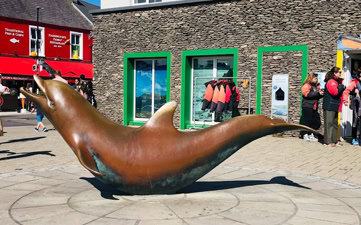
His memorial on Dingle’s waterfront gives visitors who never saw him a physical connection with the story. For people who did see Fungie, it can bring back very specific memories: the first glimpse of a fin, a dolphin suddenly appearing beside a boat or simply the excitement of knowing a wild animal had chosen to remain here year after year.
It is also worth remembering that Fungie was never a captive dolphin placed in Dingle for visitors.
He was a wild bottlenose dolphin.
He arrived, stayed and interacted with people on his own terms. That is fundamental to understanding why the relationship became so extraordinary.
Visitors interested in the marine environment can still experience that side of Dingle today. A Dingle Sea Safari, for example, offers a very different experience from the old Fungie trips, exploring the coastline and its wildlife rather than setting out to find one resident dolphin. Wildlife encounters are naturally never guaranteed.
Understanding Fungie Through the Dingle Peninsula
For anyone visiting Dingle today, Fungie’s story is also a good introduction to the peninsula’s relationship with the Atlantic.
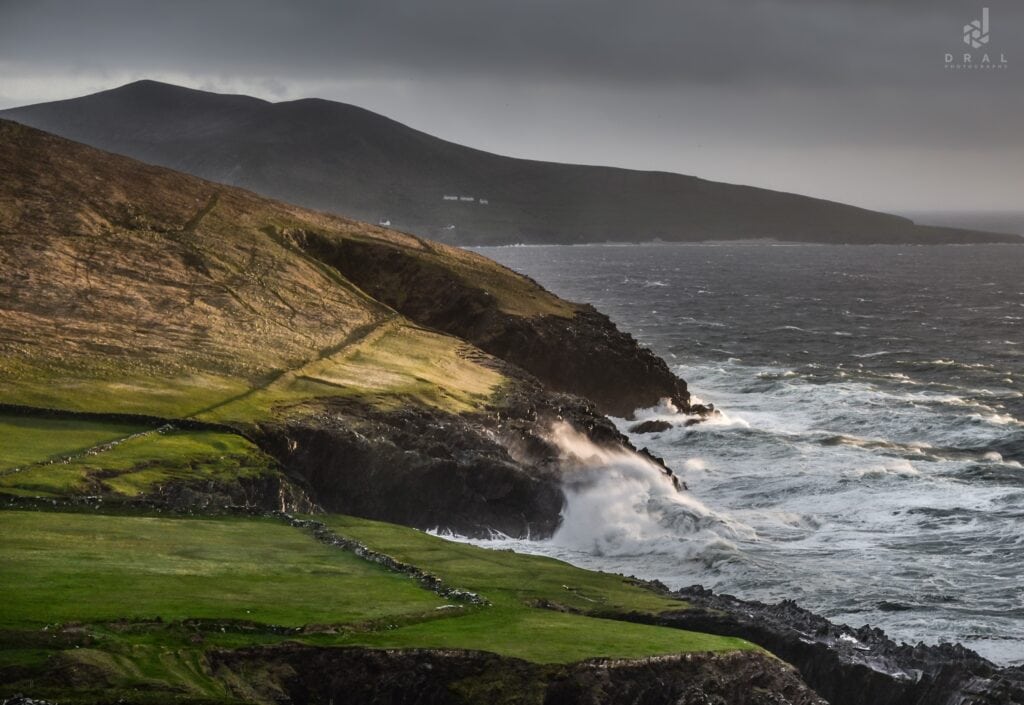
It is easy to experience the Dingle Peninsula entirely from the road: driving along the coastline, stopping at beaches, looking towards the Blasket Islands and standing at viewpoints above the Atlantic. Guides to the viewpoints of the Dingle Peninsula and beaches around the peninsula naturally concentrate on what we see from land, but the sea itself is an equally important part of the story.
Fishing, migration, island life and maritime traditions have shaped communities around the peninsula for generations. Farther west, the story of the Blasket Islands is inseparable from the Atlantic, while places such as Brandon Creek carry their own maritime traditions and connections.
Fungie’s genetic results add another layer to that picture.
They don’t provide us with a route showing how he reached Dingle in 1983. But they remind us that the dolphin who became synonymous with one harbour belonged to a much larger Atlantic environment.
Visiting Dingle With Fungie’s Story in Mind
If you’re coming to Dingle for the first time, I would still make time for the harbour rather than treating the town simply as the starting point for a drive around the peninsula.
Walking the waterfront gives you a sense of the working harbour and the relationship between the town and the sea. Fungie’s memorial adds another layer to that experience, particularly once you understand how extraordinary his 37-year presence really was.
From there, Dingle opens naturally into the wider peninsula. My first trip to Dingle guide is useful if you’re trying to understand the area before arriving, while things to do in Dingle covers some of the different ways of spending time in and around the town.
If you have a full day, the harbour can become the beginning rather than the whole experience. A day exploring Dingle can continue west into the landscapes and communities that make the peninsula so distinctive.
Visitors with several days available can go considerably deeper. A three-day Dingle Peninsula itinerary allows time for the coast, historical sites, beaches, villages and the stories behind them rather than trying to fit everything into a single drive.
Continue Exploring the Dingle Peninsula
Fungie’s story belongs to Dingle Harbour, but it also sits naturally within the wider story of the peninsula.
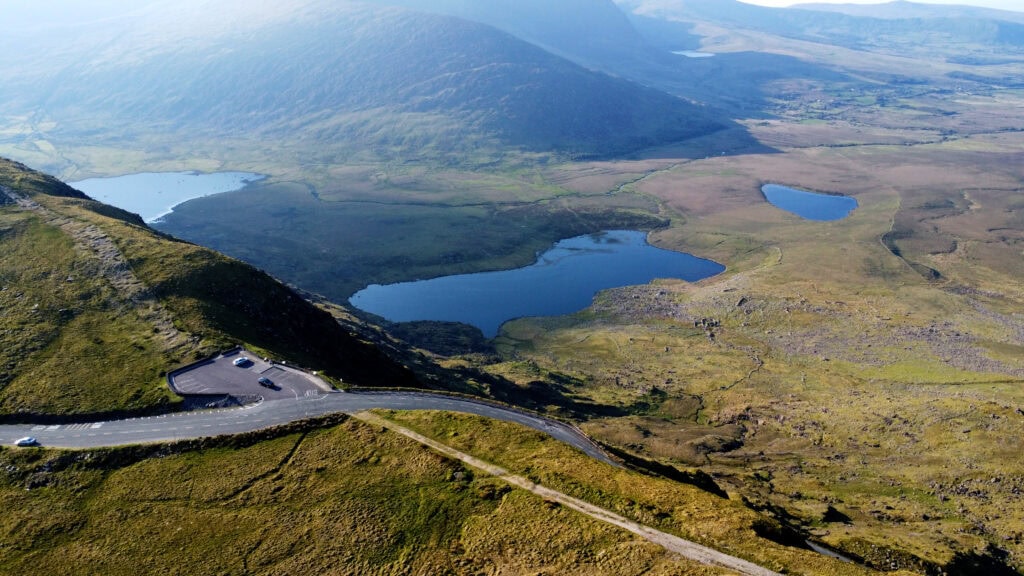
From Dingle, the best-known journey west is Slea Head Drive, where the road follows the Atlantic coastline through some of the peninsula’s most historically and culturally important landscapes. Visitors planning to drive it themselves may also find the guide to whether Slea Head Drive is worth doing in one day useful when working out how much time to allow.
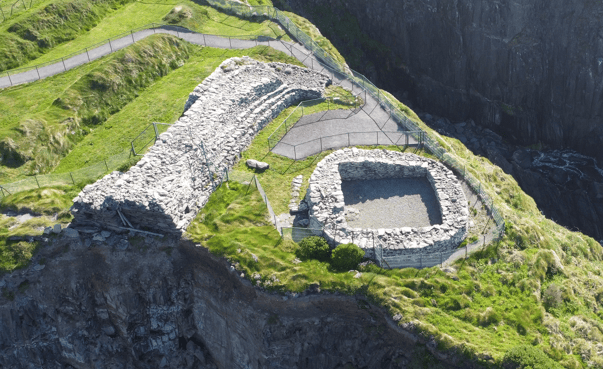
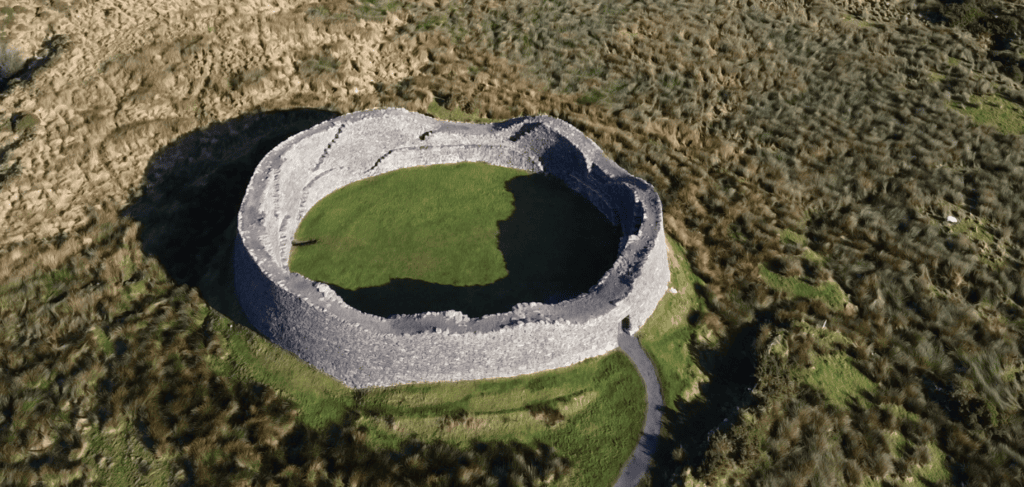
The journey connects Dingle with a much older West Kerry story. Sites such as Dún Beag Fort, Gallarus Oratory and Kilmalkedar Church reveal different periods of human settlement on the peninsula, while the Blasket story explains the extraordinary relationship between local communities, language and the Atlantic.
That wider context is one of the reasons I prefer visitors not to experience the peninsula simply as a collection of photography stops. The landscape becomes much more interesting when you understand what happened here and why particular places matter.
For visitors who would rather explore that story with a local guide, my private Dingle Peninsula tour connects the scenery with the history, communities and stories behind the places we visit.
And now, when we begin in Dingle and look back across the harbour, there is another part of the story to tell.
More than forty years after Fungie first appeared and years after his disappearance, science is still teaching us something new about Dingle’s most famous dolphin.
Frequently Asked Questions About Fungie’s DNA
What did scientists discover about Fungie?
Genetic research found that Fungie’s ancestry showed connections with both the resident bottlenose dolphin population associated with the Shannon Estuary and the larger offshore population found around Ireland. This made his results particularly interesting when compared with other solitary dolphins examined in the research.
How was Fungie’s DNA obtained after he disappeared?
Researchers sampled a wetsuit worn by Denis O’Regan, a member of the Irish Whale and Dolphin Group who had regularly swum with Fungie. Genetic material recovered from the wetsuit included dolphin DNA that could be used as part of the research.
Does Fungie’s DNA tell us where he was born?
No. The genetic results provide information about Fungie’s ancestry and population relationships, but they do not identify his exact birthplace or reconstruct his movements before he appeared in Dingle.
Did scientists discover why Fungie lived alone?
No. Why some bottlenose dolphins become solitary and develop prolonged interactions with humans remains an important research question. Fungie’s mixed genetic ancestry is interesting, but the research does not establish that it caused his solitary behaviour.
Were other solitary dolphins included in the research?
Yes. Other well-known solitary dolphins examined included Nick from Cork Harbour, Finn from Carlingford Lough, Dusty from north Clare and Nimmo from Galway. These dolphins were genetically assigned to the offshore population, while Fungie’s ancestry showed connections involving both the offshore and Shannon Estuary populations.
Do we now know what happened to Fungie?
No. Fungie disappeared from Dingle in October 2020 after approximately 37 years in the area. The genetic research tells us more about his ancestry but does not establish what happened to him after his disappearance.
Where can I learn more about Fungie before visiting Dingle?
The dedicated Fungie the Dolphin guide covers the wider story of his years in Dingle, while the Dingle Town travel guide provides more context for exploring the town and harbour during your visit.