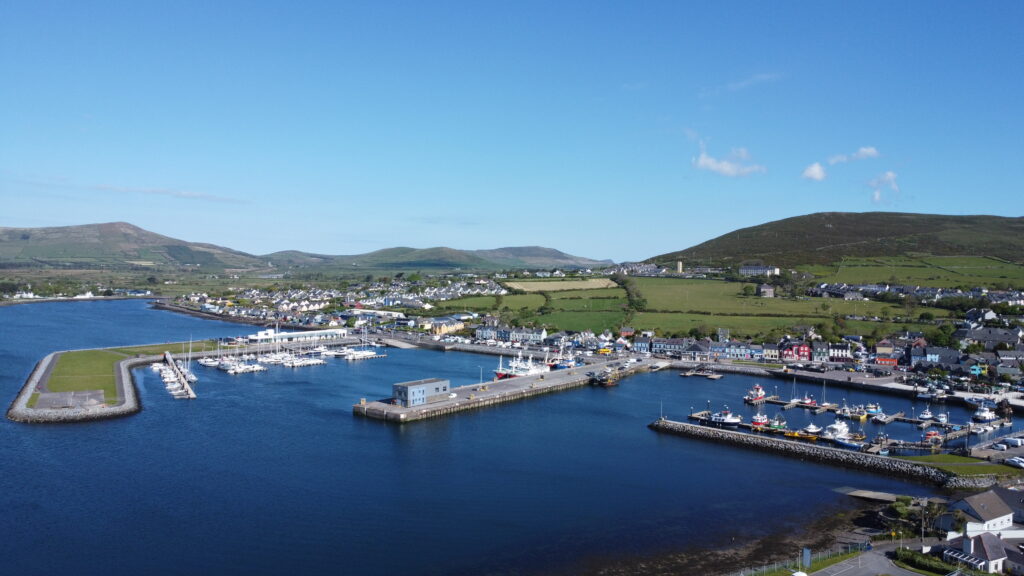
For almost four decades, a wild bottlenose dolphin lived around the entrance to Dingle Harbour and became one of the best-known residents of Dingle. His name was Fungie, and from his arrival in 1983 until his disappearance in October 2020, his presence became part of everyday life in the town.
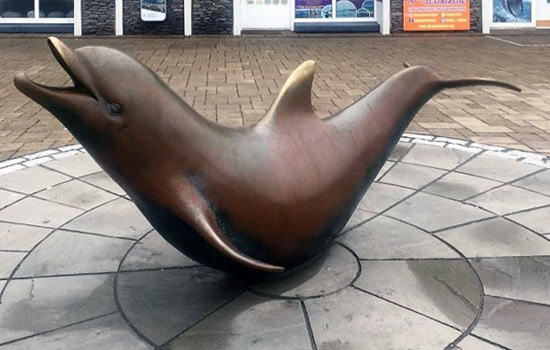
For visitors who come to Dingle today, the bronze dolphin on the harbourfront is a reminder of that remarkable period. But Fungie’s story is about much more than a famous tourist attraction. It is the story of an unusual wild animal, the community that grew accustomed to sharing its harbour with him, and a relationship that lasted for approximately 37 years.
Who Was Fungie the Dolphin?
Fungie was a male Atlantic bottlenose dolphin (Tursiops truncatus) who appeared around Dingle Harbour in 1983. Lighthouse keeper Paddy Ferriter is credited with one of the earliest recorded sightings, and before long local fishermen had become familiar with the dolphin regularly appearing around their boats.
Bottlenose dolphins are normally highly social animals, making Fungie’s long-term solitary life particularly interesting. Although he lived without a permanent pod in Dingle, this did not necessarily mean he was completely isolated from other dolphins. Other bottlenose dolphins periodically entered Dingle Bay, and Fungie was observed interacting with them.
What made his story exceptional was the length of time he remained associated with essentially the same place.
Dingle Harbour became his home for the next 37 years.
How Fungie Became Part of Life in Dingle
At first, Fungie was a curiosity.
A wild dolphin repeatedly appearing beside fishing boats was unusual enough, but it gradually became apparent that he was not simply passing through. He continued returning to the waters around the harbour entrance, often approaching boats and interacting with people on the water.
Fishermen became accustomed to seeing him. Swimmers and divers encountered him. Visitors began travelling out by boat specifically hoping to see him.
Over time, something extraordinary became remarkably normal.
People arriving in Dingle could walk along the harbour, board one of the dolphin boats and have a very good chance of encountering the same wild animal that local boatmen had known for years.
That reliability was central to Fungie’s fame. Local dolphin trips became closely associated with Dingle, with operators eventually offering guarantees based on whether passengers saw him.
For many returning visitors, seeing Fungie became part of coming back to Dingle.
Why Did Fungie Stay in Dingle?
Nobody can say with certainty why Fungie chose Dingle Harbour or why he remained there for so long.
Solitary dolphins are unusual, but Fungie was not the only bottlenose dolphin known to adopt this type of lifestyle. Researchers have documented other individual dolphins and whales living for extended periods away from a conventional social group and, in some cases, developing regular interactions with humans.
What distinguished Fungie was the extraordinary duration of his residency.
His familiar territory centred on the entrance to Dingle Harbour and the surrounding waters, although he could travel farther into Dingle Bay and encounter other dolphins.
It is tempting to interpret his behaviour in human terms and imagine that he simply preferred the company of the people of Dingle. The reality is more complicated. Fungie was always a wild animal, and the reasons behind his behaviour can never be known with certainty.
That uncertainty is part of what makes his story so interesting.
The World’s Longest-Recorded Solitary Dolphin
By the time Fungie had been living around Dingle for more than three decades, his longevity had attracted attention far beyond County Kerry.
In 2019, Guinness World Records recognised Fungie as the longest-recorded solitary dolphin, following research into documented solitary whales and dolphins.
At that point, he had been recorded living around Dingle for 36 years and was estimated to be at least 40 years old.
His exact age was never known because he was already an adult when he appeared in Dingle. Local marine biologist Kevin Flannery later estimated that Fungie may have been around nine years old when he arrived in 1983, which would have placed him in his mid-forties by 2020.
Whatever his precise age, the length of his association with one small corner of the Kerry coast was remarkable.
What DNA Research Revealed About Fungie
Fungie’s identity as a male bottlenose dolphin was eventually supported through scientific analysis rather than local assumption alone. Researchers were able to study genetic material connected with him, adding another factual layer to a story that had already become surrounded by affection, speculation and folklore.
The article examining Fungie’s DNA and scientific identification explains how researchers confirmed details about Dingle’s famous dolphin and what that evidence contributed to our understanding of him.
How Fungie Changed Tourism in Dingle
It is difficult to separate the story of Fungie from the development of modern tourism in Dingle.
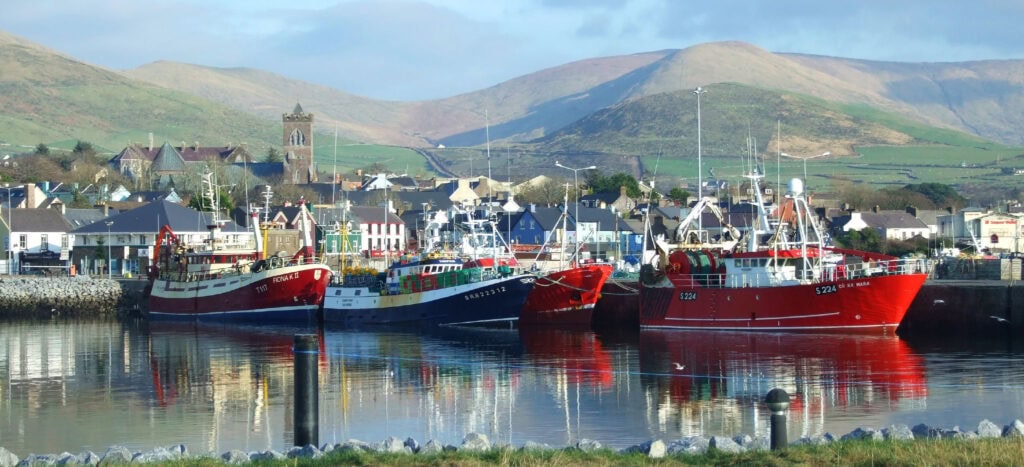
As word spread about the dolphin living at the harbour entrance, going out to see him became an attraction in its own right. Dolphin boats became a familiar sight on the waterfront, carrying generations of Irish and international visitors towards the harbour mouth.
By the time Fungie disappeared in 2020, RTÉ reported that as many as 12 boats were operating dolphin trips during busy periods, supporting more than 50 jobs.
But Fungie’s influence went beyond the boat operators.
His image became closely associated with Dingle itself. He appeared on souvenirs, signs and artwork and became part of how many visitors remembered the town.
There is an important distinction, however.
Fungie was never owned by Dingle, nor was he a trained animal performing on command. He remained a wild bottlenose dolphin whose unusually predictable behaviour happened to create an extraordinary wildlife experience.
That is an important part of understanding his story.
What Happened to Fungie?
In October 2020, something changed.
Fungie failed to appear in the places where local boatmen expected to find him.
Initially there was hope that he had simply travelled farther into Dingle Bay. Bottlenose dolphins had been feeding in the area, and one possibility was that Fungie had temporarily joined other dolphins.
There were also reports of possible sightings.
But as the hours became days, concern grew.
For people accustomed to Fungie’s routines, his prolonged absence was highly unusual. Local boatmen said that previously he might disappear for several hours, but he would reliably return.
This time, he did not.
Boats searched Dingle Harbour and an increasingly large stretch of the surrounding coastline. Divers from Mallow Search and Rescue joined the operation, searching coves and caves associated with Fungie, while sonar was used around the harbour entrance.
Nothing was found.
After approximately a week without a confirmed return, those who had known Fungie for decades increasingly accepted that he might not be coming back.
Did Anyone Ever Find Fungie?
No body was recovered, and Fungie’s fate was never established with certainty.
His age inevitably led to speculation that he had died, while another possibility was that he had left the area.
There were reports of possible sightings during the early stages of the search, but none resulted in Fungie’s established return to his familiar territory around Dingle Harbour.
For that reason, it is more accurate to say that Fungie disappeared in October 2020 than to state definitively how or where he died.
After approximately 37 years of remarkably predictable residency, he simply stopped returning.
Dingle Without Fungie
Fungie’s disappearance affected Dingle in a way that is difficult to appreciate if you only know the town today.
By 2020, an entire generation had grown up without knowing Dingle Harbour without him.
Children who had first gone out to see Fungie during the 1980s and 1990s had returned years later with children of their own. Boatmen had spent much of their working lives looking for the familiar fin breaking the surface near the harbour mouth.
For visitors, seeing Fungie might have been a memorable hour of a holiday.
For Dingle, he had been there for 37 years.
His absence therefore marked the end of a distinctive chapter in the town’s modern history. The wider history of the Dingle Peninsula contains many older stories, but few modern events have affected the town’s identity quite like Fungie’s arrival and disappearance.
The Fungie Statue in Dingle
Visitors can still meet Fungie in a different form on the Dingle waterfront.
A bronze sculpture of the dolphin stands close to Dingle Pier and has become one of the most recognisable landmarks around the harbour. The sculpture predates Fungie’s disappearance and was created as part of Dingle’s Millennium project by American sculptor and environmentalist James “Bud” Bottoms, who came from Santa Barbara, California, a sister city of Dingle.
Today the statue has acquired a significance its creators could not originally have anticipated.
When Fungie was still alive, it celebrated Dingle’s famous resident.
Now it serves as his memorial.
If you stop beside it, look beyond the sculpture towards the harbour entrance. Those are the waters where generations of visitors travelled out to find the real Fungie and where local fishermen had first become accustomed to his company decades earlier.
Boat Trips and Marine Wildlife in Dingle Today
Fungie is no longer waiting at the harbour entrance, but Dingle remains closely connected with the Atlantic and its marine wildlife.
Modern boat trips explore Dingle Bay and the waters around the peninsula, with opportunities to appreciate the coastline and possibly encounter dolphins, seals, seabirds or other marine animals. The experience is now different because no individual animal can be expected to appear with Fungie’s former reliability.
Wildlife sightings should always be treated as possible rather than guaranteed. Routes and departures are also dependent on sea conditions and the judgement of the operator.
The guide to Dingle Sea Safari experiences explains another way visitors can explore the peninsula’s coastline from the water. Families interested in marine life can also visit Dingle Oceanworld Aquarium near the waterfront.
Why Fungie’s Story Still Matters
Fungie could easily be remembered simply as a successful Dingle tourist attraction.
That would miss the most interesting part of his story.
He was a wild animal whose behaviour created an unusually long relationship with one community. For approximately 37 years, his presence connected fishermen, boat crews, swimmers, marine researchers, local families and visitors with the waters surrounding Dingle Harbour.
There was no guarantee in 1983 that he would remain.
There was no way of knowing that decades later he would still be there.
And there was no definitive explanation for why he chose to stay.
Perhaps that is why Fungie’s story remains so closely connected with Dingle. Amid all the publicity, photographs, boat trips and souvenirs was something genuinely unusual: a wild bottlenose dolphin that arrived in a harbour on Ireland’s Atlantic coast and made it his territory for almost four decades.
Today, visitors walking along Dingle’s waterfront will see fishing boats, tour boats and the bronze figure of a dolphin overlooking the harbour.
Understanding the story behind that sculpture reveals another layer of Dingle—a town whose modern identity has been shaped not only by its people, language, fishing traditions and landscape, but also by one extraordinary resident who appeared from the Atlantic in 1983.
Continue Exploring Dingle
The Fungie statue is easy to include in a walk around Dingle Harbour before exploring the town’s shops, cafés and streets. Visitors planning the rest of their stay can use the guide to the best things to do in Dingle to connect the harbour with the wider peninsula.
Beyond town, Slea Head Drive leads towards Ventry, the western coastline, Dún Chaoin and the Blasket Islands. This journey reveals how Dingle Harbour fits into a much larger Atlantic landscape shaped by fishing, island communities and generations of maritime travel.
Visitors interested in combining the town with the surrounding countryside can follow the perfect day in Dingle itinerary. In the evening, the town’s traditional music pubs and local food businesses reveal another side of modern Dingle.
Steve’s Peninsula Tours’ private Dingle half-day tour can combine the town’s stories with selected places around the peninsula, with the route adjusted to suit the group’s interests and available time.
Frequently Asked Questions About Fungie
Was Fungie a wild dolphin?
Yes. Fungie was a wild male Atlantic bottlenose dolphin. He was not a captive or trained dolphin, although he became accustomed to boats and human activity during his long residency around Dingle Harbour.
When did Fungie arrive in Dingle?
Fungie was first recorded around Dingle Harbour in 1983. Lighthouse keeper Paddy Ferriter is credited with one of his earliest recorded sightings.
How long did Fungie live in Dingle?
Fungie remained associated with Dingle Harbour for approximately 37 years, from 1983 until his disappearance in October 2020.
How old was Fungie?
His exact age was unknown because he was already an adult when he arrived. Guinness World Records estimated that he was at least 40 years old in 2019, while local estimates placed him in his mid-forties by the time he disappeared.
Why did Fungie stay in Dingle?
Nobody knows for certain. Solitary bottlenose dolphins have been documented elsewhere, but the extraordinary length of Fungie’s residency made his case particularly notable.
What happened to Fungie?
Fungie disappeared in October 2020. Extensive searches involving boats, divers and sonar failed to establish what happened to him, and his body was never recovered.
Is Fungie still in Dingle?
Fungie has not returned to his established territory since October 2020. Visitors can, however, see his bronze sculpture on the Dingle waterfront.
Where is the Fungie statue?
The bronze Fungie sculpture stands on the waterfront close to Dingle Pier. From here, visitors can look towards the harbour entrance and the waters where Fungie was encountered for almost four decades.