Brandon Creek: St Brendan, the Atlantic and a Legendary Voyage
Brandon Creek is a small, narrow inlet on the north-western side of the Dingle Peninsula, but its place in the story of West Kerry is much larger than its size suggests. Known locally as Cuas an Bhodaigh, the creek lies near Feohanagh in the Irish-speaking Gaeltacht of Corca Dhuibhne, beneath the great mass of Mount Brandon and facing directly towards the open Atlantic.
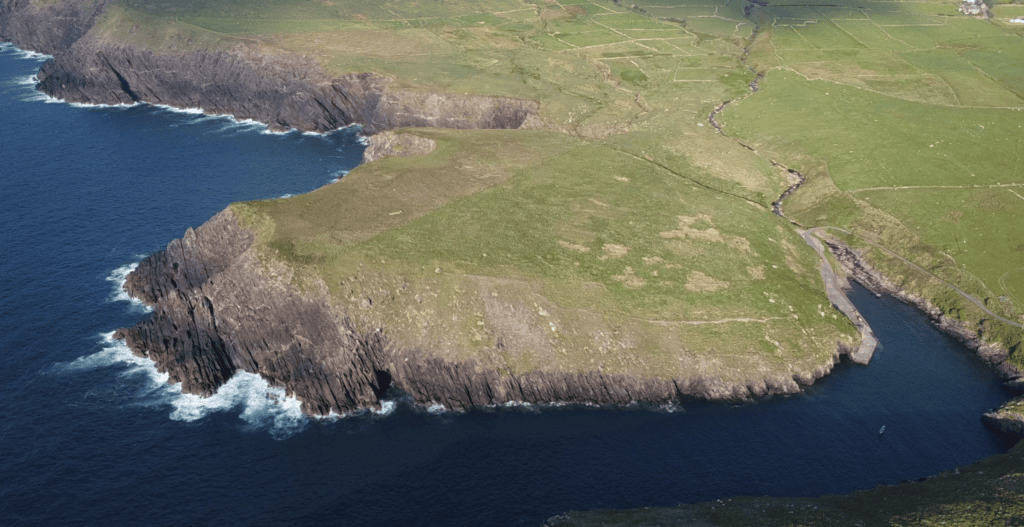
At first sight, there is very little here in the conventional sense of a visitor attraction. There is no large visitor centre, no elaborate interpretation and no need for a long visit. Instead, you arrive at a rocky Atlantic inlet surrounded by steep grassy ground, exposed coastline and the kind of landscape that still feels closely connected to the sea.
What makes Brandon Creek important is its association with St Brendan the Navigator. Local tradition identifies this inlet as the place from which Brendan and his companions set out on the extraordinary sea voyage later celebrated in the medieval Navigatio Sancti Brendani. More than a thousand years later, explorer Tim Severin used the same tradition as the inspiration for an experimental voyage across the North Atlantic in a leather boat.
For visitors exploring Kerry beyond the main attractions, Brandon Creek is one of those places where geography, early Christianity, folklore and Atlantic seafaring come together remarkably well.
Where Is Brandon Creek?
Brandon Creek lies on the northern side of the Dingle Peninsula in County Kerry, west of Feohanagh and not far from Ballydavid. It sits within Corca Dhuibhne, one of Ireland’s important Gaeltacht regions, where Irish remains a living community language rather than simply part of the area’s historical identity.
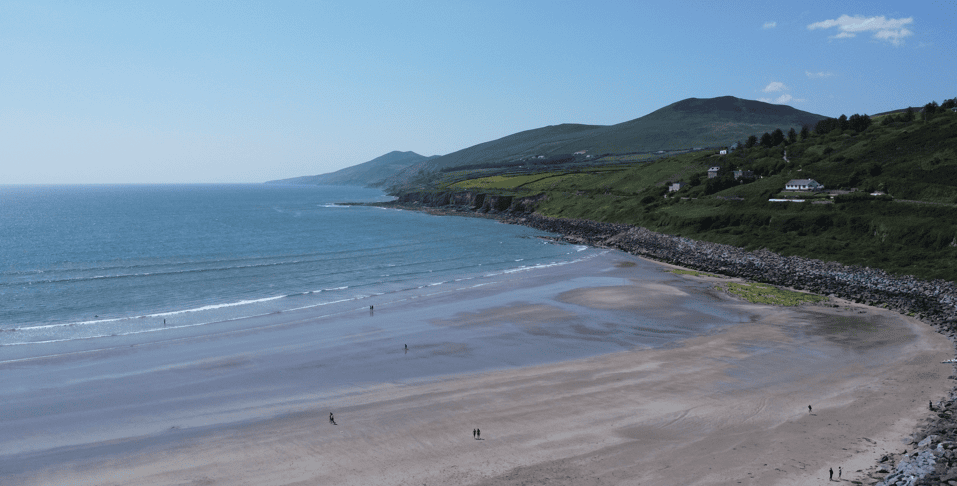
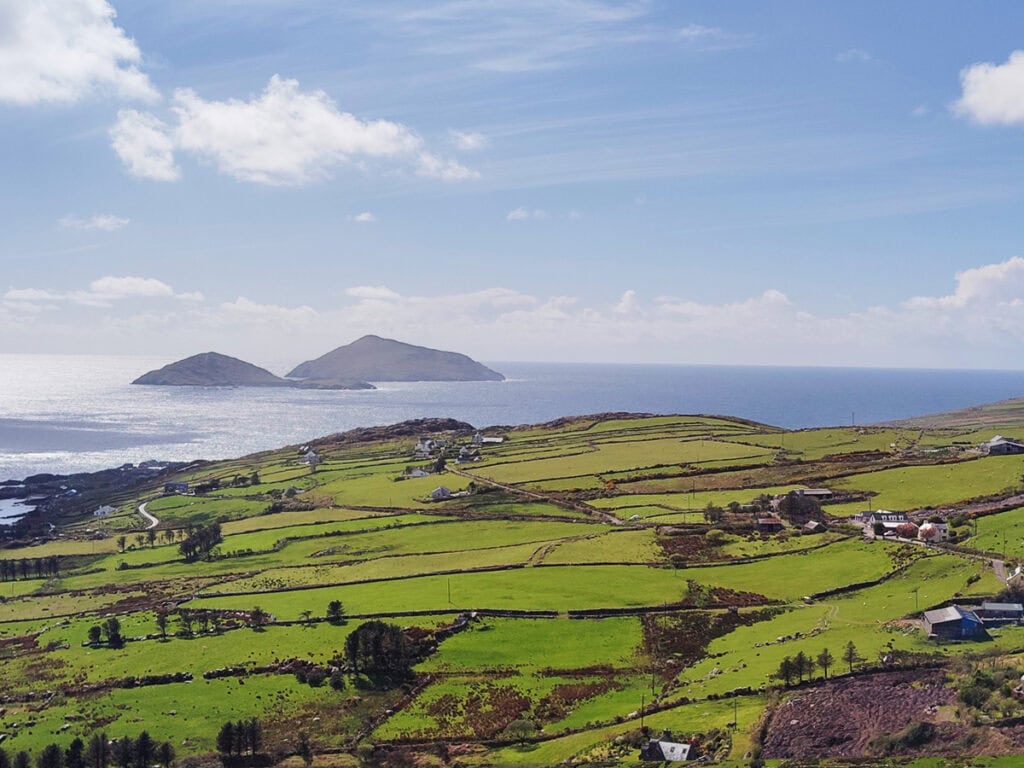
The creek is tucked into a rugged section of coastline beneath the Brandon mountain range. The landscape here feels noticeably different from the better-known coastal scenery around Slea Head. There are fewer major visitor stops, the roads become quieter and narrower, and the relationship between mountain and Atlantic becomes particularly strong.
This is also useful geography to understand when exploring the wider peninsula. Mount Brandon rises inland, while Ballydavid and Smerwick Harbour lie farther around the coast. Continue south and west and the landscape eventually connects with the better-known western sections of the Slea Head Drive.
Why Is Brandon Creek Associated with St Brendan?
Brandon Creek is traditionally associated with St Brendan of Clonfert, generally known as St Brendan the Navigator. Brendan was an early Irish monastic saint traditionally dated to the late fifth and sixth centuries, and his reputation became inseparable from stories of extraordinary journeys by sea.
According to longstanding local tradition, Brendan and his companions departed from this part of the Dingle Peninsula on a voyage into the Atlantic. The story eventually developed into one of medieval Europe’s most widely known voyage narratives.
It is important, however, to distinguish tradition from established historical fact. We cannot document a sixth-century departure from Brandon Creek in the way we could verify a modern sailing. The importance of the site comes from the strength and longevity of the tradition connecting Brendan, the surrounding landscape and the Atlantic voyage.
That distinction does not make the story less interesting. In many ways it makes the creek more valuable to visit, because you are standing in a landscape where early Christian history and later medieval storytelling became closely intertwined.
The Voyage of St Brendan
The best-known account of Brendan’s journey survives in the medieval Latin text Navigatio Sancti Brendani Abbatis, or The Voyage of Saint Brendan the Abbot. Rather than reading like a modern geographical record, it belongs to a medieval literary and religious tradition in which pilgrimage, adventure, miracle and spiritual symbolism are combined.
Brendan and his monks travel westwards across the ocean in search of a promised land. Their voyage includes strange islands, encounters with extraordinary creatures and episodes that clearly belong to religious storytelling rather than straightforward navigation.
The tale circulated widely throughout medieval Europe. That matters because Brandon Creek is connected not merely with a local Kerry legend but with a story that became part of the wider imagination of medieval Christianity.
Over time, some readers began asking a different question: could early Irish seafarers actually have travelled considerable distances across the North Atlantic in the types of vessels available to them?
That question eventually brought Brandon Creek into an extraordinary twentieth-century experiment.
Tim Severin and the Brendan Voyage
In 1976, British explorer and writer Tim Severin set out to investigate whether a vessel constructed using materials and techniques broadly comparable with those available in early medieval Ireland could survive an Atlantic journey.
The boat, named Brendan, was built as a leather-hulled craft, using ox hides stretched over a wooden framework. The experiment was not intended to prove that St Brendan had reached North America. Rather, Severin wanted to test whether such a voyage was technically possible.
Brandon Creek was chosen as the departure point because of its traditional association with Brendan.
The expedition travelled northwards through the Atlantic world, reaching the Hebrides and the Faroe Islands before wintering and continuing the following year. In 1977, Severin and his crew successfully reached Newfoundland.
The achievement demonstrated something important: a carefully constructed leather boat could survive an extended North Atlantic voyage.
It did not prove that St Brendan had sailed to America centuries before Columbus, and that claim should not be presented as historical fact. What the expedition did establish was that the basic concept of a long Atlantic journey in such a vessel was physically feasible.
Standing at Brandon Creek with that story in mind changes how you look at the inlet. What initially appears to be a quiet opening in the Kerry coastline becomes a starting point for thinking about how people once understood the Atlantic: not simply as an edge, but as a route into an unknown world.
What Will You Actually See at Brandon Creek?
Brandon Creek itself is compact. The attraction is the setting rather than a collection of buildings or monuments.
The narrow inlet cuts into a rocky coastline, creating a naturally sheltered opening compared with the exposed Atlantic immediately beyond it. Grassy slopes rise around the water and the surrounding countryside remains distinctly rural.
There is something useful about the simplicity of the place. Without a large amount of modern infrastructure competing for attention, it is easier to concentrate on the geography and imagine why a small creek could have been valuable to people using traditional boats.
The Atlantic is the dominant feature. Conditions can change the character of the creek dramatically. On a calm, bright day the water can make the inlet appear remarkably peaceful; in wind and Atlantic swell, the exposed nature of the surrounding coast becomes much more obvious.
Whenever I explain Brandon Creek to visitors, I find that it works best when you give the story a little time. If you simply arrive, photograph the water and leave, it can seem like a very small stop. Once you understand Brendan, the medieval voyage tradition and Severin’s expedition, the landscape suddenly has much more meaning.
Brandon Creek and the Wider Early Christian Landscape
Brandon Creek should not be viewed in isolation. The Dingle Peninsula contains an unusually rich concentration of early Christian and medieval sites, reflecting centuries of settlement, worship, pilgrimage and religious activity in this Atlantic landscape.
The association with St Brendan is particularly strong around the Brandon mountain range. The mountain itself became an important place of pilgrimage, while old religious routes and ecclesiastical sites connect different parts of the peninsula.
One of the most interesting is Cosán na Naomh, the Saints’ Road, an old pilgrimage route running from the Ventry area towards the foot of Mount Brandon. Sport Ireland records the waymarked route at approximately 17.7 kilometres, finishing at Baile Breac near the mountain.
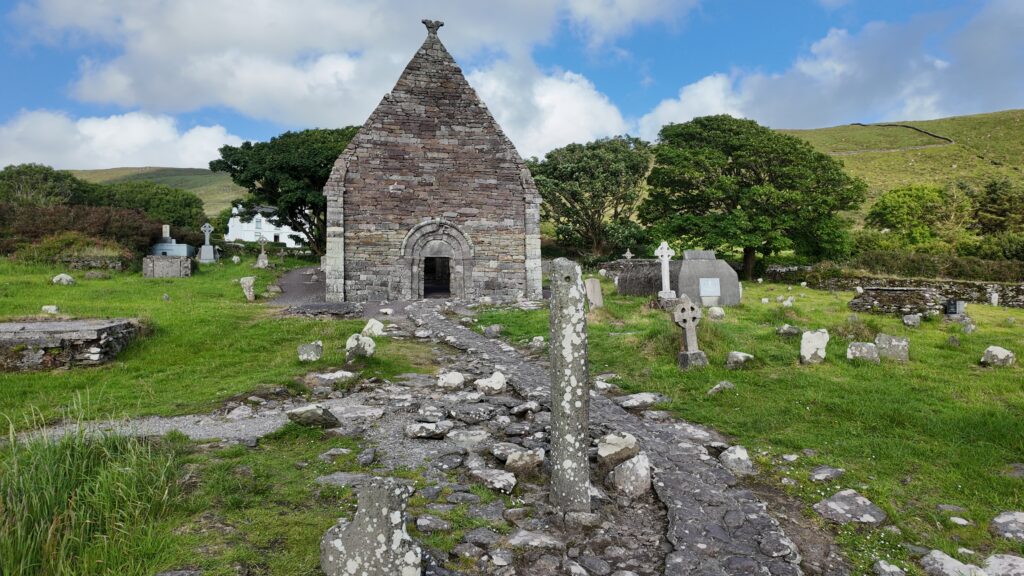
Elsewhere around Corca Dhuibhne, visitors can explore the peninsula’s surviving churches, cross slabs, ogham stones and monastic remains through the historical sites of Kerry. Together they provide a much fuller picture of the religious landscape in which traditions surrounding Brendan developed.
Mount Brandon and the Pilgrimage Tradition
The connection between the creek and nearby Mount Brandon is difficult to ignore. The mountain dominates this part of the peninsula and takes its English name from Brendan.
Mount Brandon has a longstanding pilgrimage tradition, with routes approaching the mountain from different directions. The Christian pilgrimage is itself layered onto a landscape that was significant long before modern roads and tourism transformed how people moved around the peninsula.
For walkers, this distinction is important. Visiting Brandon Creek is a straightforward sightseeing stop; climbing Mount Brandon is a mountain undertaking requiring appropriate preparation, footwear, navigation awareness and attention to weather conditions.
Kerry’s Atlantic weather can change quickly at elevation. A clear view of the summit from the coast does not guarantee clear conditions higher on the mountain.
Visiting Brandon Creek Today
The journey to Brandon Creek is part of the experience. You leave the busier roads and travel through the rural landscape around Feohanagh towards the coast. Roads become narrower as you approach the creek, so this is somewhere to drive patiently rather than trying to fit into a rushed itinerary.
There is no need to plan several hours at the creek itself. For most visitors, around 20–30 minutes is a sensible amount of time for a straightforward stop. That allows time to look around, understand the story and take photographs without treating the site as simply another pin on a map.
If you have a particular interest in St Brendan, pilgrimage traditions, maritime history or photography, you may naturally stay longer.
As with many small rural locations in West Kerry, access and roadside conditions should be treated sensibly. Do not obstruct gateways, local access or narrow roads, and be prepared to walk a short distance where appropriate rather than assuming you can park immediately beside the exact viewpoint you want.
Walking and Terrain
You do not need to undertake a substantial walk to appreciate Brandon Creek. This makes it quite different from many of the mountain experiences nearby.
The ground around an exposed coastal inlet can nevertheless be uneven, wet or slippery, particularly after rain. Good footwear is worthwhile if you intend to move away from the immediate roadside area.
Visitors should also remember that this is working countryside rather than a manicured attraction. Respect private land, gates, livestock and any local signage you encounter.
Weather at Brandon Creek
Weather matters here because the Atlantic is completely exposed beyond the shelter of the inlet. Wind can make conditions feel considerably cooler than they do inland, while rain and sea mist can reduce visibility surprisingly quickly.
That does not mean Brandon Creek is only worthwhile in sunshine. Broken cloud, changing light and rougher Atlantic conditions can actually make the geography easier to appreciate.
For photography, I would be more interested in visibility and light than in finding a perfectly blue sky. Moving cloud across the Brandon range and patches of sunlight on the water can create far more interesting photographs than flat midday sunshine.
Bring a waterproof layer even when the forecast appears reasonable, particularly if Brandon Creek is one of several exposed coastal stops during your day.
Photography at Brandon Creek
The challenge with photographing Brandon Creek is scale. A close photograph of the water alone does not always explain what makes the location interesting.
Try to include the surrounding slopes and coastline so that the viewer can understand how the creek sits within the landscape. Wider compositions work particularly well because they show the contrast between the sheltered inlet and the Atlantic beyond.
If conditions allow, look for foreground details such as rock, grass or the curve of the shoreline rather than photographing only towards the horizon.
For anyone creating a photographic record of the Dingle Peninsula, Brandon Creek also provides a useful contrast with the broader beaches, cliffs and coastal panoramas found elsewhere among the places to see around Kerry.
Is Brandon Creek Worth Visiting?
Yes, but it helps to understand what you are coming to see.
If you expect a large attraction with extensive facilities, Brandon Creek may initially feel understated. If you are interested in the stories that connect Kerry’s landscape with early Christianity, pilgrimage and Atlantic exploration, it becomes a very worthwhile stop.
It is particularly suitable for visitors interested in history, Irish culture, maritime stories and quieter parts of the Dingle Peninsula. It also works well for travellers who have already seen the principal Slea Head attractions and want to understand another side of Corca Dhuibhne.
From a touring point of view, I would not rush across the peninsula solely to photograph the creek for five minutes. I would incorporate it into a wider exploration of this northern side of West Kerry, where the Brandon range, Ballydavid, Feohanagh and the surrounding Gaeltacht landscape can be understood together.
Exploring Brandon Creek as Part of a Dingle Peninsula Tour
Brandon Creek is slightly removed from the standard sequence of stops made by visitors concentrating only on the most familiar Slea Head route. That is precisely why it can work particularly well on a longer day.
A private full-day Dingle Peninsula tour gives more freedom to explore places such as this without sacrificing the better-known western coastline. The route can be adapted around weather, visibility and the interests of the people travelling rather than treating every stop as compulsory.
For someone particularly interested in early Christianity, the Brandon story can also be connected with ecclesiastical and archaeological sites elsewhere on the peninsula. For someone more interested in landscapes, the emphasis can shift towards the mountain, Atlantic coastline and quieter northern roads.
Continue Exploring the Dingle Peninsula
Brandon Creek makes most sense as one part of the larger Corca Dhuibhne landscape. From here, the Brandon mountain range rises inland while Feohanagh and Ballydavid connect you with the northern coastline and the sheltered waters around Smerwick Harbour.
Travelling farther around the peninsula brings you towards the dramatic western coastline explored on Slea Head Drive. There, the landscape opens towards the Blasket Islands and a completely different collection of cliffs, beaches, archaeological sites and Atlantic viewpoints.
If you want to build a broader itinerary rather than concentrating on one route, the Explore Kerry guide brings together natural attractions, historical places and destinations across the county. Brandon Creek fits particularly well within that wider approach: it is not a major attraction because of its size, but because of the remarkable story attached to a very small piece of the Kerry coastline.
Frequently Asked Questions About Brandon Creek
Where is Brandon Creek?
Brandon Creek is on the north-western side of the Dingle Peninsula in County Kerry, close to Feohanagh and beneath the Brandon mountain range. It lies within the Gaeltacht region of Corca Dhuibhne.
What is Brandon Creek famous for?
Brandon Creek is best known for its traditional association with St Brendan the Navigator and the legendary Atlantic voyage described in the medieval Brendan tradition. It was also the departure point associated with Tim Severin’s twentieth-century experimental Brendan voyage.
Did St Brendan really sail from Brandon Creek to America?
The connection between St Brendan and Brandon Creek belongs to longstanding tradition rather than independently verified historical evidence. Medieval accounts describe Brendan’s extraordinary Atlantic voyage, but they should not be treated as proof that he reached North America. Tim Severin’s successful leather-boat expedition demonstrated that a transatlantic journey in such a craft was technically possible; it did not prove that Brendan made that voyage.
How long should I spend at Brandon Creek?
For most visitors, approximately 20–30 minutes is enough to see the creek, take photographs and appreciate the story. Visitors with a strong interest in St Brendan, maritime history or photography may want longer.
Do I need to climb Mount Brandon to visit Brandon Creek?
No. Brandon Creek can be visited independently of Mount Brandon. A climb of Mount Brandon is a separate mountain activity requiring considerably more time, preparation and appropriate weather conditions.
What should I wear when visiting Brandon Creek?
Bring a waterproof outer layer and footwear suitable for uneven or damp ground if you intend to explore beyond the immediate roadside area. The location is exposed to Atlantic wind and conditions can change quickly.
What else should I see near Brandon Creek?
Brandon Creek combines naturally with Feohanagh, Ballydavid, the landscape around Mount Brandon and the wider northern Dingle Peninsula. If you are continuing around West Kerry, you can connect the visit with Slea Head Drive and explore further natural and historical attractions through the Places to See in Kerry guide.