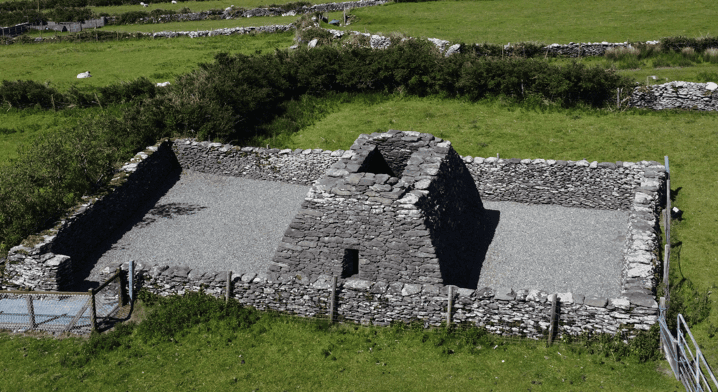
St Brendan’s Oratory is a small early medieval stone church near Kilmalkedar on the northern side of the Dingle Peninsula. Although it stands only about 400 metres north-west of the main ecclesiastical complex at Kilmalkedar Church, it is easily missed by visitors following the better-known roads around West Kerry.
The oratory is believed to have been constructed around the tenth century, although its precise date remains uncertain. It was built in the distinctive boat-shaped style associated with a small number of stone churches in Corca Dhuibhne, using carefully worked stones and a corbelling technique in which each course projects slightly inwards above the one below.
Its roof has collapsed, so it does not have the immediately recognisable complete outline of nearby Gallarus Oratory. However, that loss also reveals how the building was constructed. Standing inside the surviving walls, you can examine the inward slope of the stonework, the narrow eastern window and the remains of a place of worship connected with one of the peninsula’s most important early Christian landscapes.
Where Is St Brendan’s Oratory?
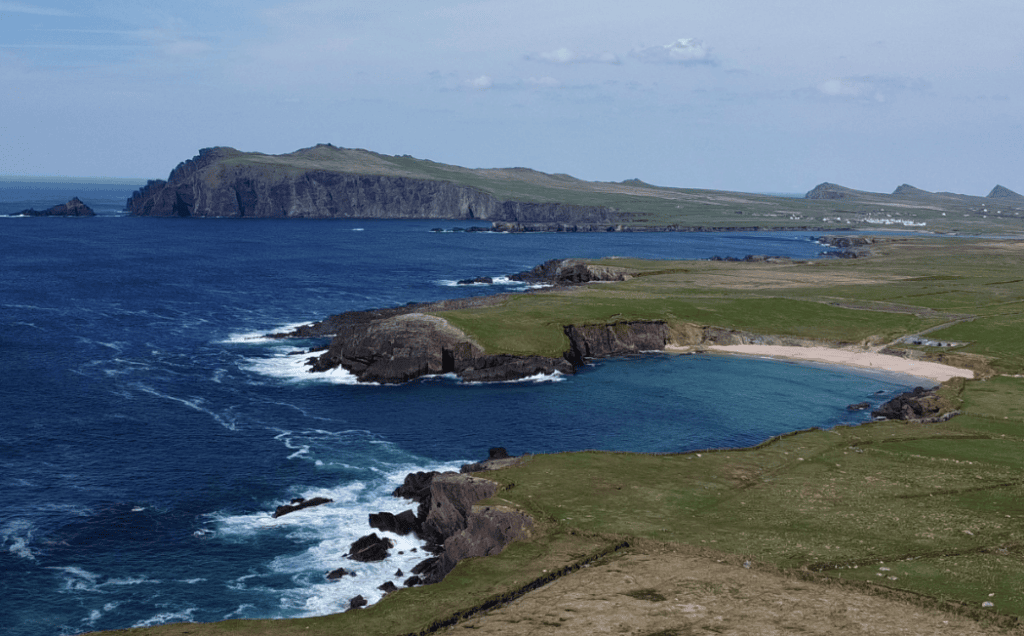
St Brendan’s Oratory is situated in the countryside around Cill Maoilchéadair, usually anglicised as Kilmalkedar, west of Dingle Town. It lies close to the R559 and the northern section of the wider Slea Head Drive, within a landscape of stone walls, farmland, scattered settlements and views towards the Mount Brandon range.
The monument is separate from the main Kilmalkedar graveyard and church complex. A short path entered through a roadside gate leads to it. Visitors should take particular care near the road because the entrance is close to a bend and traffic can approach with limited visibility.
From a geographical point of view, the oratory belongs to a remarkable concentration of early Christian and medieval sites. Gallarus lies nearby, while the excavated monastic settlement at Riasc is found farther west. Together, these places show that the religious history of the peninsula was not centred on a single monastery. It developed through a network of churches, burial grounds, pilgrimage routes, hermitages and smaller places of worship spread across the landscape.
What Is an Oratory?
An oratory is a small place of prayer or worship. In early medieval Ireland, some oratories were considerably smaller and simpler than the parish churches that appeared during later centuries. They may have served religious communities, pilgrims or people living within the surrounding ecclesiastical landscape.
St Brendan’s Oratory is oriented approximately east to west, as was customary for Christian churches. Its lintelled entrance is in the western end, while a narrow rectangular window survives in the eastern wall above the position traditionally occupied by the altar.
The interior measures approximately 5.5 metres long and 3 metres wide. This makes it a very modest building, but its importance does not depend on size. The construction represents a highly skilled form of stone craftsmanship developed in a region where builders had generations of experience working with the peninsula’s local stone.
How the Oratory Was Built
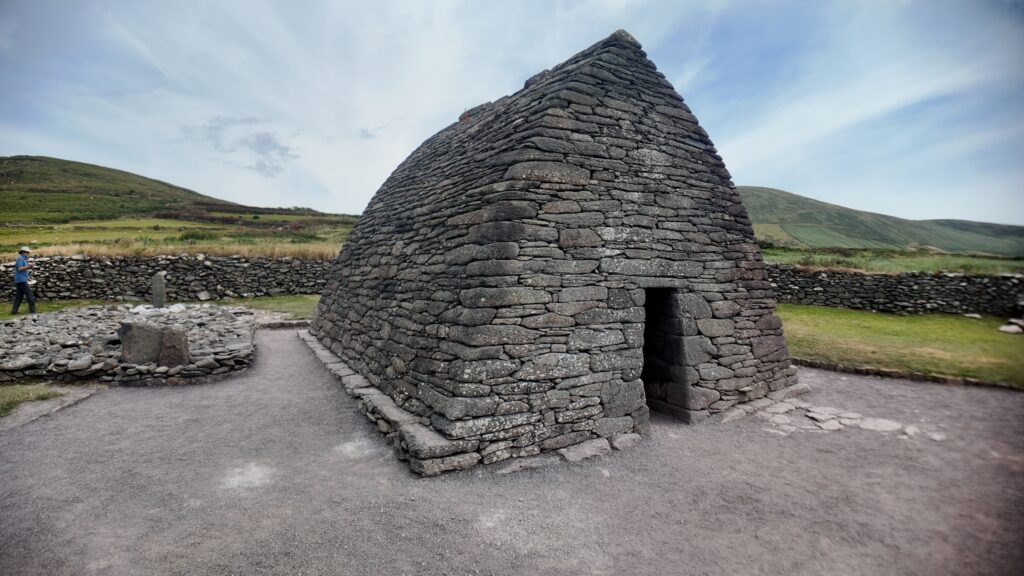
The walls were constructed largely without mortar using a dry-stone corbelling technique. As the walls rose, successive courses of stone were placed slightly farther inwards. If the original roof had survived, the two sides would have continued towards one another until the remaining opening could be closed.
This technique created the characteristic profile often compared to an upturned boat. It required careful judgement. The stones had to be selected, shaped and positioned so that the weight of the structure remained stable while rainwater was directed away from the interior.
The building is now roofless and has undergone conservation work, including intervention completed in 2017. Its incomplete condition should not be seen simply as damage. It allows visitors to look directly into the construction and compare it with the nearly complete roof at Gallarus.
The exterior and interior faces of the stones were worked to produce a relatively smooth finish. That detail matters because it shows the building was not a roughly assembled shelter. Considerable labour and skill went into creating a small but carefully finished church.
When Was St Brendan’s Oratory Built?
The Office of Public Works describes St Brendan’s Oratory as a building dating from around the tenth century. Other interpretations allow for a date extending into the eleventh century or possibly somewhat earlier. Early stone churches can be difficult to date precisely because their architectural form continued over long periods and documentary evidence is often limited.
It is therefore better to understand the oratory as part of the peninsula’s early medieval Christian tradition rather than attach too much certainty to a single year or decade. Its construction belongs to a period when religious centres had become deeply established in West Kerry and pilgrimage was helping to connect individual sites across the landscape.
For a broader understanding of how these places developed, the history of the Dingle Peninsula provides useful context. Archaeological remains found across Corca Dhuibhne span prehistoric settlement, the introduction of Christianity, medieval church organisation and centuries of continuing local devotion.
The Connection with Saint Brendan
The oratory is named after Saint Brendan the Navigator, one of the best-known saints associated with County Kerry. Brendan is traditionally believed to have been born in the Tralee and Ardfert area during the early medieval period. He became associated with monastic foundations, pilgrimage and the celebrated voyage described in the medieval Navigatio Sancti Brendani.
The famous account tells of Brendan and his companions travelling across the ocean in search of the Promised Land of the Saints. It combines Christian teaching, monastic ideals and elements of voyage literature, so it should not be read as a straightforward modern record of exploration. Nevertheless, the story helped establish Brendan as one of Ireland’s most influential maritime saints.
His association with the Dingle Peninsula is especially strong around Mount Brandon and the old pilgrimage route known as Cosán na Naomh, the Saints’ Path. This route traditionally crossed the peninsula towards the mountain, passing through or connecting several ecclesiastical landscapes.
Kilmalkedar became an important station within that tradition. Although the place-name Cill Maoilchéadair refers to Saint Maolcethair rather than Brendan, the wider complex became closely connected with devotion to Saint Brendan. The nearby oratory forms part of that larger spiritual geography.
Its Relationship with Kilmalkedar
St Brendan’s Oratory should not be treated as an isolated ruin. The surviving evidence suggests that it was associated with the important ecclesiastical centre at Kilmalkedar and may once have stood within its own enclosure. Other archaeological features may have existed around it but are no longer visible above ground.
The main Kilmalkedar site contains the remains of a Romanesque church, a large stone cross, a sundial and several early carved stones. One of its most distinctive monuments is the Kilmalkedar Ogham Stone, which represents an earlier phase in the long religious history of the area.
Visiting both places helps the landscape make sense. At the main complex, you see evidence of a substantial and evolving centre used over many centuries. At St Brendan’s Oratory, the experience is quieter and more intimate: a small stone church standing apart in the surrounding farmland.
Whenever I bring visitors through this part of the peninsula, I find that the two sites tell a stronger story together. Kilmalkedar demonstrates the scale and importance of the ecclesiastical settlement, while the oratory reveals how places of worship extended beyond the principal church and graveyard.
What Will You See?
The first impression is of a compact, roofless building with thick, inward-sloping stone walls. The structure is not large, and the visit is more about examining details than walking through an extensive complex.
Look carefully at the western doorway and the way its lintel is positioned across the entrance. Inside, notice how the surviving wall courses begin to lean towards one another. These stones formed the lower part of the original corbelled roof.
At the eastern end, the narrow rectangular window provided a limited source of light above the altar area. A stone-built altar survives beneath it, although this feature is probably considerably later than the original construction of the oratory.
It is also worth stepping back to look at the building in its wider setting. The fields, boundary walls and mountains are not simply a background. They help explain the relative isolation of early religious sites and their relationship with the communities, routes and working landscape around them.
Visiting St Brendan’s Oratory Today
St Brendan’s Oratory is an unguided National Monument in state guardianship. Visitors can consult the current Heritage Ireland information for Saint Brendan’s Oratory before travelling, particularly if weather or access conditions may affect the visit.
Access is by a short path from the roadside. The ground can be uneven and may be wet after rain, so footwear with a reliable grip is sensible. The rural path and historic entrance should not be assumed to provide easy wheelchair access, and visitors with reduced mobility may find the terrain difficult.
This is not a staffed visitor attraction. Do not expect a reception area, indoor interpretation, toilets or refreshments at the monument itself. Dingle and the villages along the peninsula are the most practical places to organise food, drinks and other facilities.
As at every archaeological site, avoid climbing on the walls, moving stones or disturbing the surrounding ground. The monument has survived for roughly a thousand years, and even apparently harmless contact can contribute to erosion or instability.
How Long Should You Allow?
Allow approximately 20 to 30 minutes for a straightforward visit. That provides enough time to follow the path, examine the doorway, window, altar and corbelled walls, and appreciate the building within its landscape.
If you have a serious interest in archaeology, early Christianity or photography, you may want longer. I would also allow additional time if you are combining the oratory with Kilmalkedar Church, as the main complex contains several separate features that deserve careful attention.
A combined visit to both locations can comfortably occupy 45 minutes to an hour, depending on your pace. Trying to rush them into a very short roadside stop usually means overlooking the connections that make the area important.
Weather and Photography
The site is exposed to West Kerry’s changeable Atlantic weather. Low cloud can hide the upper slopes of the surrounding mountains, while rain can make the path and grass slippery. A light waterproof layer is useful even when conditions appear settled at the beginning of the day.
Overcast weather often suits the stonework surprisingly well, bringing out variations in colour and texture without the harsh contrast of strong sunlight. After rain, however, take care on wet stones and uneven ground.
For photographs, begin with a wider view that shows the oratory within the fields and mountain landscape. Then move closer to record the western entrance, the eastern window and the inward slope of the surviving walls. Photographing from inside towards the window can help illustrate how little natural light originally entered the building.
Places to Visit Nearby
The clearest companion site is Gallarus Oratory, where the corbelled roof remains intact. Comparing the two buildings helps visitors understand both the original appearance of St Brendan’s Oratory and the construction method used by their builders.
Kilmalkedar Church should be included in the same visit rather than treated as an optional extra. Farther west, Riasc Monastic Settlement offers a different kind of early Christian site, with the foundations of an ecclesiastical enclosure and an important cross-inscribed stone.
Visitors interested in how stone construction developed across the peninsula can also explore the Dingle Peninsula’s beehive huts. These structures served a different purpose, but their carefully corbelled stonework provides another example of the building traditions found throughout West Kerry.
For a wider coastal journey, continue towards Clogher Head, Clogher Strand and the western end of the peninsula. The Blasket Centre near Dún Chaoin explains the language, literature and island community that shaped another important part of West Kerry’s cultural identity.
A Local Guide’s Perspective
St Brendan’s Oratory is not a place that depends on dramatic scale. Its value lies in the details and in its relationship with the surrounding religious landscape. A visitor who sees only a roofless stone building may spend ten minutes here and leave. A visitor who understands the links with Kilmalkedar, pilgrimage, Gallarus and Mount Brandon will see something much more significant.
The site works particularly well as part of a carefully paced journey around the northern side of the peninsula. A private full-day Dingle Peninsula tour allows time to connect these smaller archaeological places with the better-known coastal viewpoints, rather than racing between isolated stops.
Continue Exploring the Dingle Peninsula
From St Brendan’s Oratory, the natural journey continues through the ecclesiastical sites of western Corca Dhuibhne before returning to the Atlantic coast. The contrast between the quiet inland church sites and places such as Dunquin Pier helps reveal how closely farming, pilgrimage, settlement and seafaring were connected on the peninsula.
Visitors planning a longer route can use the Slea Head Drive route guide to understand the order of the principal stops. Those with a particular interest in archaeology can also explore the wider collection of historical sites in Kerry, including promontory forts, medieval churches, castles and monastic settlements.
St Brendan’s Oratory may be one of the quieter stops on that journey, but it adds an important piece to the story: a small, carefully built church connected with a religious landscape that has shaped this part of Kerry for more than a thousand years.
Frequently Asked Questions About St Brendan’s Oratory
Where is St Brendan’s Oratory?
It is near Kilmalkedar on the northern side of the Dingle Peninsula, approximately 400 metres north-west of the main Kilmalkedar ecclesiastical complex.
Is St Brendan’s Oratory the same as Gallarus Oratory?
No. They are separate monuments. Both were built in a similar boat-shaped, corbelled style, but St Brendan’s Oratory has lost its roof while Gallarus remains almost completely intact.
How old is St Brendan’s Oratory?
It is generally associated with the early medieval period and is commonly dated to around the tenth century. Its exact construction date is not known with certainty.
Is there an admission charge?
The oratory is an unguided National Monument. Check current Heritage Ireland information before travelling in case access arrangements change.
How long does a visit take?
Allow approximately 20 to 30 minutes for the oratory itself. A combined visit with Kilmalkedar Church may take 45 minutes to an hour.
Is the site suitable for visitors with reduced mobility?
Access involves a rural path and uneven ground. Conditions may be especially difficult after rain, so visitors should assess the terrain carefully rather than assume step-free or wheelchair-friendly access.
What else should I visit nearby?
Kilmalkedar Church, Gallarus Oratory and Riasc Monastic Settlement are the most relevant nearby historical sites. They can be combined to create a particularly strong introduction to early Christianity on the Dingle Peninsula.