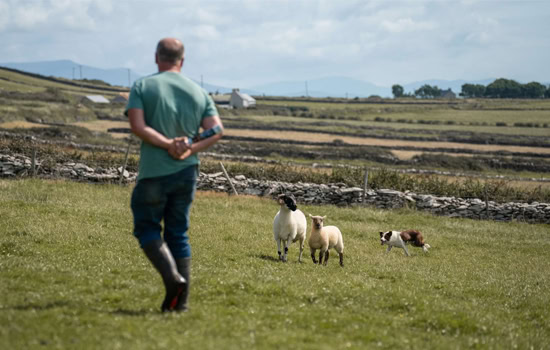
Watching a working sheepdog gather sheep is one of the clearest ways to understand how farming still shapes the Dingle Peninsula.
At Dingle Sheepdogs in Fahan, on Slea Head Drive west of Ventry, visitors can watch a local farmer use trained sheepdogs to gather and control a flock on the slopes of Mount Eagle. What makes the demonstration particularly interesting in West Kerry is that the dogs are worked using commands in Irish, connecting an everyday farming skill with the language and culture of Corca Dhuibhne.
It is important, however, to distinguish what visitors normally see here from a competitive sheepdog trial.
A demonstration shows how the dog and farmer work together in a practical farming setting.
A sheepdog trial is a scored competition.
Understanding that difference makes the experience much more interesting.
What Is a Sheepdog Demonstration?
A sheepdog demonstration allows visitors to watch a trained working dog move and gather sheep under the direction of a farmer or handler.
The dog may work at a considerable distance from the farmer, responding to spoken commands, whistles or a combination of both.
What initially looks almost effortless is the result of instinct, careful breeding, training and a remarkably precise form of communication between dog and handler.
The purpose is not simply to make sheep run around a field.
A skilled working dog needs to control the flock, position itself correctly and respond immediately when the farmer changes direction or asks it to stop.
At Dingle Sheepdogs, the demonstration also introduces visitors to aspects of local farming life and the methods traditionally used by farmers on this part of the peninsula.
Sheepdog Demonstration or Sheepdog Trial?
The terms are often used interchangeably by visitors, but they describe different things.
Sheepdog Demonstration
A demonstration is primarily educational.
The farmer shows visitors how a dog gathers and controls sheep and explains how the partnership works in everyday farming.
There is no competition to win.
Sheepdog Trial
A sheepdog trial is a formal competition based on the same working skills.
Dog and handler complete a defined course and are judged on how accurately they handle a small group of sheep.
The International Sheep Dog Society describes trials as practical tests based on the work sheepdogs perform on farms and hillsides. Dogs can be judged on elements including the outrun, lift, fetch and drive, with points deducted for mistakes during the course.
The first recorded sheepdog trials were held at Bala in North Wales in 1873. The International Sheep Dog Society was established later, in 1906.
So if you visit a working farm on Slea Head and watch a farmer showing you what the dog can do, you are normally watching a demonstration, not a competitive trial.
How Does a Sheepdog Control Sheep?
This is the part worth watching carefully.
The dog does not simply chase the flock.
A good working sheepdog uses position, movement and pressure to influence where the sheep travel.
Several basic ideas help explain what you are seeing.
The Outrun
When sent to gather sheep, a trained dog will usually travel in a wide arc around the flock rather than running directly towards them.
This is called the outrun.
The aim is to reach a position beyond the sheep without unnecessarily scattering them.
In competition, the outrun is one of the formal elements of a sheepdog trial. On a farm, the same basic skill allows the dog to reach animals that may be spread over a large field or hillside.
The Lift
Once the dog reaches the correct position behind the sheep, it begins moving them.
This initial movement is known as the lift.
Watch how little movement may be required.
The dog does not necessarily need to charge at the flock. Its position and controlled approach can be enough to encourage the sheep to move.
The Fetch
The fetch describes the movement of the sheep towards the handler after they have been gathered.
In a formal trial, this takes place along a defined route.
On a working farm, the farmer might instead be bringing sheep towards a gate, field entrance, handling area or another part of the land.
Direction and Pace
Once the flock is moving, the farmer can redirect the dog.
A change in command may send it left or right.
Another may ask it to stop.
The dog constantly adjusts its position relative to the sheep and farmer.
This ability to influence both direction and pace is much of what makes a trained sheepdog useful.
Why Are Border Collies So Good at Working Sheep?
The Border Collie has become particularly associated with sheep work because generations of breeding have selected for characteristics useful on working farms.
The International Sheep Dog Society highlights qualities such as intelligence, stamina and obedience, particularly for dogs expected to work sheep across difficult terrain.
But instinct alone is not enough.
A useful working dog must also learn to respond reliably to the farmer.
That is what becomes obvious during a demonstration.
The impressive part is not simply that the dog wants to gather sheep.
It is that the farmer can control how it does so.
Commands, Whistles and Communication
Different handlers use different systems.
Some rely heavily on whistles.
Others use spoken commands.
Many combine both.
A whistle is particularly useful when a dog is working too far away for an ordinary voice to carry clearly.
Different tones and patterns can communicate different instructions.
The International Sheep Dog Society confirms that handlers in trials may work their dogs using voice, whistle or a combination of the two.
Irish Commands at Dingle Sheepdogs
One of the most distinctive aspects of the demonstration in Fahan is that the dogs are worked using commands in Irish.
Dingle Sheepdogs specifically identifies this as part of the experience and connects the skill with generations of sheep farming on Mount Eagle.
That matters because Fahan lies within the cultural landscape of Corca Dhuibhne, where Irish remains a living community language.
The language is therefore not being added to the demonstration as entertainment for visitors.
It belongs to the place.
Hearing a farmer working sheep through Irish commands provides a small but very real example of how farming, language and everyday life remain connected on the western Dingle Peninsula.
Sheep Farming on the Dingle Peninsula
Sheep are such a familiar part of the Kerry landscape that visitors can easily stop noticing them.
They appear beside mountain roads, behind drystone walls and across fields overlooking the Atlantic.
But these are working animals within an agricultural landscape.
The Dingle Peninsula contains steep slopes, upland ground and fields where livestock may need to be gathered across terrain that is difficult or impractical for vehicles.
A trained dog can move quickly across this ground and respond to a farmer working from some distance away.
That practical value is why the sheepdog should not be thought of simply as part of a traditional rural scene.
It remains a working tool on farms.
The demonstration becomes much more interesting once you understand that the skills being shown have a practical purpose. The wider history of the Dingle Peninsula provides further context for the farming communities and settlement patterns that shaped this landscape.
What Happens During a Dingle Sheepdog Demonstration?
At Dingle Sheepdogs, visitors watch a local sheep farmer work trained dogs with a flock on the farm at Fahan.
The demonstration focuses on gathering and controlling the movement of sheep while explaining aspects of the farmer’s work and rural knowledge.
Rather than watching only the sheep, watch the dog.
Notice:
- how widely it circles the flock
- where it positions itself
- how quickly it responds when the farmer changes the command
- how little movement may be required to change the direction of the sheep
- how the farmer manages a dog working some distance away
Once you know what to look for, the demonstration becomes less about watching an energetic dog and more about understanding a working partnership.
Where Can You See Sheepdog Demonstrations in Dingle?
The established visitor experience is Dingle Sheepdogs, located at:
Fahan
Ventry
Dingle
County Kerry
The setting is useful geographically.
Fahan lies west of Ventry beneath Mount Eagle, placing the demonstration directly on one of the main routes used by visitors exploring Slea Head.
You do not need to make a completely separate journey across the peninsula to include it.
When Are the Demonstrations Available?
Dingle Sheepdogs currently states that it welcomes visitors daily from the beginning of April until the end of October.
Advance booking for sheepdog demonstrations is recommended to avoid disappointment.
Because demonstration schedules and seasonal arrangements can change, check directly with Dingle Sheepdogs before building your day’s itinerary around a particular time.
That is especially important outside the busiest summer months. The guide to the best time to visit Dingle explains how visitor services, weather and daylight change through the year.
Do You Need to Book?
I recommend it.
The farm itself advises visitors to book sheepdog demonstrations in advance.
If seeing the dogs is one of the main reasons for your day on Slea Head, don’t simply assume a demonstration will begin when you arrive.
Check first and then structure the surrounding stops around the confirmed time.
Is a Sheepdog Demonstration Good for Children?
Yes.
For many families, this is one of the easier cultural experiences on the peninsula for children to understand.
The relationship between action and result is immediately visible.
The farmer gives a command.
The dog changes direction.
The sheep move.
Children do not need a detailed knowledge of Irish history or farming to follow what is happening.
Dingle Sheepdogs also currently operates a petting farm, where visitors can encounter animals including ponies, donkeys and lambs when in season.
For families, that can make the farm a more substantial stop than the demonstration alone. The guide to things to do in Dingle includes other family-friendly activities that can be combined with it.
What Else Is at Dingle Sheepdogs?
The Fahan site currently includes several visitor experiences in addition to the working-dog demonstration.
These include:
- a petting farm
- Famine Cottages
- beehive huts
I would treat each part differently.
The animals and sheepdog demonstration can be appreciated immediately.
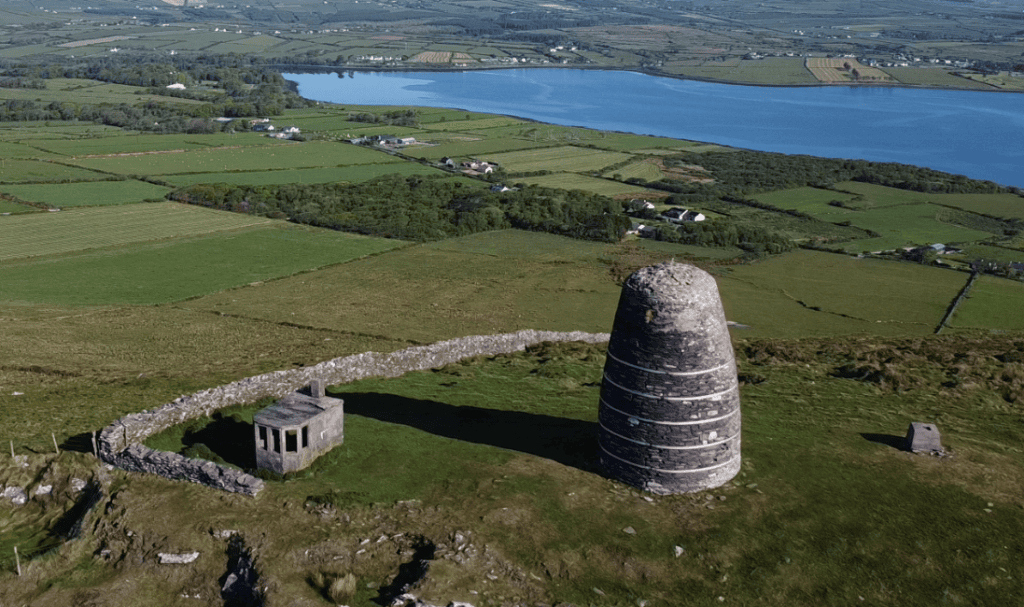
The historical interpretation attached to the cottages and archaeological structures deserves more context, particularly because the wider Fahan area contains important clocháns, or drystone huts, dating from the early medieval period.
If archaeology interests you, explore the history rather than simply using the huts as another photograph.
How Long Should You Allow?
Do not plan this as though it were a full-day attraction.
The sheepdog demonstration is better understood as one meaningful stop within a wider Slea Head journey.
Allow enough time to arrive before the demonstration, watch without feeling rushed and explore any additional farm experiences that interest you.
If you are booking a specific demonstration, use the current duration provided by Dingle Sheepdogs when organising the rest of the day rather than relying on an old travel article.
Is a Sheepdog Demonstration Worth Seeing?
If you are interested in working animals, farming, Irish language or everyday rural life, yes.
I particularly recommend it for families and for visitors who have already noticed sheep everywhere on the peninsula but know very little about how farmers actually work with them.
It also creates a useful contrast with the historical sites along Slea Head.
At places such as Dún Beag or the Fahan Clocháns, you are looking at evidence of people who lived in this landscape many centuries ago.
A working sheepdog demonstration shows you something about how people continue to use the landscape today.
That makes it more than entertainment.
What Else Is Nearby?
Dingle Sheepdogs sits directly within the Slea Head landscape, so several important places fit naturally into the same journey.
Fahan Clocháns
The Fahan Clocháns, often called beehive huts, are part of the early medieval archaeological landscape of this area.
They deserve explanation beyond their unusual appearance.
Dún Beag Promontory Fort
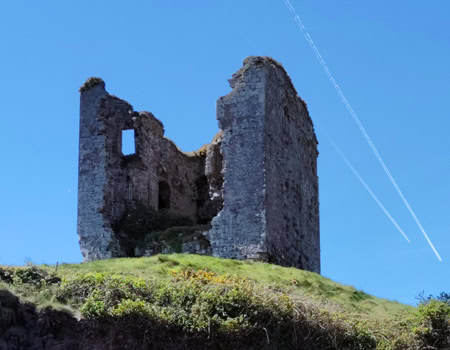
Nearby Dún Beag occupies a dramatic defensive position above the Atlantic and provides a very different window into human activity on the peninsula.
Ventry
Travelling from Dingle, Ventry is reached shortly before Fahan and provides an easy stop for the beach and village.
Slea Head
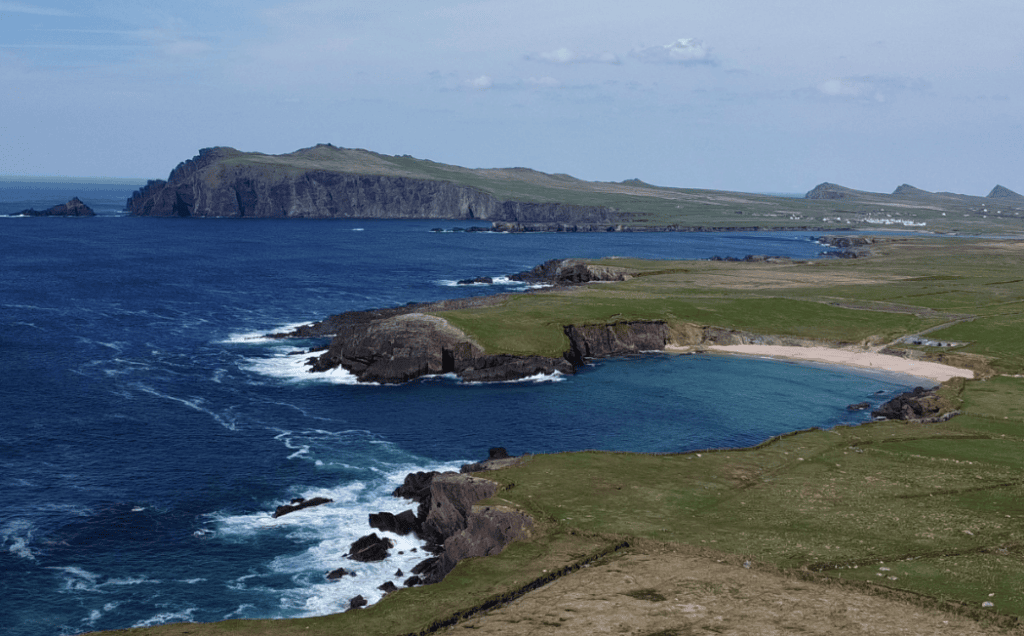
Continue west and the road eventually reaches the main Slea Head viewpoints overlooking the Atlantic and Blasket Islands.
Coumeenoole Beach
Farther around the route, Coumeenoole Beach provides one of the strongest coastal landscapes on the western peninsula.
Combining a farm demonstration with archaeology and coastline helps explain something important about Slea Head.
This is not untouched wilderness.
It is a landscape that people have lived in, farmed and shaped for generations.
Continuing Around Slea Head
After the demonstration, visitors can continue west towards the principal Slea Head viewpoints, Coumeenoole and Dunquin Pier.
Farther around the peninsula, the Blasket Centre explains the Irish-speaking island community that lived offshore until 1953.
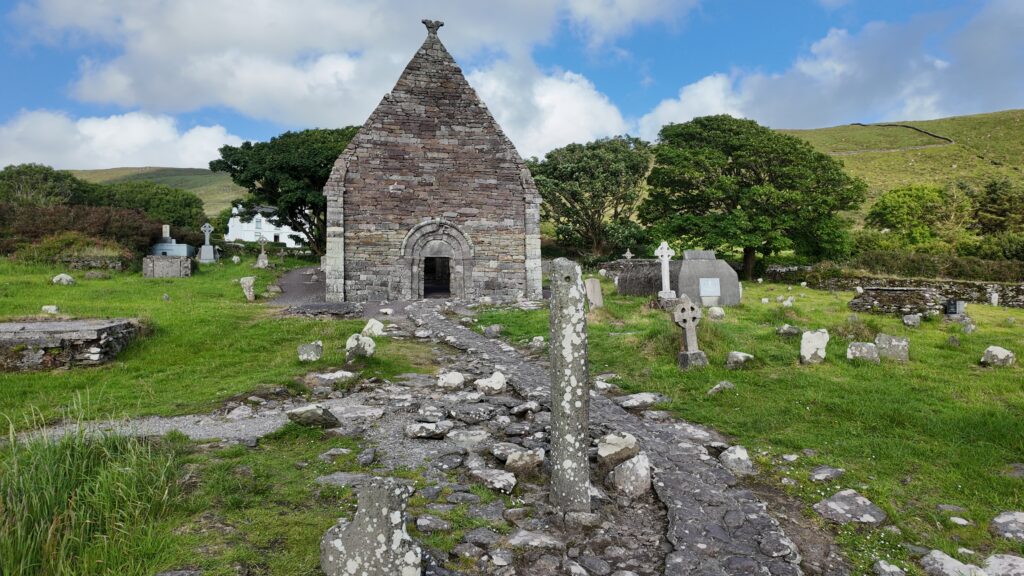
Returning towards Dingle through Ballyferriter also creates opportunities to explore Gallarus Oratory and Kilmalkedar Church.
The complete Slea Head Drive route guide can help you decide which stops to combine without overloading the day.
Sheepdogs and the Wider Story of West Kerry
Visitors understandably come to the Dingle Peninsula for scenery.
But much of that scenery is inseparable from agriculture.
Fields, grazing animals, farm roads, stone boundaries and houses are part of a working rural landscape.
Understanding farming therefore helps explain what you are looking at.
A sheepdog demonstration is one small part of that story.
It shows how knowledge passes between generations, how animals are managed across difficult terrain and how Irish can continue to function as the language of ordinary work.
Those details reveal considerably more about West Kerry than simply watching the dog run.
Continue Exploring the Dingle Peninsula
A sheepdog demonstration fits naturally into a full day around the western peninsula but works best when the confirmed starting time is used to organise the surrounding route.
Visitors staying longer can use the three-day Dingle Peninsula itinerary to combine the farm with beaches, archaeology, Dún Chaoin and other parts of Corca Dhuibhne at a more relaxed pace.
Steve’s Peninsula Tours’ private full-day Dingle Peninsula tour can sometimes incorporate a pre-booked sheepdog demonstration when seasonal availability and timing allow.
Frequently Asked Questions About Dingle Sheepdog Demonstrations
What is the difference between a sheepdog trial and a demonstration?
A sheepdog trial is a formal competition in which dogs and handlers complete a course and are scored. A demonstration shows visitors how working sheepdogs perform similar skills in a farming context.
Where can I see a sheepdog demonstration near Dingle?
Dingle Sheepdogs operates at Fahan near Ventry on Slea Head Drive.
Are the dogs given commands in Irish?
At Dingle Sheepdogs, the farmer uses native Irish commands when working the sheepdogs.
When can you see sheepdog demonstrations in Dingle?
Dingle Sheepdogs currently operates for visitors from the beginning of April until the end of October. Check directly for current demonstration times.
Do sheepdog demonstrations need to be booked?
Advance booking is recommended by Dingle Sheepdogs, particularly if the demonstration is an important part of your itinerary.
Are sheepdog demonstrations suitable for children?
Yes. The visible interaction between the farmer, dog and sheep makes the experience easy for children to follow. The Fahan attraction also currently includes a petting farm.
What breed of dog is normally used for sheep work?
Border Collies are particularly associated with sheep work because of characteristics such as intelligence, stamina, responsiveness and working ability.
What is an outrun?
The outrun is the wide route a sheepdog takes around the flock to reach a position beyond the sheep before beginning to gather them.
When did sheepdog trials begin?
The first recorded sheepdog trials were held at Bala in North Wales in 1873. The International Sheep Dog Society was founded in 1906.
Can I include a sheepdog demonstration while driving Slea Head?
Yes. Dingle Sheepdogs is located at Fahan directly on Slea Head Drive, making it straightforward to combine with nearby archaeological sites and coastal viewpoints.