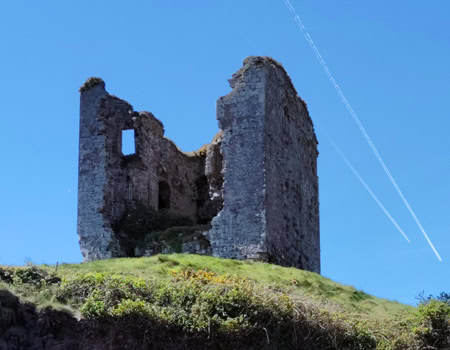
Minard Castle stands above a distinctive storm-boulder beach on the southern side of the Dingle Peninsula, between Lispole and Annascaul.
The surviving ruin is generally associated with the Fitzgeralds and the Knight of Kerry and dates to the sixteenth century. It was later badly damaged during the Cromwellian conflicts of the seventeenth century and never returned to use as a residence.
What makes Minard particularly interesting is the combination of history and geology. The ruined tower house sits directly above a shoreline of huge rounded sandstone boulders, creating one of the most unusual coastal settings on the peninsula. The same local sandstone has also been linked with ogham stones found elsewhere in West Kerry.
Minard is not a formal visitor attraction with a large car park or visitor centre. It is a quiet historical site reached by narrow rural roads, with limited parking and no major facilities. That is part of its appeal, but it also means visitors should plan the stop properly.
What Is Minard Castle?
Minard Castle is a ruined sixteenth-century tower house overlooking Minard Bay and the waters of Dingle Bay.
Tower houses were fortified residences rather than enormous castles in the later romantic sense. They provided accommodation for an important family while also offering protection through thick masonry walls, restricted entrances and vertically arranged living spaces.
Minard Castle once stood as a substantial coastal stronghold. Today, only the main ruin survives, but enough remains to give a clear impression of the scale and strength of the original building.
It forms part of a much wider collection of historical sites across County Kerry, although its combination of a tower house, boulder beach and open bay makes its setting particularly distinctive.
Who Built Minard Castle?
Minard Castle is generally attributed to the Fitzgerald family, specifically the branch associated with the Knight of Kerry.
The exact details of its construction are not always recorded consistently, so it is better to treat the attribution carefully rather than claim a precise builder or construction year without firm documentary evidence.
What can be said with confidence is that Minard belongs to the sixteenth-century tower-house tradition of southwest Ireland and formed part of the wider political landscape of powerful landed families in Kerry.
For visitors interested in placing the castle within the peninsula’s broader story, the guide to the history of the Dingle Peninsula explains how different periods of settlement, religion, conflict and land ownership shaped the region.
What Type of Castle Was Minard?
Minard was a tower house, a type of fortified residence found throughout Ireland during the later medieval and early modern periods.
These buildings were designed to combine:
- Residence
- Defence
- Storage
- Control of the surrounding estate
Rather than spreading across a huge fortified complex, the accommodation was arranged vertically. Lower levels were generally more defensive and practical, while the principal living spaces were positioned higher in the building.
Minard’s surviving walls still show how substantial this type of residence could be. Its elevated position also provided a commanding view across Minard Bay and the surrounding approaches.
The Seventeenth-Century Attack
The most dramatic episode in Minard Castle’s history occurred during the wars of the seventeenth century.
The castle was attacked by Parliamentary forces during the Cromwellian campaign in Ireland and was left badly damaged. Traditional accounts describe the use of artillery and explosive charges against the building.
The broad historical point is clear: Minard was violently taken out of use during this period and was not subsequently restored as a working residence.
The exact tactical details differ between later accounts, so they should be treated more cautiously than the fact of the castle’s destruction itself. What remains today is therefore not simply a structure abandoned through gradual decline. It is a ruin shaped by conflict.
Why Is So Much of the Castle Still Standing?
Even in ruin, Minard’s surviving walls remain substantial. That reflects the heavy construction typical of tower houses.
Thick masonry was designed to withstand both weather and attack. Although the building was severely damaged, the core structure proved difficult to erase completely.
Visitors can still appreciate the height, scale and strength of the original tower from outside. The ruin should not, however, be treated as a safe structure to enter.
Can You Go Inside Minard Castle?
No. Visitors should not enter Minard Castle.
The ruin is unstable, and all warning signs should be respected. Do not climb the walls, enter openings or attempt to explore the interior.
The castle is best appreciated from a safe distance, where the surviving structure, boulder beach and wider landscape can be viewed together. This is not a managed heritage attraction with inspected staircases, barriers or an approved interior visitor route.
Minard’s Storm-Boulder Beach
The beach below the castle is one of the most distinctive geological features of the site.
Rather than sand or small pebbles, the shoreline is covered with large rounded sandstone boulders. This type of coast is commonly described as a storm beach.
Powerful waves move and reshape the boulders over time, gradually rounding them as they collide with one another. The result is very different from the long sandy beaches found elsewhere on the peninsula.
Minard Beach is best understood as a geological landscape rather than a conventional swimming beach. If you want to compare it with the peninsula’s sandy shorelines, the guide to beaches around the Dingle Peninsula explains the different coastal environments visitors can experience.
Why Are the Boulders So Large?
The size of the boulders reflects the energy of the coastline.
During heavy Atlantic conditions, waves can exert enormous force against the shore. Over time, pieces of local sandstone are broken, moved and repeatedly rolled against one another.
That process gradually creates the smooth, rounded forms visible today. On rough days, the shoreline provides an impressive reminder of the amount of energy carried by Atlantic weather systems into Dingle Bay.
It is also a reason to remain well back from the water during heavy swell. Never assume that a position is safe simply because the previous waves did not reach it.
Minard Beach and Ogham Stones
One of the most interesting connections at Minard lies between geology and archaeology.
Sandstone from this area has been associated with a number of ogham stones found around the Dingle Peninsula. Ogham stones are early inscribed monuments, generally dating from the early medieval period, carved with a distinctive script represented by groups of lines cut along the edge of the stone.
The significance at Minard is not that an ogham inscription stands on the beach today. It is that the local geology may have provided suitable stone for monuments erected elsewhere on the peninsula.
That creates an unusual connection between landscape, geology and early written language in Ireland. Visitors interested in this subject can learn more through the dedicated guide to ogham stones in Kerry.
Minard Castle and Ryan’s Daughter
Minard Castle is also associated with the filming of Ryan’s Daughter, David Lean’s 1970 film shot extensively on the Dingle Peninsula.
The production used several locations around the peninsula, and Minard’s combination of ruined architecture and exposed coastal landscape suited the film’s visual style.
For visitors interested in screen locations, Minard therefore has an additional layer of twentieth-century cultural history alongside the much older castle itself. It is important, however, to appreciate Minard as a genuine historic and geological site rather than solely as a filming location.
The Setting Above Dingle Bay
The view from Minard extends across Dingle Bay towards the Iveragh Peninsula.
Unlike Slea Head Drive, where much of the coastline faces directly into the open Atlantic, Minard occupies the southern side of the Dingle Peninsula. That gives it a very different character.
The castle, large sandstone boulders and mountains across the bay create a compact landscape in which several geological and historical layers can be seen at once.
It is a particularly strong location for photography, but you do not need dramatic sunset light to appreciate it. The relationship between the structure and shoreline is the main subject.
How Do You Get to Minard Castle?
Minard lies off the N86 between Lispole and Annascaul. The final approach follows narrow rural roads.
Do not expect the access to feel like the entrance to a major visitor attraction. Drive slowly and be prepared to meet:
- Local residents
- Farm vehicles
- Cyclists
- Walkers
- Livestock
Navigation apps can help you locate Minard, but once you leave the main road, use common sense rather than assuming every visible lane is suitable for a larger vehicle.
Minard lies away from the peninsula’s main western sightseeing circuit. It works best as part of a journey through the southern side of the peninsula or as a deliberate detour when travelling between Dingle Town and Annascaul.
Is There Parking at Minard Castle?
Parking is very limited.
There is a small area near Minard Strand, but capacity is limited and the access road is narrow. Do not assume you will always find a space immediately beside the beach.
If parking is full:
- Do not block gateways
- Do not obstruct farm access
- Do not leave your vehicle on a blind bend
- Do not create a parking space where none exists
This is particularly important during busy periods. Larger campervans and motorhomes may find both the approach and parking awkward.
Are There Toilets or Visitor Facilities?
There are no major visitor facilities at Minard Castle.
Do not expect:
- A visitor centre
- A café
- Public toilets at the site
- A ticket office
- Staffed interpretation
Plan accordingly and use facilities in Dingle, Lispole, Annascaul or another suitable stop before travelling to Minard.
This is one reason Minard works best as part of a wider journey rather than as a destination around which you build an entire day.
Accessibility and Terrain
Minard is not one of the most accessible heritage sites on the Dingle Peninsula.
Although the castle can be viewed without a long walk, the ground near the shoreline is uneven and the beach consists of large boulders. The ruin also has no formal accessible interior visitor route.
Visitors with reduced mobility may still be able to appreciate the general setting from safer, firmer ground, but the boulder beach and immediate areas around the ruin will not suit everyone. Buggies and wheelchairs are particularly impractical on the shoreline.
Conditions can change after rain or storms, so assess the ground in front of you rather than relying on photographs taken during better weather.
Is Minard Beach Safe for Swimming?
I would not choose Minard as a swimming beach.
The shoreline is formed from large boulders rather than sand, and Atlantic swell can be powerful. Moving across wet boulders can also be difficult, with a risk of slipping or becoming unsteady.
The main reasons to visit are:
- The castle
- Geology
- Scenery
- Photography
- History
For swimming or a conventional beach visit, other locations are more appropriate. Inch Beach, farther east, provides a completely different coastal experience, although visitors should still assess local weather, tides and sea conditions before entering the water.
How Long Should You Allow?
Quick Stop
Allow around 15–20 minutes if you simply want to see the castle and coastline from a safe position.
Castle and Beach
Allow around 30–45 minutes to explore the setting at a comfortable pace and examine the boulder shoreline without rushing.
Photography or Deeper Interest
Allow closer to an hour if you are interested in photography, geology or the structure of the castle.
Parking conditions may add time during busier periods.
Is Minard Castle Worth Visiting?
Yes – if the experience matches your interests.
I particularly recommend Minard if you enjoy:
- Ruined castles
- Coastal geology
- Photography
- Quieter historical sites
- Walking
- Places without a formal visitor-centre atmosphere
It is less essential if you have only a few hours on the Dingle Peninsula and are trying to prioritise the major western sights around Slea Head.
Minard sits away from the main Slea Head loop. That means it works best when you have more time or are already travelling through the southern side of the peninsula.
I would rather see someone give Minard half an hour on the right day than force it into an already overloaded Slea Head itinerary.
Minard Castle on the Dingle Way
Minard also has a natural connection with walkers.
The Dingle Way passes through this part of the peninsula on the section between Annascaul and Dingle. For long-distance walkers, Minard therefore becomes part of the landscape encountered on foot rather than a separate driving detour.
That changes the experience considerably. Approaching through the rural landscape gives more context to the castle than simply arriving, taking a photograph and leaving.
Walkers should use current route information, carry suitable clothing and be prepared for changing weather. Road sections require particular care because local roads may be narrow and have limited verges.
Minard, Lispole and Annascaul
Minard belongs geographically to the southern and eastern side of the Dingle Peninsula. The most natural surrounding places are therefore Lispole and Annascaul, rather than Slea Head.
Lispole
Lispole lies between Minard and Dingle and provides the nearest village context on the Dingle side. The wider area contains layers of rural, archaeological and transport history that deserve more attention than visitors often give them.
Annascaul
Continue east and you reach Annascaul, strongly associated with Antarctic explorer Tom Crean. Annascaul also sits directly on the Dingle Way and makes a useful base for understanding this less-visited side of the peninsula.
Inch
Farther east, Inch Beach provides a completely different coastal experience from Minard.
The contrast is worth noting. Minard is a boulder storm beach beneath a ruined tower house, while Inch is a long sandy strand extending into Dingle Bay.
Minard or Slea Head?
They are not really competing experiences.
Slea Head is the major western coastal route and deserves priority for most first-time visitors with limited time. Minard is quieter and more specialised.
Choose Minard when you want:
- A ruined castle
- Coastal geology
- Fewer formal attractions
- A south-peninsula detour
- A stop between Annascaul, Lispole and Dingle
If you have several days on the peninsula, there is no reason to choose between them. The three-day Dingle Peninsula itinerary explains how to divide your time between the main western circuit, Dingle Town and quieter parts of the peninsula.
However, I would not treat Minard as another stop on a tightly timed Slea Head loop.
What Else Is Nearby?
Strong nearby or related places include:
- Lispole: The nearest village on the Dingle side.
- Annascaul: A heritage stop associated with Tom Crean and the Dingle Way.
- Inch Beach: A major sandy beach farther east.
- Dingle: The peninsula’s main town and visitor base.
- Dingle Way: The long-distance walking route passing through the southern peninsula.
- Ogham sites: Early inscribed monuments connected with the peninsula’s geology and language.
Together, these places create a very different itinerary from the better-known Slea Head loop. Visitors looking for more ideas can browse the wider collection of places to see in Kerry.
Exploring Minard with a Local Guide
Minard can fit naturally into a longer journey through the southern and eastern sides of the peninsula, particularly when combined with Inch, Annascaul and Dingle Bay.
A private full-day Dingle Peninsula tour provides the flexibility to include quieter locations when time, weather and local conditions make them appropriate, while still protecting enough time for the peninsula’s principal landscapes and historical sites.
Frequently Asked Questions About Minard Castle
Where is Minard Castle?
Minard Castle is on the southern side of the Dingle Peninsula, between Lispole and Annascaul, overlooking Minard Bay.
When was Minard Castle built?
The castle dates to the sixteenth century and is generally associated with the Fitzgeralds and the Knight of Kerry.
What type of castle is Minard?
Minard is a tower house – a fortified residence typical of later medieval and early modern Ireland.
Who destroyed Minard Castle?
The castle was badly damaged by Parliamentary forces during the Cromwellian conflicts of the seventeenth century.
Can you go inside Minard Castle?
No. The ruin is unstable, and visitors should obey warning signs and view the structure from a safe distance.
Is Minard Castle free to visit?
There is no formal admission charge for viewing the site, but access arrangements, warning signs and private-property boundaries must always be respected.
Is there parking?
Parking near Minard Strand is very limited. The approach road is narrow, and visitors must avoid blocking local access, gateways or farm entrances.
Are there toilets at Minard Castle?
No major visitor facilities are available at the site. Use facilities in a nearby town or village before travelling to Minard.
How long do you need at Minard Castle?
Around 30–45 minutes is enough for most visitors to appreciate the castle and storm beach. Photographers and visitors with a deeper interest may prefer closer to an hour.
Is Minard Beach suitable for swimming?
It is not a conventional swimming beach. The shoreline consists of large storm boulders and can be exposed to powerful Atlantic conditions.
Was Minard Castle used in Ryan’s Daughter?
Yes. Minard was among the Dingle Peninsula locations associated with David Lean’s Ryan’s Daughter.
Is Minard Castle on Slea Head Drive?
No. Minard lies on the southern side of the Dingle Peninsula and is separate from the Slea Head loop.
Is Minard Castle worth visiting?
Yes, particularly for visitors interested in ruined castles, geology, photography or quieter heritage locations. If your time on the peninsula is very limited, prioritise the main Slea Head area first.
Continue Exploring the Dingle Peninsula
Minard Castle reveals a quieter side of the Dingle Peninsula, where geology, conflict, farming landscapes and coastal history meet in one compact setting.
Continue your journey east towards Inch Beach or return west towards Dingle and the peninsula’s larger collection of historic and coastal sites. The separate guide to Minard Castle and Lispole provides further local context, while the Dingle Peninsula hidden gems guide introduces other places that can be overlooked on a first visit.
Minard works best when it is given enough time to be understood on its own terms: not as another castle photograph, but as a place where architecture, geology and the force of the Atlantic have shaped the same landscape.