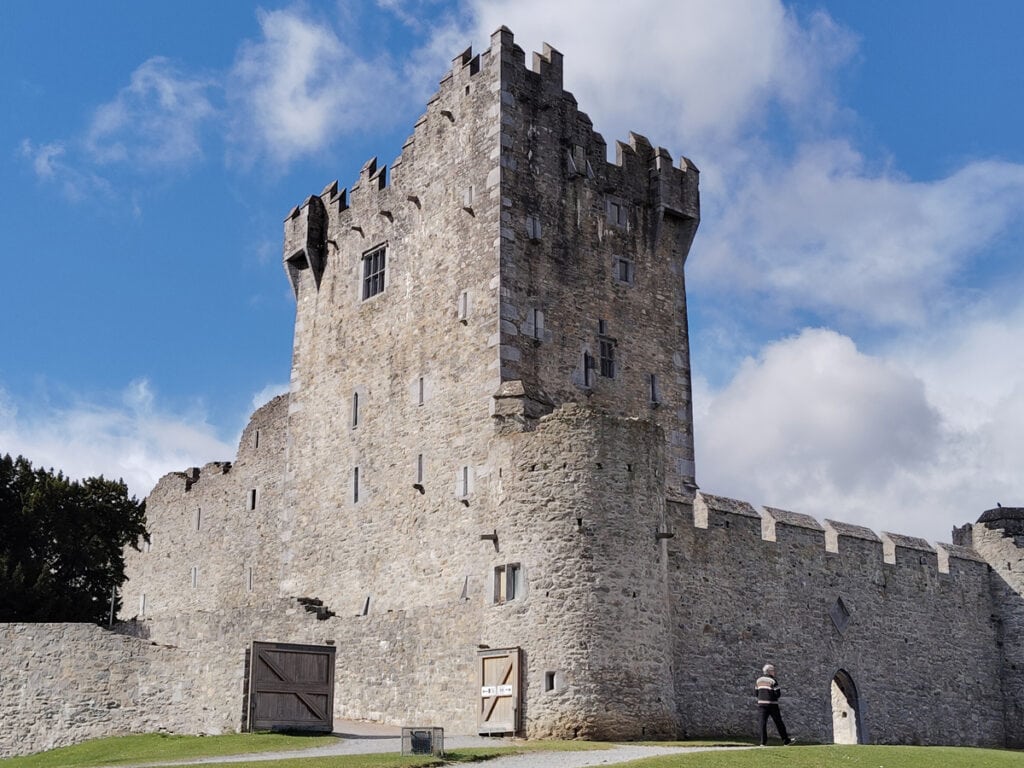
Ross Castle stands on the shore of Lough Leane in Killarney National Park, a short distance from Killarney Town. Built during the fifteenth century, probably by O’Donoghue Mór, it is one of the best places in County Kerry to understand how an Irish tower house functioned as both a fortified residence and a centre of local power.
Its setting is as important as the building.
The castle overlooks the largest of the Lakes of Killarney, while Ross Island extends behind it through woodland towards lakeshore walks and some of Ireland’s earliest known prehistoric copper-mining remains.
Visitors can explore the exterior and lakeside setting, take a seasonal guided tour through the castle interior, walk across Ross Island or leave from the nearby pier on a boat trip across Lough Leane.
For anyone interested in the history of Killarney rather than simply its scenery, Ross Castle is one of the most useful places to begin.
What Is Ross Castle?
Ross Castle is a fifteenth-century Irish tower house traditionally associated with the O’Donoghue Mór chieftains.
Tower houses were fortified residences rather than the enormous royal castles visitors may associate with medieval Europe.
They needed to provide living accommodation while also protecting the family, household and possessions inside.
Ross Castle therefore rises vertically through several storeys rather than spreading across a large complex.
Thick stone walls, restricted entrances, defensive features and carefully controlled internal access all reflect that purpose.
Today the castle is maintained as a heritage site, with access to the interior available through guided tours during the visitor season.
Who Built Ross Castle?
Ross Castle was probably built during the fifteenth century by O’Donoghue Mór, head of a Gaelic lordship associated with the Killarney lakes and surrounding territory.
The O’Donoghues were one of the important Gaelic families of southwest Ireland.
Building beside Lough Leane provided the castle with a naturally strong setting. Water protected part of the site while the surrounding woodland, lake and mountains formed part of a landscape the O’Donoghues would have known intimately.
The castle should therefore not be viewed as an isolated medieval monument.
It belonged to a wider political and cultural landscape surrounding the Lakes of Killarney. Visitors interested in comparable monuments can explore the wider collection of historical sites in Kerry.
What Is an Irish Tower House?
Tower houses became common throughout Ireland during the later medieval period.
They were usually compact stone buildings containing several floors of accommodation within a tall defensive structure.
Ross Castle is particularly useful because visitors can still understand that vertical arrangement when touring the interior.
Lower levels were generally better suited to storage, service functions and areas requiring less comfort.
More important living spaces occupied higher floors.
Access between levels was controlled by narrow stairways, while windows and rooms changed according to their purpose and position within the building.
The structure therefore reveals something important about medieval domestic life.
This was not simply a military fortification.
People lived here.
Food had to be stored and prepared. Fires provided heat. Household members and visitors occupied different spaces, while the building itself had to offer protection during periods of instability.
Defensive Features at Ross Castle
A tower house relied on more than thick walls.
Its entrance was one of its most vulnerable points, so access could be defended from inside the building. Narrow openings limited opportunities for attackers while allowing defenders to observe or respond to activity outside.
Higher positions gave occupants greater security and visibility.
When you visit the interior, it is worth thinking about how difficult everyday movement must have been compared with a modern house.
Rooms were stacked vertically.
Stairs were narrow.
Light was limited.
Every architectural choice balanced comfort against defence.
That tension is one of the most interesting things about exploring a surviving tower house.
The Siege and Surrender of Ross Castle
One of the best-known events in Ross Castle’s history came during the Cromwellian conquest of Ireland in the seventeenth century.
By the early 1650s, forces opposed to the Cromwellian government still held positions in parts of Munster.
Ross Castle became one of the final strongholds in the province.
The defending forces were associated with Lord Muskerry, while Cromwellian troops under General Edmund Ludlow eventually advanced against the castle.
According to the traditional account, a prophecy claimed that Ross Castle could not be taken until a ship appeared on Lough Leane.
The lake therefore became central to both the folklore and the military story.
Ludlow’s forces brought a large boat onto the lake.
The sight of an armed vessel on waters the defenders had regarded as part of their protection was said to have fulfilled the prophecy and contributed to the decision to surrender.
Ross Castle subsequently passed into new ownership.
The important distinction is that the military surrender is historical, while the belief that the castle could only fall when a ship appeared on the lake belongs to the traditional story surrounding the event.
The two became inseparable in local memory.
The Legend of O’Donoghue
Ross Castle is also closely connected with one of Killarney’s best-known legends.
According to local tradition, O’Donoghue Mór did not simply die.
He disappeared beneath the waters of Lough Leane and continues to inhabit a great palace beneath the lake.
The story says that on the first morning of May, once every seven years, O’Donoghue rises from the water on a white horse and travels across the lake.
Anyone fortunate enough to see him is said to enjoy good fortune.
There are different versions of the story, as is common with oral tradition.
What matters is not whether we treat the legend as literal history.
It demonstrates how Ross Castle and the lakes became part of a much wider imaginative landscape.
The physical place and the stories told about it developed together.
What Can You See Inside Ross Castle?
The interior is accessible through a guided tour.
This is worth doing if you want to understand the building rather than simply photograph it from the lakeshore.
The tour takes visitors through the vertical structure of the tower house and explains how different rooms functioned, how the castle was defended and how life would have been organised within its stone walls.
Period furnishings and interpretation help make the rooms easier to understand.
The most important thing is to look beyond individual objects.
Pay attention to:
- the thickness of the walls
- the size and position of windows
- the narrow circulation routes
- how rooms are stacked above one another
- the relationship between private living space and defensive architecture
Those details explain the building far better than the exterior alone.
Guided Tours of Ross Castle
For the 2026 season, Ross Castle is currently scheduled to open from 5 March until 3 November.
Current visitor information lists:
- Opening: 9.30am–5pm
- First guided tour: 10am
- Last guided tour: 4.55pm
The interior can only be visited by guided tour.
Tours operate on a first-come, first-served basis, and each group is limited to approximately 15 visitors.
That small group size is good for interpretation, but it also means waits can develop during busy summer periods.
If seeing the interior is important to you, I would avoid arriving immediately before you need to leave.
Opening arrangements can change, so check Heritage Ireland directly before travelling.
Ross Castle Admission
Current 2026 admission prices are:
- Adult: €5
- Senior or group: €4
- Child or student: €3
- Family: €13
These prices relate to the managed visitor experience and may change in future seasons.
Always check the official Heritage Ireland information when planning your visit.
Accessibility at Ross Castle
This needs a little more consideration than many short travel guides suggest.
The lakeside setting and exterior can be enjoyed without climbing through the castle.
The interior is different.
Ross Castle is a medieval tower house with steep internal access, uneven surfaces and confined circulation, so visitors with reduced mobility may find the guided interior challenging.
Official visitor information specifically warns of difficult access and steep inclines.
Accessible toilet facilities are available.
If mobility is a concern, I would still consider visiting Ross Castle for the lakeside setting, exterior architecture and nearby views even if the interior tour is not appropriate.
Ross Castle and Lough Leane
The castle makes considerably more sense when viewed as part of Lough Leane rather than simply as a building beside water.
Lough Leane is the largest of the Lakes of Killarney.
Its islands, woodland, mountains and historical sites create a cultural landscape that has been occupied and used for thousands of years.
Ross Castle sits at one of the easiest places for visitors to access that landscape.
From the shore you can look across towards the mountains and islands while boats leave from the nearby pier.
That relationship with the lake is one reason Ross Castle remains such a strong starting point for exploring Killarney National Park. The broader Killarney National Park visitor guide can help you understand how the castle fits into the wider park.
Boat Trips from Ross Castle
Boat trips depart from the pier beside Ross Castle and provide a completely different perspective on the landscape.
Depending on the operator and route, trips may explore Lough Leane or travel towards places including:
- Innisfallen Island
- Dinis
- Lord Brandon’s Cottage
- other parts of the Killarney lake system
Both open and covered boats operate on the lakes.
If the weather is reasonable and you have time, combining Ross Castle with a boat journey can work particularly well.
The castle explains part of the human history around the lake.
The boat explains the geography.
Innisfallen Island
One of the most interesting destinations accessible by boat from Ross Castle is Innisfallen Island.
The island contains the remains of an early monastic settlement founded many centuries before Ross Castle was built.
Its history is therefore much older than the medieval tower house.
Monks associated with Innisfallen produced the Annals of Inisfallen, an important medieval chronicle recording events in Ireland over several centuries.
The contrast is useful.
Ross Castle introduces the world of late-medieval Gaelic lordship.
Innisfallen introduces an earlier monastic landscape.
Both occupy the same lake.
That concentration of history is one of the reasons Killarney National Park deserves more than scenic sightseeing alone.
Walking on Ross Island
You do not need to leave the area immediately after visiting the castle.
Walking routes extend across Ross Island through woodland and along sections of the lakeshore.
One of the most useful routes leads towards Library Point.
The walk is approximately 5 kilometres return, depending on the exact route taken, and provides a quieter experience than the busy castle forecourt.
If you have a couple of hours available rather than a quick sightseeing stop, combining the castle with a Ross Island walk makes the visit much more rewarding.
Bronze Age Copper Mining on Ross Island
Ross Island’s human history stretches far beyond Ross Castle.
Archaeological evidence shows that people were mining copper here during the Bronze Age, around the third millennium BC.
That means humans were extracting metal from this landscape more than three thousand years before the O’Donoghues built their tower house.
This is an extraordinary chronological contrast.
Visitors can arrive thinking they are looking at an old castle and discover that the surrounding island contains evidence of industrial activity from prehistoric Ireland.
That deeper history deserves considerably more attention.
The National Parks and heritage services periodically offer guided interpretation of Ross Island’s prehistoric copper-mining remains.
How Long Should You Allow at Ross Castle?
It depends on what you want to do.
Exterior and Lakeshore Only
Allow approximately 20–30 minutes for a short stop.
Castle Interior
Allow at least 45–60 minutes, with additional time during busy periods in case you need to wait for the next guided tour.
Castle and Ross Island Walk
Allow approximately 2–3 hours, depending on your walking pace and route.
Castle and Boat Trip
This can easily become a half-day experience, depending on the journey you choose.
The main mistake is assuming Ross Castle needs exactly the same amount of time for every visitor.
A quick photograph and a castle tour are two very different experiences.
When Is the Best Time to Visit Ross Castle?
There is no single best time.
Early morning can be useful if you prefer a quieter lakeshore and softer light.
Late afternoon can also produce attractive conditions around Lough Leane, particularly when the water is calm.
During the busiest summer period, the more practical consideration is tour capacity.
Because interior groups are small, visiting earlier in the day can reduce the risk of a lengthy wait.
Killarney weather changes quickly, so don’t assume rain necessarily makes the visit unsuccessful.
A dramatic sky can suit the castle extremely well.
Is Ross Castle Good for Families?
Yes, particularly for children old enough to engage with castles and stories.
The exterior is immediately recognisable as a medieval stronghold, while the interior tour makes it easier to imagine how people actually lived inside.
The legend of O’Donoghue also provides an accessible entry point into local folklore.
Families can then extend the visit with:
- a lakeshore walk
- a boat trip
- a shorter section of Ross Island
The steep interior stairs may not suit very young children or visitors with mobility difficulties, so consider the individual needs of your group.
Is Ross Castle Worth Visiting?
Yes.
If you are spending time in Killarney National Park, Ross Castle is one of the easiest historical sites to recommend.
The exterior alone gives you a strong lakeside setting, but the guided interior tour adds considerably more value because it helps explain how a Gaelic tower house actually functioned.
I particularly recommend allowing extra time rather than treating it as a ten-minute photograph stop.
Walk a little farther onto Ross Island.
Take a boat if conditions and your schedule suit.
Look across towards Innisfallen.
Once you connect the castle with the lake and surrounding landscape, Ross Castle becomes considerably more interesting.
What Else Is Nearby?
Ross Castle sits within Killarney National Park, but not every famous Killarney attraction is immediately beside it.
That distinction helps when planning your day.
Directly From Ross Castle
- Ross Island walks
- Library Point
- boat trips on Lough Leane
- Innisfallen Island
These can be experienced directly from the castle area.
Elsewhere in Killarney National Park
A short drive or cycle brings you towards other major attractions including:
- Muckross House
- Muckross Abbey
- Torc Waterfall
- Muckross Lake
- the roads towards Ladies View and Moll’s Gap
Rather than attempting everything in one rushed visit, choose the parts of the park that match your interests.
Visitors who want more detailed background can continue with the dedicated guides to Muckross House and Muckross Abbey.
Ross Castle as Part of a Killarney Day
Ross Castle works particularly well near the beginning of a day exploring Killarney National Park.
A history-focused day might combine:
Ross Castle → Innisfallen or Ross Island → Muckross Abbey → Muckross House
A landscape-focused day could continue towards:
Torc Waterfall → Ladies View → Moll’s Gap
You do not need to include every stop.
Killarney National Park contains enough history and landscape for several days.
Continue Exploring Killarney and the Ring of Kerry
Ross Castle is a natural starting point for exploring Killarney, but it also fits into a wider County Kerry itinerary.
Visitors continuing south through the national park can follow the roads towards Moll’s Gap and join the Ring of Kerry. The guide to the top sites on the Ring of Kerry can help identify the strongest onward stops.
If you are deciding how to divide a longer stay between the county’s two principal visitor bases, the guide comparing Dingle and Killarney explains the different advantages of each.
Visitors with a full week can also use the seven-day Kerry itinerary to connect Killarney National Park with the Dingle Peninsula and other parts of the county.
Steve’s Peninsula Tours’ private Killarney National Park tour can include Ross Castle alongside selected lakeside, historical and landscape stops, with the day adjusted around the interests and walking ability of the group.
Frequently Asked Questions About Ross Castle
Where is Ross Castle?
Ross Castle is on Ross Island beside Lough Leane in Killarney National Park, a short distance from Killarney Town.
When was Ross Castle built?
Ross Castle was probably built during the fifteenth century by O’Donoghue Mór.
What type of castle is Ross Castle?
Ross Castle is an Irish tower house—a fortified multi-storey residence common in Ireland during the later medieval period.
Can you go inside Ross Castle?
Yes, during the visitor season. The interior is accessible only on a guided tour.
Do you need to book a Ross Castle tour?
Current tours operate on a first-come, first-served basis rather than advance timed booking. Group sizes are small, so waits can occur during busy periods.
How much does Ross Castle cost?
For the 2026 season, current admission is €5 for adults, €4 for seniors or groups, €3 for children or students and €13 for families. Check Heritage Ireland for current pricing before travelling.
How long should you spend at Ross Castle?
Allow around 20–30 minutes for the exterior only, roughly an hour for the castle and guided tour, and several hours if you add Ross Island or a boat trip.
Is Ross Castle accessible?
The exterior and lakeside area can be enjoyed by many visitors, but the medieval interior contains steep and challenging access. Check current Heritage Ireland accessibility information if mobility is a concern.
Can you take a boat from Ross Castle?
Yes. Boat trips depart from the pier beside the castle and can explore Lough Leane and destinations such as Innisfallen Island.
Can you walk around Ross Island?
Yes. Several walking routes begin near the castle, including the route towards Library Point.
What happened at Ross Castle during the Cromwellian conquest?
Ross Castle became one of the final strongholds in Munster to resist Cromwellian forces. General Edmund Ludlow brought a large boat onto Lough Leane, after which the garrison surrendered.
What is the legend of O’Donoghue?
Local tradition says O’Donoghue lives beneath Lough Leane and rises from the water on a white horse once every seven years on the first morning of May. Seeing him is said to bring good fortune.
What else can I visit near Ross Castle?
Directly from the castle you can explore Ross Island or take a boat towards Innisfallen. Elsewhere in Killarney National Park, Muckross Abbey, Muckross House and Torc Waterfall are among the strongest nearby attractions.