Dingle or Killarney? Which Is the Better Place to Stay in Kerry?
Dingle or Killarney is one of the most important choices when planning a trip to County Kerry. Both are excellent bases, but they offer noticeably different experiences. Killarney provides immediate access to lakes, mountains, woodland and some of Kerry’s largest visitor attractions. Dingle is a smaller Atlantic harbour town surrounded by the archaeology, beaches, islands and Irish-language culture of the Dingle Peninsula.
If you want national park walks, historic houses, organised excursions, extensive accommodation choices and straightforward public transport connections, Killarney is usually the more practical choice. If you want a compact coastal town, traditional music, seafood, maritime culture and one of Ireland’s most rewarding coastal routes, Dingle is likely to feel more distinctive.
For visitors with four or more nights in Kerry, my honest recommendation is not to choose between them. Spend time in both. Killarney and Dingle are close enough to combine within one holiday but different enough that staying in each creates a much fuller understanding of Kerry.
Dingle or Killarney: The Short Answer
Choose Dingle if your priorities are:
- Slea Head Drive and Atlantic coastal scenery
- A smaller, walkable harbour town
- Traditional music and an informal evening atmosphere
- The Blasket Islands and West Kerry Gaeltacht
- Early Christian sites, stone forts and clocháin
- Seafood, boat trips and maritime culture
- A slower stay centred on one peninsula
Choose Killarney if your priorities are:
- Killarney National Park
- Lakes, woodland, waterfalls and mountain scenery
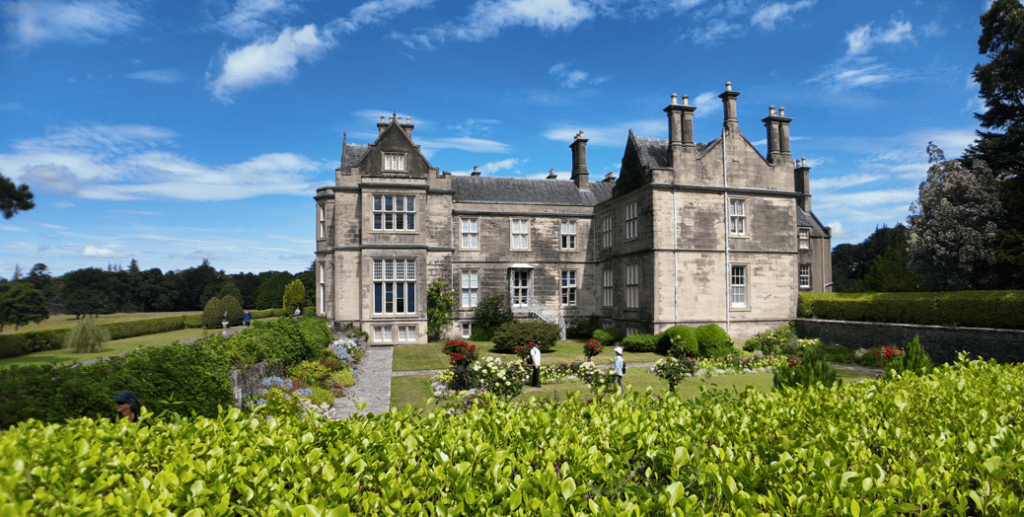
- Muckross House, Muckross Abbey and Ross Castle
- The Gap of Dunloe
- A larger choice of hotels, restaurants and organised tours
- Direct rail connections and easier car-free travel
- A central base for the Ring of Kerry
Choose both if you have at least four nights. Two nights in Killarney followed by two nights in Dingle is far better than repeatedly driving between them.
How Different Are Dingle and Killarney?
Dingle and Killarney are not competing versions of the same destination. They occupy different landscapes and have developed around different histories.
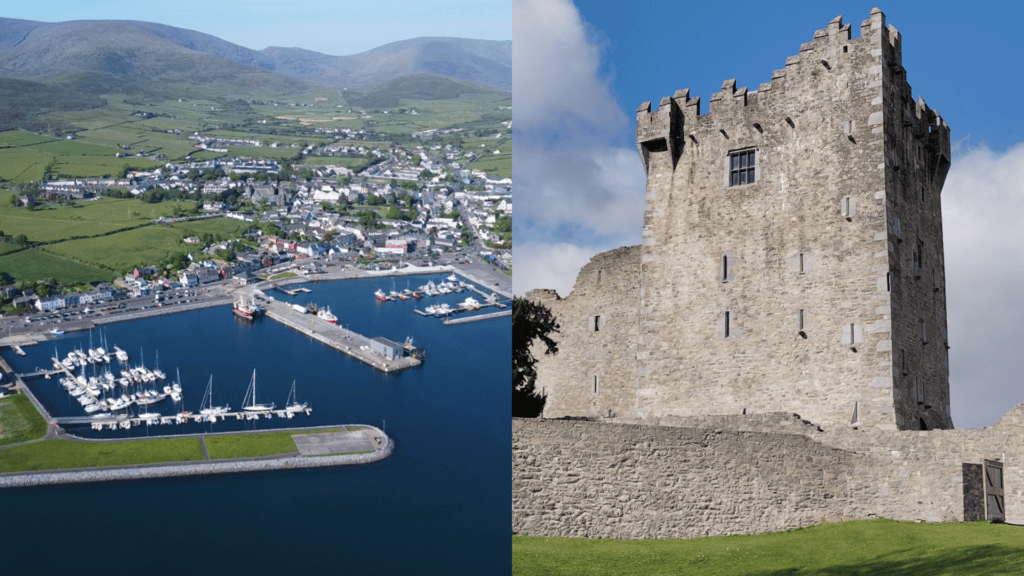
Killarney sits beside Lough Leane on the eastern side of the MacGillycuddy’s Reeks. The town grew into one of Ireland’s principal visitor centres because of the lakes, mountains, estates and woodland surrounding it. Killarney National Park begins close to the town centre, creating an unusually direct connection between a busy tourism town and a protected natural landscape.
Dingle, known in Irish as Daingean Uí Chúis or An Daingean, is a working harbour town near the western end of the Dingle Peninsula. Mountains rise behind it, while Dingle Bay opens towards the Atlantic. Travelling west leads into Corca Dhuibhne, a Gaeltacht district where Irish remains part of everyday community life.
Killarney feels like a well-established resort town beside a national park. Dingle feels like a coastal community that also welcomes a significant number of visitors. That distinction affects everything from the landscape and accommodation to the pace of an evening in town.
Which Town Has the Better Scenery?
This depends on the kind of scenery you want to experience.
Killarney’s Lakes, Mountains and Woodland
Killarney is the stronger choice for inland scenery. Its landscape combines three lakes, native woodland, historic estates and the mountains of the MacGillycuddy’s Reeks.
Within a relatively small area, you can visit Ross Castle on the shore of Lough Leane, walk through the Muckross estate, explore Muckross Abbey, see Torc Waterfall and continue towards Ladies View and Moll’s Gap. Longer days can include the Gap of Dunloe, boat journeys through the lakes or mountain walks.
The variety is particularly useful in unsettled weather. If cloud hides the higher viewpoints, you can explore woodland, gardens, castles or historic buildings instead.
Dingle’s Atlantic Coast and Island Views
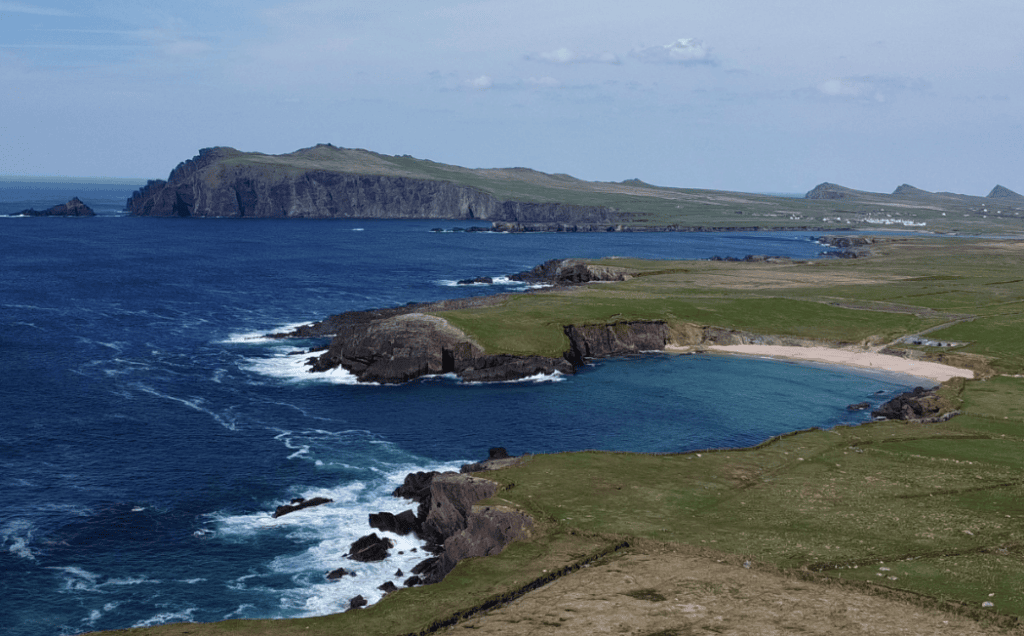
Dingle is the stronger choice for ocean scenery. West of the town, the land narrows between mountains and the Atlantic before reaching Slea Head, Dunquin, Ballyferriter and the coast overlooking the Blasket Islands.
The landscape includes exposed headlands, small sandy coves, long beaches, stone-walled fields and offshore islands. On a clear day, the Great Blasket dominates the view across the Blasket Sound. In rougher weather, waves and rapidly changing light give the coast a completely different character.
If your idea of Kerry is a winding road above the Atlantic with islands on the horizon, Dingle is the better base. Browse the wider collection of places to see in Kerry to compare the county’s coastal and inland landscapes.
Dingle Peninsula or Killarney National Park?
This is the real geographical choice behind the question.
Killarney National Park is best for visitors who enjoy accessible walking, cycling, lakes, woodland, waterfalls and historic estates. Parts of the park can be reached directly from Killarney town, making it possible to enjoy a full day without a car.
The Dingle Peninsula is best for visitors interested in coastal driving, archaeology, island history, Irish-language culture and small communities. The principal attractions are distributed across a much wider area, so a car, bicycle, local bus or guided tour is needed to understand the peninsula properly.
The two experiences complement one another. Killarney explains Kerry’s lake and mountain landscape; Dingle reveals its Atlantic, archaeological and cultural character.
Which Is Better for History and Culture?
Dingle has the advantage for early settlement, archaeology and living Gaeltacht culture. Killarney has the advantage for castles, landed estates and the history of tourism.
History Around Dingle
The western Dingle Peninsula contains an exceptional concentration of archaeological and early Christian remains. These include promontory forts, ringforts, clocháin, ogham stones, ecclesiastical enclosures and medieval churches.
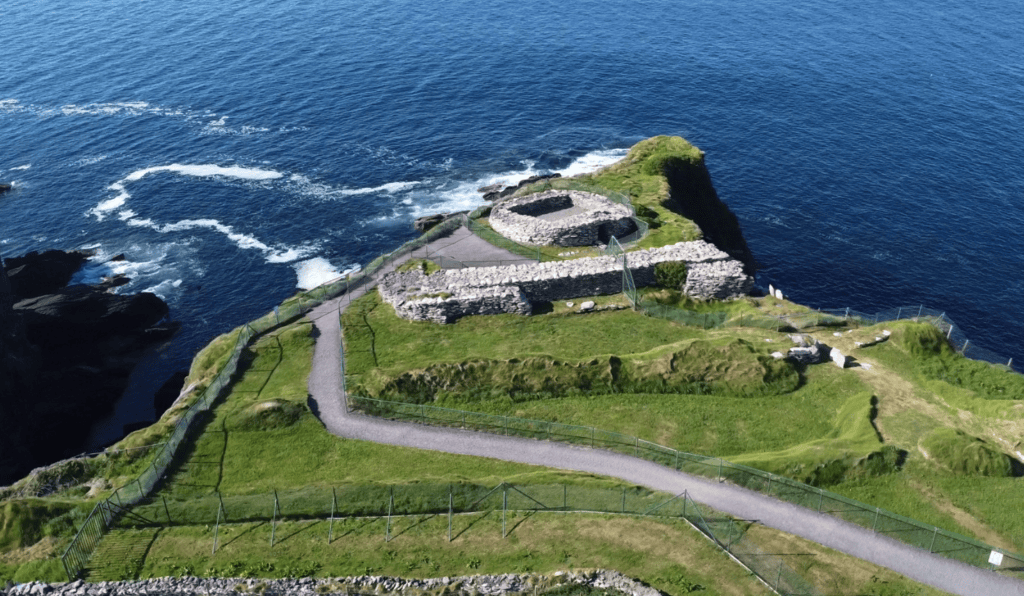
Dún Beag occupies a defensive position above the Atlantic. The Fahan district contains groups of corbelled stone huts, while Gallarus Oratory is one of Ireland’s best-known early stone churches. Kilmalkedar preserves a Romanesque church and features associated with pilgrimage.
The Blasket Islands add another cultural dimension. The island community produced an important body of Irish-language literature describing daily life, emigration, fishing, storytelling and the eventual evacuation of the Great Blasket in 1953.
Dingle is therefore the better choice if you want history embedded throughout a living coastal landscape rather than concentrated within a small number of formal attractions.
History Around Killarney
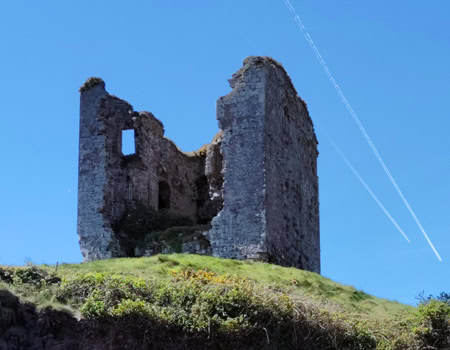
Killarney’s historical experience is organised around several major sites. Ross Castle represents the fortified world of Gaelic lordship, while Muckross Abbey reflects the religious history of the region. Muckross House introduces the nineteenth-century landed estate and the social world that developed around it.
The growth of tourism is also part of Killarney’s story. Visitors have travelled to see the lakes and mountains for centuries, and many of the area’s roads, viewpoints, boat routes and visitor traditions developed around that early interest.
If you prefer large historic properties, formal interpretation and sites that can be combined easily within one day, Killarney is the more convenient choice. Additional monuments across the county can be found through the Historical Sites in Kerry guide.
Which Has the Better Town Centre?
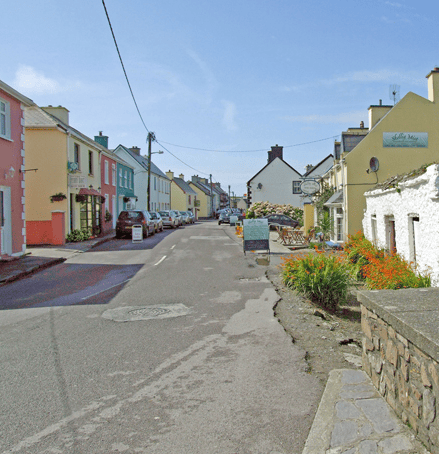
Dingle has the more compact and immediately distinctive centre. The harbour, restaurants, pubs and shops are concentrated within a walkable area. Colourful shopfronts and older mixed-use businesses give the streets a character that still reflects the town’s history as a local market and fishing centre.
Killarney is larger and busier. It has more hotels, a broader range of shops and restaurants, and a greater number of services aimed at visitors. The town centre can feel crowded during the main season, but that scale gives travellers more options.
For atmosphere and ease of wandering, I would give Dingle the advantage. For choice, convenience and visitor facilities, Killarney wins.
Which Is Better for Traditional Music and Evenings Out?
Both towns have pubs, live music and busy evenings, particularly during the visitor season. The difference is in scale and atmosphere.
Dingle’s centre is small enough that visitors can walk between the harbour, restaurants and music pubs without planning the evening in advance. Traditional music is closely connected with the cultural identity of West Kerry, although performances, times and venues naturally change.
Killarney offers a larger nightlife scene, with hotel bars, music venues, restaurants and pubs spread across a broader town centre. It is generally the better choice for groups wanting variety or a livelier resort-town evening.
Choose Dingle for a smaller coastal-town experience. Choose Killarney for a wider selection of venues and a busier night out.
Which Is Better for Food?
Dingle has developed a strong food identity centred on seafood, local produce and independent restaurants. Its harbour setting gives the town a natural association with fish and shellfish, while the wider peninsula supports farms, food producers and small hospitality businesses.
Killarney has a much larger overall selection. You will find casual cafés, traditional pubs, hotel restaurants and formal dining across the town. This can make it easier for families or groups with different budgets and preferences.
Dingle has the edge for a compact, locally distinctive food experience. Killarney has the edge for breadth of choice and availability.
Restaurants in both towns can become busy during summer weekends and major events. If there is somewhere you particularly want to eat, booking ahead is sensible.
Which Is Better Without a Car?
Killarney is the easier destination without a car.
The town has a railway station with connections towards Cork and Dublin through the wider rail network. Bus services also connect Killarney with other towns and regional destinations. Most importantly, parts of Killarney National Park can be reached on foot or by bicycle from the town centre.
Seasonal visitor services, organised excursions and local transport options make it possible to see Muckross, Ross Castle, the Gap of Dunloe and the Ring of Kerry without driving yourself. Exact services and timetables should always be checked before travelling.
Dingle does not have a railway station. It is connected by bus with Tralee, Killarney and communities across the peninsula, and local services make some car-free exploration possible. Guided tours, boat trips and bicycle hire provide further options.
However, Dingle’s attractions are more dispersed. Reaching several archaeological sites, beaches and viewpoints in one day is easier with a car or organised tour.
If you are relying entirely on public transport, Killarney is the safer first choice. If Dingle is your priority, it remains possible without a car, but the trip requires more preparation.
Which Is Better for Driving and Day Trips?
Killarney is the more central base for the Ring of Kerry, Kenmare, the Gap of Dunloe and the eastern side of the Iveragh Peninsula. It is also convenient for travellers arriving from Cork, Dublin or Limerick.
Dingle is better for Slea Head, the Blasket coast, Conor Pass, Inch, Ballyferriter and the northern side of the Dingle Peninsula. It can also work for trips towards Tralee and North Kerry.
Dingle is not an efficient base for repeatedly touring the Ring of Kerry, just as Killarney is not the ideal base for exploring the western Dingle Peninsula over several consecutive days. The connecting journey is entirely manageable, but driving back and forth wastes valuable time.
If you are staying in both towns, treat the journey between them as part of the holiday. Inch Strand makes a natural stop, while alternative routes can incorporate Castlemaine, Annascaul and other parts of the peninsula.
Which Is Better for Families?
Killarney usually provides more straightforward options for families. The national park offers walks and cycle routes, while boat trips, carriage rides, historic attractions and organised tours provide alternatives for different ages.
Dingle works especially well for families interested in boats, beaches, wildlife, archaeology and exploring a smaller town. The aquarium and harbour activities can also be useful when younger visitors need a change from scenic driving.
Neither destination should be treated as weatherproof. Outdoor plans may need to change, and children require close supervision near water, cliffs, narrow roads and exposed archaeological sites.
For a first family trip with limited planning time, Killarney is the simpler choice. For families who enjoy coastlines and smaller towns, Dingle may be the more memorable one.
Which Is Better for Walking?
Killarney is better for accessible walking directly from your accommodation. The national park contains routes through Knockreer, Ross Island and the Muckross estate, alongside more demanding mountain options in the wider area.
Dingle has excellent coastal and mountain walking, but many trailheads require transport from town. Walks around Mount Brandon, Ballydavid, Dunquin and the western peninsula can be rewarding, although weather and terrain require realistic preparation.
For casual walkers who want to leave the hotel on foot, Killarney wins. For experienced walkers seeking exposed coastal and mountain landscapes, the Dingle Peninsula has considerable appeal.
Which Is Better in Bad Weather?
Killarney has more concentrated indoor alternatives. Muckross House, shops, cafés, visitor attractions and hotel facilities provide useful options when rain or low cloud makes mountain viewpoints less rewarding.
Dingle also has indoor attractions, restaurants, pubs, shops and cultural experiences, but much of the peninsula’s appeal comes from the coast. Heavy rain, strong wind or fog can affect boat trips and reduce visibility along Slea Head.
That does not mean Dingle should be avoided in unsettled weather. Atlantic conditions are part of the landscape, and short breaks between showers can produce excellent light. It simply requires more flexibility.
If weather certainty is a major concern, Killarney offers a broader backup plan.
Which Is Quieter?
Neither town is consistently quiet during the main visitor season. Killarney receives large numbers of visitors because of its accommodation capacity, transport connections and position beside the national park. Dingle is smaller, so busy periods can be very noticeable within its compact centre.
Outside the busiest daytime and evening periods, Dingle can feel more intimate. Travelling a short distance into the western peninsula also brings you into smaller villages and open countryside.
Killarney’s scale makes it easier to spread visitors across hotels, streets and attractions, but the centre remains active. Quieter experiences are found in the national park early in the morning or along less-used walking routes.
If tranquillity is your priority, the best solution may be to stay outside either town centre while remaining close enough to visit.
How Many Nights Should You Spend in Each?
For a short Kerry visit, allow at least two nights in whichever town you choose. One night gives little more than an arrival evening and a single sightseeing day.
Two nights in Killarney allow one complete national park day. Three nights create space for the Gap of Dunloe or part of the Ring of Kerry.
Two nights in Dingle allow one complete Slea Head day and time in the town. Three nights make room for a boat trip, the northern peninsula, Conor Pass or a slower day exploring archaeological sites.
For four nights, divide the stay evenly between Killarney and Dingle. For five or six nights, use three nights in the area most closely aligned with your interests and two or three in the other.
Can You Visit Dingle as a Day Trip from Killarney?
Yes, but it will be a full day. The journey between Killarney and Dingle is only part of the outing; a proper visit should also include Slea Head and selected stops around the western peninsula.
A day trip works best when you leave early, choose your principal stops and avoid spending too long in Dingle town before beginning the coastal circuit. Attempting to include Inch, every archaeological site, Dunquin, the Blasket Centre, Ballyferriter, Gallarus and Conor Pass in one day is unrealistic.
If Dingle is one of the main reasons for your Kerry holiday, stay overnight. The town is more enjoyable after day visitors leave, and you will not have a long return drive at the end of the evening.
Can You Visit Killarney as a Day Trip from Dingle?
Killarney can also be visited from Dingle, but you need to decide whether the day is about the national park or the Ring of Kerry. Combining both properly is not practical.
For a national park day, concentrate on Ross Castle, Muckross House and Gardens, Muckross Abbey, Torc Waterfall and perhaps Ladies View. That already creates a substantial itinerary before the return journey to Dingle.
If you want the Gap of Dunloe, a boat journey through the lakes or a complete Ring of Kerry tour, staying in Killarney is the more sensible arrangement.
Dingle or Killarney for the Ring of Kerry?
Killarney is clearly the better base for the Ring of Kerry. The traditional circuit begins and ends around Killarney, providing access to Killorglin, Glenbeigh, Cahersiveen, Waterville, Sneem and Kenmare.
Dingle lies on a separate peninsula to the north. Although the Ring of Kerry can be reached from Dingle, the additional travelling time creates an unnecessarily long day.
If the Ring of Kerry and Skellig Ring are central to your plans, stay in Killarney or divide your accommodation between Killarney and South Kerry. Dingle should then be treated as a separate part of the holiday rather than a base for every excursion.
Dingle or Killarney for Slea Head Drive?
Dingle is the correct base for Slea Head Drive. The route begins just west of the town and travels through Ventry, Fahan, Slea Head, Dunquin, Ballyferriter and Gallarus before returning to Dingle.
A short circuit can be completed in a few hours, but a proper visit takes half a day or longer. Archaeological sites, beaches, viewpoints and the Blasket Centre can easily turn it into a full-day experience.
Staying in Dingle allows you to begin before the busiest traffic and return to town without another long drive. The route can be explored independently or as part of my private full-day Dingle Peninsula tour, with the day adjusted around history, photography, walking ability and the weather.
My Honest Recommendation
If you have only two nights and are visiting Kerry for the first time, choose Killarney if convenience, public transport and a wide range of attractions matter most. Choose Dingle if you already know that the Atlantic coast, Slea Head and a smaller harbour town are your priorities.
If you are travelling without a car, Killarney is generally easier. If you want a stronger sense of West Kerry’s coastal and Irish-language identity, Dingle is more rewarding.
If you have four nights, spend two in each. The landscapes are too different for one town to replace the other. Moving once will give you a better experience than making two long return day trips.
My personal preference for atmosphere is Dingle, but that does not make it the right answer for every visitor. Killarney is more accessible, has a broader range of accommodation and provides immediate access to one of Ireland’s most important national parks. The right choice depends on the holiday you actually want rather than which town is more famous.
Continue Exploring Kerry
Dingle and Killarney form two of Kerry’s strongest visitor bases, but they reveal different sides of the county. Dingle connects naturally with Slea Head, the Blasket Islands, Inch and the wider Dingle Peninsula. Killarney connects with the national park, the Gap of Dunloe, Kenmare and the Ring of Kerry.
If you are planning a longer stay, use the main Explore Kerry guide to compare towns, historical sites and natural attractions across the county. Practical itineraries and destination advice are also available through Steve’s Peninsula Blog.
The best Kerry itinerary usually combines one coastal base with one inland or lake-based destination. Dingle and Killarney achieve that particularly well, giving you Atlantic headlands, islands, archaeology, woodland, mountains and lakes within the same journey.
Frequently Asked Questions About Dingle and Killarney
Is Dingle better than Killarney?
Dingle is better for Slea Head, Atlantic scenery, traditional music, archaeology and a compact harbour-town atmosphere. Killarney is better for national park access, public transport, accommodation choice and organised day trips. Neither is universally better.
Should I stay in both Dingle and Killarney?
Yes, if you have four or more nights in Kerry. Two nights in each town gives you a much stronger experience than staying in one place and repeatedly travelling back and forth.
Which is easier to reach without a car?
Killarney is easier because it has a railway station and good regional connections. Dingle is served by buses but has no rail station, and its surrounding attractions are more widely dispersed.
Which town is better for the Ring of Kerry?
Killarney is the better base for the Ring of Kerry. Dingle is on a different peninsula and adds considerable travelling time to an already long sightseeing day.
Which town is better for couples?
Dingle often suits couples looking for a smaller town, coastal drives, restaurants and relaxed evenings. Killarney suits couples who want spa hotels, national park walks, organised activities and a larger choice of accommodation.
Which town is better for families?
Killarney generally offers more family activities and convenient wet-weather alternatives. Dingle is a strong choice for families interested in boats, beaches, wildlife and the Slea Head landscape.
How long does it take to travel between Dingle and Killarney?
Allow considerably more time than the direct driving estimate if you intend to stop at Inch or explore villages along the way. Road conditions, summer traffic and weather can all affect the journey, so it should not be planned as a rushed transfer.