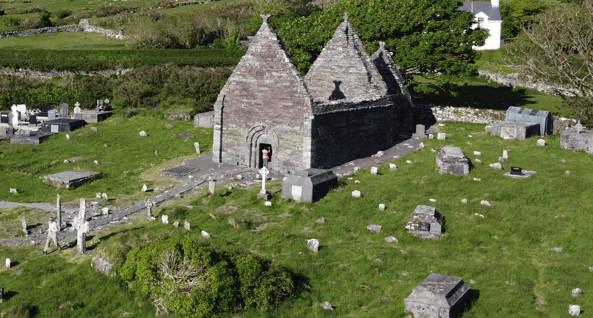
Kilmalkedar Church is one of the most important historic sites on the Dingle Peninsula, not because of one single monument but because so many different periods of West Kerry’s religious history survive together in the same place.
Pilgrimage, Ogham Stones and Early Christianity in West Kerry
The ruined Romanesque church is the centrepiece of the site, but Kilmalkedar is much older than the surviving twelfth-century building. Within and around the graveyard are an ogham stone, pillar sundial, carved stones, crosses and other evidence showing that this landscape was associated with Christian worship and commemoration long before the present church was constructed.
Kilmalkedar is also connected with the old pilgrimage traditions of the Dingle Peninsula and is commonly associated with Saint Brendan the Navigator. The surviving evidence, however, belongs to several different periods, so it is important to separate later tradition from what archaeology and architecture can establish.
If you are planning a visit, my permanent Kilmalkedar Church visitor guide provides the essential site information. This article looks more closely at why Kilmalkedar matters, what the individual monuments tell us and how the site fits into the wider religious landscape of Corca Dhuibhne.
Where Is Kilmalkedar Church?
Kilmalkedar lies on the western Dingle Peninsula, around five kilometres east of Baile an Fheirtéaraigh, or Ballyferriter, within the Gaeltacht of West Kerry. The site overlooks the wider landscape towards Smerwick Harbour and sits beneath the northern slopes of the peninsula.
The Irish name is Cill Maoilchéadair, with cill meaning church. The name preserves the association with Saint Maolcethair, who is traditionally regarded as the site’s founder and is recorded as having died in the seventh century.
The location is important because Kilmalkedar does not stand alone. Nearby are Gallarus Oratory, Riasc Monastic Settlement and other historic remains that demonstrate just how concentrated early Christian and medieval activity was on the western peninsula.
A Site Older Than the Church
The building most visitors photograph today dates from the medieval period, but Christian activity at Kilmalkedar began much earlier.
The strongest evidence comes from monuments such as the ogham stone and sundial. These belong to an earlier phase of the site’s history and show that Kilmalkedar was already important centuries before the Romanesque church appeared.
This is one of the reasons I find the site so rewarding to explain. If you look only at the church ruins, you are seeing one chapter. Once you begin examining the stones around it, the site becomes a much longer story of worship, burial, pilgrimage and commemoration.
The broader history of the Dingle Peninsula provides useful background to this transition from early settlement through the Christian and medieval periods.
The Kilmalkedar Ogham Stone
One of the most important monuments at the site is the Kilmalkedar Ogham Stone.
Ogham is an early writing system generally represented by groups of strokes cut along the edge of a standing stone. Most surviving inscriptions record personal names, often in commemorative contexts.
The Kilmalkedar stone is particularly interesting because the Dingle Peninsula contains one of Ireland’s greatest concentrations of ogham inscriptions. This makes the stone part of a much wider regional tradition rather than an isolated curiosity.
Heritage Ireland dates the stone to around the early seventh century and records an inscription containing personal names. Whatever the precise circumstances in which it was first erected, its survival inside the later ecclesiastical landscape shows how older monuments could remain meaningful as a religious site developed over centuries.
What Ogham Tells Us About Early Ireland
Visitors often imagine early Irish history as a largely unwritten world before monasteries began producing manuscripts. Ogham complicates that picture.
The inscriptions demonstrate that communities were using a formal writing system to record identities and relationships centuries before many of Ireland’s most famous illuminated manuscripts were created.
The stones also tell us something about status. Cutting an inscription into a substantial standing stone required intent, skill and social purpose.
At Kilmalkedar, the ogham pillar becomes even more interesting because it stands within a site that later developed into a major Christian complex. The landscape preserves several layers of literacy, religion and commemoration in one place.
The Pillar Sundial
Another unusual monument stands near the western side of the graveyard: a stone pillar sundial.
The pillar has a rounded upper section divided into sectors, with a central hole that once held a projecting rod. The shadow cast by that rod could be used to mark the passage of time.
For an early Christian community, measuring the day had practical religious importance. Monastic and ecclesiastical routines were structured around periods of prayer, and a sundial offered a simple way of organising those daily observances.
This is exactly the kind of feature visitors can easily walk past without understanding what they are seeing. Once its purpose is explained, a plain stone pillar becomes evidence for the organisation of everyday religious life more than a thousand years ago.
The Romanesque Church
The surviving church was built shortly after 1134 during a period of political rivalry involving the MacCarthaigh rulers of South Munster and the Uí Briain of North Munster.
Architecturally, it belongs to the Romanesque tradition. The building consists of a nave and chancel, with carefully dressed sandstone and carved details that make it very different from the simpler stone structures associated with earlier Christian sites.
The western doorway is one of the features worth examining closely. Its rounded arch, multiple orders and carved details immediately show that this was not a crude rural building. Skilled masons were working here within an architectural tradition connected to wider developments in medieval Ireland.
When I bring visitors to Kilmalkedar, I normally encourage them to step back before walking inside. The overall proportions of the church are easier to appreciate when you first see the complete building within the graveyard and surrounding countryside.
The West Doorway
The western entrance is one of the strongest architectural features of Kilmalkedar.
The round-headed doorway is built in several recessed orders and is framed with carefully worked stone. Decorative elements include contrasting stone and carved animal-head stops.
Those details matter because they demonstrate the resources invested in the church. Kilmalkedar was not simply a small local chapel erected with whatever material happened to be available.
It belonged to a sophisticated medieval architectural tradition, and comparison with buildings such as Cormac’s Chapel at Cashel has long attracted scholarly attention.
The Nave and Chancel
Inside the church, the division between nave and chancel reflects the organisation of medieval worship.
The nave formed the principal body of the church, while the chancel contained the altar and the most sacred liturgical area.
Although the roof no longer survives, the walls retain evidence of how the structure was supported. Architectural details in the gables and wall surfaces reveal something of the original construction that is easy to miss if you simply walk through the ruin quickly.
Take time to look at the masonry. The colour and treatment of the sandstone change in places, and carved heads survive around the upper levels of the building.
Saint Maolcethair
Kilmalkedar is named in honour of Saint Maolcethair, whose name survives directly in Cill Maoilchéadair.
Heritage Ireland identifies him as the founder associated with the site and records his death in 636 AD.
As with many early Irish saints, the surviving historical record is limited, and later traditions can become difficult to separate from earlier evidence.
What matters for the visitor is that Kilmalkedar preserves a name connected with the early Christian development of the western peninsula long before the twelfth-century church was built.
Kilmalkedar and Saint Brendan
The site is also closely associated with Saint Brendan the Navigator, one of Kerry’s best-known early saints.
Saint Brendan belongs to a much wider religious geography around the Dingle Peninsula, particularly the pilgrimage landscape connected with Mount Brandon.
Kilmalkedar forms part of the traditional Cosán na Naomh, or Saints’ Road, a pilgrimage route that crosses the peninsula towards Mount Brandon.
It is important not to claim that the surviving Romanesque church was personally founded or used by Brendan. The building was constructed centuries after his lifetime. The connection instead belongs to the broader pilgrimage tradition that developed around the saint and the sacred landscape of Corca Dhuibhne.
The Saints’ Road
The old pilgrimage route helps explain why Kilmalkedar’s location matters.
Religious sites on the peninsula were connected not merely through shared beliefs but through physical movement. Pilgrims travelled across the landscape, stopping at churches, holy places and monuments as they journeyed towards Mount Brandon.
Today we tend to experience historic sites by car, arriving at each one separately. Medieval pilgrims would have understood these places very differently because the journey between them was itself part of the religious experience.
That broader geography also helps connect Kilmalkedar with places such as Gallarus and the other ecclesiastical remains scattered across the western peninsula.
Kilmalkedar and Gallarus Oratory
Visitors frequently combine Kilmalkedar with Gallarus Oratory, and the comparison is useful.
Gallarus is compact, largely undecorated and remarkable for the survival of its stone roof. Kilmalkedar is larger, architecturally more elaborate and clearly part of a substantial medieval ecclesiastical complex.
The two monuments should therefore not be treated as interchangeable examples of ‘ancient churches’.
Seeing both demonstrates how religious architecture changed across the peninsula and why broad labels such as early Christian can sometimes hide important differences in date, construction and function.
Kilmalkedar and Riasc
The contrast with Riasc Monastic Settlement is even greater.
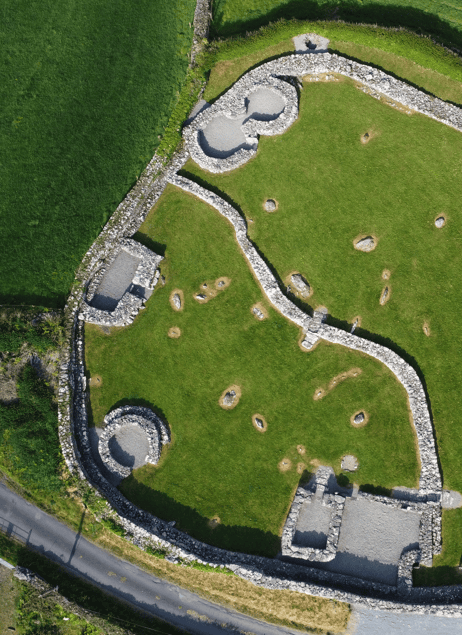
Riasc preserves the excavated plan of an early medieval ecclesiastical settlement containing an enclosure, oratory, clocháns, burials and evidence of everyday work.
Kilmalkedar presents a later and much more monumental architectural landscape.
Together, Riasc, Gallarus and Kilmalkedar give visitors a much clearer understanding of how Christian communities and religious architecture developed in West Kerry over many centuries.
Stone Building Across the Peninsula
One of the most distinctive features of West Kerry is the amount of stone construction visible throughout the landscape.
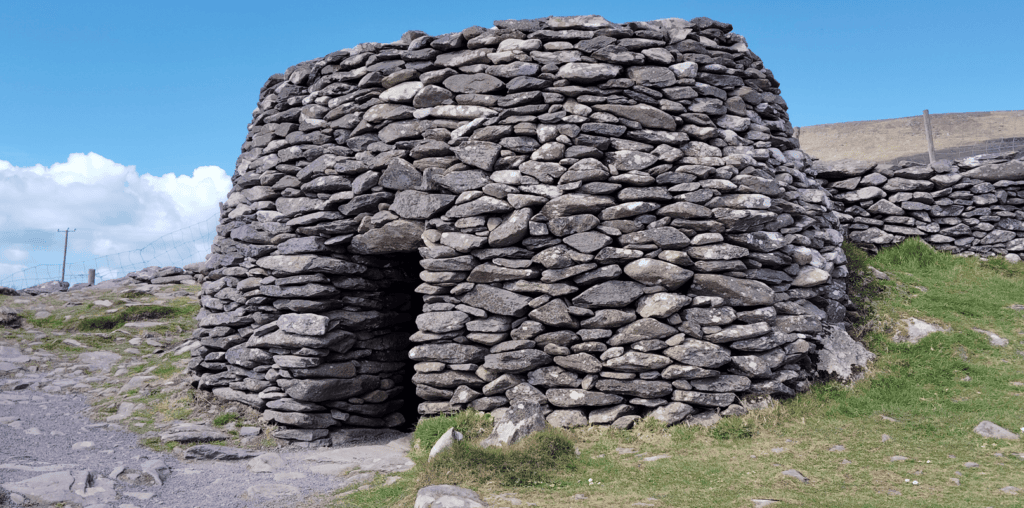
At Kilmalkedar, carefully dressed Romanesque masonry stands alongside earlier inscribed stones. Elsewhere, Fahan’s Beehive Huts demonstrate a different tradition of corbelled stone building, while forts and field walls show how extensively local stone was used for practical and defensive purposes.
The techniques differ, but together they demonstrate the extraordinary importance of stone as a building material on the peninsula.
A Living Graveyard
Kilmalkedar is not simply an archaeological display.
The church stands within a graveyard that has remained part of the local community’s burial landscape. Visitors should therefore remember that they are entering a place that combines archaeology with continuing personal and family significance.
Move respectfully around graves and monuments, avoid climbing on fragile masonry and remember that the site exists for more than tourism.
I think that continuing connection actually strengthens the experience. Kilmalkedar has not become separated completely from the community around it.
What Visitors Commonly Miss
Many people arrive, photograph the church and ogham stone, and leave.
That means they often miss the relationship between the individual monuments.
The important question is not simply, ‘What is this stone?’ It is, ‘Why are all these monuments here together?’
The ogham pillar, sundial, medieval church, graveyard and pilgrimage tradition belong to different phases of a site that remained significant over centuries.
That continuity is what makes Kilmalkedar exceptional.
Visiting Kilmalkedar Church Today
Kilmalkedar Church is a state-owned National Monument in the care of the Office of Public Works and is an unguided historic site.
The monument sits within open countryside and an active graveyard, so visitors should expect uneven ground rather than a modern purpose-built attraction.
There is limited parking near the access point. Because practical arrangements can change, particularly around smaller heritage sites, check current information before travelling if parking or mobility access is important to your visit.
Comfortable footwear is sensible, especially after rain.
How Long Should You Spend at Kilmalkedar?
For a straightforward visit, I would allow approximately 30 to 45 minutes.
That gives you enough time to examine the church, ogham stone, sundial and other features without simply walking through the graveyard.
If archaeology, architecture or photography is a particular interest, allow closer to an hour.
Kilmalkedar is one of those places where an extra ten minutes of looking closely can reveal far more than another hurried stop elsewhere.
Photography at Kilmalkedar
The church itself is naturally the strongest subject, particularly when photographed within the wider graveyard and surrounding West Kerry landscape.
The Romanesque doorway deserves closer architectural photographs, while the ogham stone can be photographed in relation to the church rather than entirely on its own.
Overcast conditions can actually work well here because softer light reveals carved details without the extreme contrast created by strong midday sun.
Please remain respectful around modern graves and avoid moving or disturbing anything for the sake of a photograph.
Kilmalkedar in Kerry Weather
The site is exposed to normal West Kerry weather, so a waterproof layer is sensible even when conditions appear settled.
Rain can make the grass and stone surfaces slippery, while strong wind changes how comfortable it is to spend time examining the monuments.
Low cloud does not affect Kilmalkedar in the same way it affects a major mountain viewpoint. In fact, softer or mistier weather can give the site a very different atmosphere.
If you are planning a wider trip around the peninsula, my guide to the best time to visit Dingle explains how the seasons can influence your overall experience.
Kilmalkedar as Part of a Dingle Peninsula Journey
Kilmalkedar fits particularly well into a wider exploration of the western peninsula.
Visitors following Slea Head Drive can experience dramatic Atlantic scenery before moving inland towards the historical landscape around Ballyferriter, Gallarus and Kilmalkedar.
This creates a much more balanced day. Slea Head provides the coastline and Blasket views, while Kilmalkedar reveals the deeper religious history hidden behind the scenery.
If this is your first visit to West Kerry, my First Trip to the Dingle Peninsula guide helps place these historical sites within a realistic wider itinerary.
Other Historical Sites Nearby
The western peninsula contains enough archaeology to justify a dedicated history-focused day.
Along with Gallarus and Riasc, you can explore the prehistoric and early historic landscape around Fahan, including the Dún Beag Promontory Fort area and the clocháns further around Slea Head.
Closer to Dingle, Garfinny Bridge provides a completely different example of how historic infrastructure and travel routes shaped life on the peninsula.
The wider Historical Sites in Kerry collection is useful if heritage and archaeology are among your main reasons for visiting the county.
Seeing Kilmalkedar with a Local Guide
Kilmalkedar is exactly the kind of place where explanation changes the experience.
Without context, you may see a ruined church, several old stones and a graveyard. Once you understand the chronology, those features become evidence for centuries of religious development.
You begin with early inscriptions and timekeeping, move through medieval Romanesque architecture and then into pilgrimage traditions and the continuing burial landscape.
If history is one of your main interests, Kilmalkedar can be incorporated into my private half-day Dingle Peninsula tour, where it can be combined naturally with other historic and scenic locations without treating each place as an isolated stop.
Continue Exploring West Kerry
Kilmalkedar is one of the best places to begin understanding the depth of West Kerry’s religious history.
Continue to Gallarus Oratory to compare a very different form of medieval church architecture, or visit Riasc to explore the archaeological remains of an earlier ecclesiastical community.
If your interests extend beyond individual monuments, the main Explore Kerry collection connects Kilmalkedar with scenic drives, towns, archaeological sites and landscapes across County Kerry.
Kilmalkedar ultimately rewards visitors who look beyond the obvious church ruin. Its greatest importance lies in the layers surrounding it: an early ogham inscription, a sundial used to organise time, a major Romanesque church, centuries of pilgrimage tradition and a graveyard that continues to connect the site with the community around it.
Frequently Asked Questions About Kilmalkedar Church
How old is Kilmalkedar Church?
The surviving Romanesque church dates from the twelfth century and was built shortly after 1134. The wider ecclesiastical site is much older, with monuments such as the ogham stone demonstrating early Christian activity centuries before the present church was constructed.
Who founded Kilmalkedar?
The site is traditionally associated with Saint Maolcethair, after whom Kilmalkedar is named. Heritage Ireland records his death in 636 AD. The site is also associated with the wider pilgrimage traditions of Saint Brendan.
What is the ogham stone at Kilmalkedar?
The ogham stone is an early inscribed pillar containing personal names represented through the distinctive stroke-based ogham writing system. It belongs to the important concentration of ogham monuments found across the Dingle Peninsula.
What is the stone sundial at Kilmalkedar?
The pillar sundial was used to measure the passage of time through the movement of a shadow cast by a projecting rod. It provides valuable evidence for how an early Christian community may have organised daily religious observance.
Is Kilmalkedar connected with Saint Brendan?
Yes, through the traditional pilgrimage landscape of the Dingle Peninsula and the Saints’ Road towards Mount Brandon. The surviving twelfth-century church itself was built many centuries after Brendan’s lifetime, so the connection should be understood as part of the wider pilgrimage tradition rather than evidence that Brendan used the present building.
How long should I spend at Kilmalkedar?
Allow around 30 to 45 minutes for a normal visit. History, architecture and archaeology enthusiasts may want closer to an hour to examine the monuments properly.
Is Kilmalkedar Church free to visit?
Kilmalkedar is a state-owned National Monument and an unguided historic site. As access arrangements can change, check current official information before travelling if you have specific requirements.
Is Kilmalkedar near Gallarus Oratory?
Yes. Both sites lie on the western Dingle Peninsula and can be visited naturally during the same wider historical journey. They are particularly useful to compare because their architecture and historical development are quite different.
What other historic sites are near Kilmalkedar?
Nearby sites include Gallarus Oratory, Riasc Monastic Settlement and the archaeological landscape around Slea Head and Fahan. Together they reveal several different phases of religious, domestic and defensive settlement in West Kerry.
Is Kilmalkedar Church worth visiting?
Yes, especially if you are interested in Irish history, early Christianity or archaeology. Few places on the Dingle Peninsula bring together an ogham stone, early Christian monuments, Romanesque architecture and pilgrimage tradition as clearly as Kilmalkedar.