The Dingle Peninsula is filled with remarkable viewpoints, but the best views are not confined to one famous stretch of road. From the Atlantic coastline of Slea Head Drive to the mountains around Conor Pass, the peninsula continually changes as you travel from south to north and from sheltered bays to the open Atlantic.
The Best Coastal Views and Viewpoints Around the Dingle Peninsula
One of the things I enjoy most about showing visitors around the Dingle Peninsula is watching how quickly the landscape changes. You can leave Dingle beside a sheltered harbour, cross open farmland, look towards the Blasket Islands from the western coast and later find yourself high among the mountains with completely different views across West Kerry.
Some viewpoints are well known and easy to reach. Others are simply places where the landscape opens unexpectedly as you travel. You do not necessarily need a long hike to enjoy them, although walkers and photographers can certainly find even more if they have the time.
This guide brings together some of the viewpoints I think best demonstrate the variety of the peninsula. If this is your first visit, my guide to planning your first trip to Dingle is also useful for understanding how these places can fit into a wider stay.
Slea Head Drive
For most first-time visitors, Slea Head Drive provides the greatest concentration of coastal viewpoints on the Dingle Peninsula.
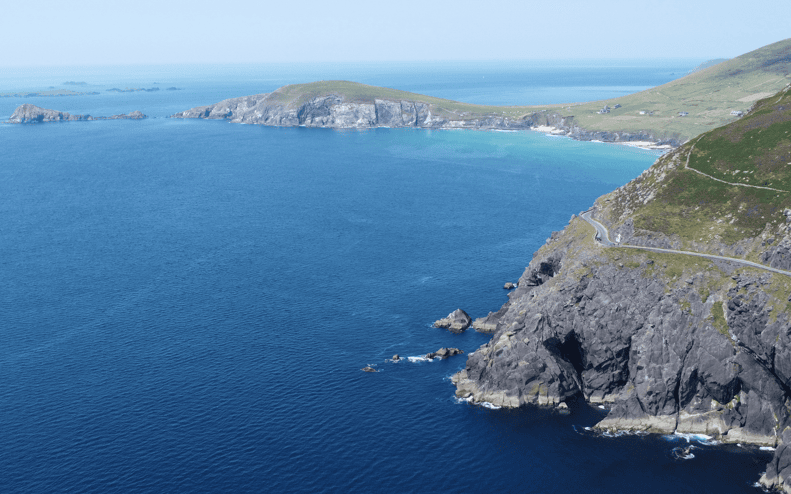
The road follows the western edge of Corca Dhuibhne, where the mountains and traditional stone-walled fields descend towards the Atlantic. Rather than one single viewpoint, the appeal comes from a succession of changing perspectives as the road winds around the coast.
At different points you can look across towards the Blasket Islands, back along the peninsula or directly out over the open Atlantic. The view can change dramatically within only a few minutes of driving.
If you are trying to decide whether to prioritise this route during a short visit, I have also looked at the question in detail in Slea Head Drive Worth It?
The Blasket Islands Viewpoints
Few views are more closely associated with the western Dingle Peninsula than the Blasket Islands sitting beyond the mainland.
What makes them particularly interesting is that you do not see them from only one position. As you travel around Slea Head, their relationship with the mainland continually changes. Islands that appear grouped together from one location can become clearly separated when viewed from somewhere else along the coast.
The scenery becomes considerably more meaningful when you know something about the people who once lived there. Great Blasket supported an Irish-speaking community whose writers left behind an extraordinary literary record of island life.
If the islands capture your interest, my history of the Blasket Islands provides more background, while the Blasket Islands Visitor Guide looks at the islands from a visitor’s perspective.
Coumeenoole and the Western Atlantic
Coumeenoole is one of those places where the scale of the Atlantic landscape becomes immediately apparent.
The small beach sits beneath steep coastal slopes near the western end of the peninsula. From the surrounding higher ground, the combination of cliffs, beach, Atlantic Ocean and offshore islands creates one of the classic landscapes of West Kerry.
It is also a good example of why I would not judge a viewpoint purely by how far you can see. Some of the best views on the peninsula come from the relationship between nearby features rather than enormous panoramas.
The sea here can be extremely powerful. Visitors should enjoy the coastline with respect for conditions rather than treating the beach as an ordinary sheltered swimming location.
Dún Chaoin and Dunquin
Dún Chaoin provides some of the most recognisable views on the Dingle Peninsula.
The winding descent towards Dunquin Pier is probably the best-known photograph, but there is considerably more to the surrounding landscape. The mainland falls steeply towards the Atlantic, the Blasket Islands sit offshore and the coastline continues around towards the westernmost settlements of the peninsula.
The pier is also historically significant because of its relationship with the Blasket community. Boats travelling between the islands and mainland used Dún Chaoin as an essential connection with the rest of the peninsula.
The nearby Blasket Centre is one of the best places to understand that relationship before or after looking across towards the islands themselves.
Ceann Sibéal and the Three Sisters
As you move around the western peninsula towards Ballyferriter and Clogher, the shape of the landscape changes again.
Ceann Sibéal and the Three Sisters become dominant features, creating a very different view from the exposed seascapes around Slea Head and Dún Chaoin.
This part of the peninsula is particularly rewarding because the mountains, headlands and Atlantic coastline overlap visually. Depending on the weather, sunlight can move across individual sections of the landscape while surrounding areas remain under cloud.
Ceann Sibéal also became internationally recognisable through its connection with Star Wars: The Last Jedi. If you are interested in the filming story, my Star Wars in Dingle guide explains more about the peninsula’s role in the production.
Clogher and the North-Western Coast
The Clogher area offers a different type of Atlantic scenery again.
Here the coastline feels particularly exposed, with Atlantic swell meeting the shore beneath the surrounding headlands. The combination of sea, beach, offshore features and the rising ground behind Clogher makes this one of my favourite areas for simply watching the landscape.
It can be especially impressive when Atlantic conditions are energetic, although visitors should always remain well back from exposed coastal edges and respect the sea.
Clogher also demonstrates something important about exploring the Dingle Peninsula: the most famous photograph is not always the best experience. Sometimes stopping and watching the weather and sea for a few minutes is more memorable than arriving simply to reproduce a photograph you have already seen online.
Conor Pass
The western coastline may receive most of the attention, but Conor Pass provides an entirely different perspective on the Dingle Peninsula.
Instead of looking from the land towards the Atlantic, you are high within the mountains looking across valleys, lakes and towards the coastline beyond.
The pass crosses the Brandon Mountains between Dingle and the northern side of the peninsula. On a clear day, the elevated position provides extensive views, while cloud and mist can transform the atmosphere completely.
Conor Pass is also a reminder that the Dingle Peninsula is not simply a coastal destination. Mountains form much of its character, influence its weather and historically affected how communities travelled between different parts of the peninsula.
The road is narrow in places and requires considerably more concentration than an ordinary main road. Visitors who are uncomfortable with narrow mountain driving should not feel that they have to include it simply because it appears on a list of attractions.
The Lakes Below Conor Pass
Some of the most striking scenery around Conor Pass comes from the contrast between steep mountain slopes and the small glacial lakes below.
These views feel completely different from Slea Head. There are no Blasket Islands and no broad Atlantic beaches dominating the scene. Instead, the landscape is enclosed by rock, mountain and water.
This is one of the reasons I recommend seeing more than Slea Head if you have sufficient time. The western coast may be the peninsula’s most famous landscape, but it represents only one part of Corca Dhuibhne.
Brandon and the Northern Peninsula
Travel beyond Conor Pass and the northern side of the peninsula opens towards Brandon Bay and the mountains surrounding Mount Brandon.
This is a quieter landscape than the busiest sections of Slea Head Drive. Broad views across the bay, mountain slopes and smaller communities give this part of the peninsula its own identity.
Mount Brandon dominates much of the northern landscape. Its presence can be felt from numerous locations rather than from one designated viewpoint, and the appearance of the mountain changes considerably according to cloud and light.
For visitors who have already experienced Slea Head, the northern peninsula is one of the best ways to discover that there is much more to this area than its most famous coastal loop.
Dingle Harbour and Dingle Bay
You do not need to travel to the far western end of the peninsula for a worthwhile view.
Dingle itself occupies an attractive position beside its harbour, with the surrounding hills and mountains providing the backdrop. Boats, fishing vessels and changing tides mean the scene is rarely exactly the same twice.
The harbour also provides geographical context. Looking out from Dingle helps explain why the town developed where it did and how closely its history has been connected with the sea.
It is worth spending some time enjoying Dingle itself rather than using the town only as somewhere to sleep before driving elsewhere. My guide to things to do in Dingle provides more ideas for exploring the town and surrounding peninsula.
Eask Tower and the View Over Dingle Bay
For visitors willing to walk for their view, Eask Tower offers a completely different perspective over Dingle Harbour and Dingle Bay.
The tower stands on Carhoo Hill on the southern side of the harbour. From the elevated landscape around it, the view looks back towards Dingle and across the entrance to the bay.
Unlike a roadside viewpoint, this is somewhere you earn the view by walking uphill. That also makes the experience feel different. You have time to watch the landscape gradually open as you gain height.
As with any outdoor walk in Kerry, conditions matter. Suitable footwear and sensible clothing are important, and visibility can change quickly.
Inch and the Eastern Dingle Peninsula
At the opposite end of the peninsula, Inch provides another completely different landscape.
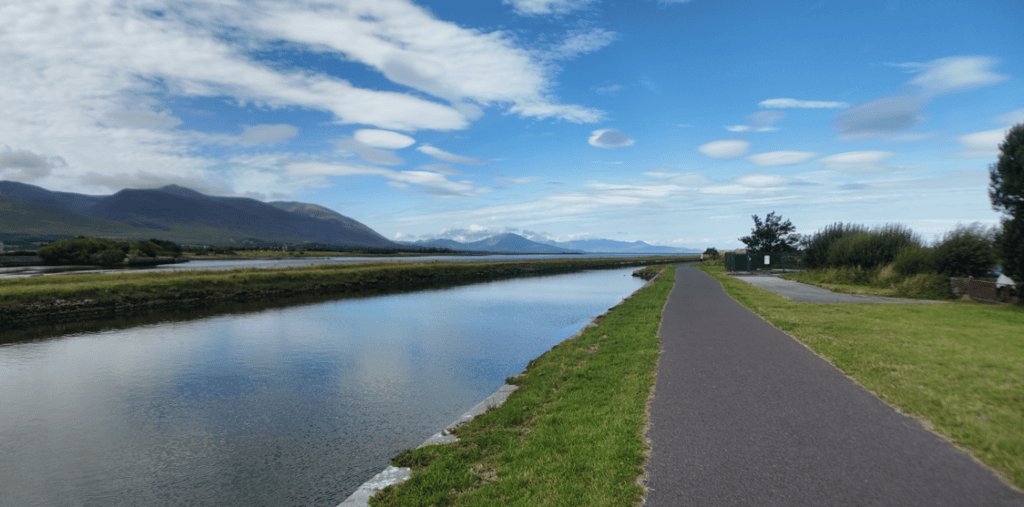
The long strand stretches into Dingle Bay, with mountain scenery rising around the surrounding coastline. The scale is very different from the small coves and tight headlands of the western peninsula.
Inch is particularly useful for understanding the wider geography of Kerry because the view extends beyond the immediate beach towards the landscapes surrounding Dingle Bay.
If you are travelling between Dingle and Killarney, it also makes a natural scenic stop rather than requiring a major detour.
Minard and the Southern Coast
The southern side of the peninsula is sometimes overlooked by visitors concentrating on Slea Head, but it contains some beautiful coastal scenery of its own.
Minard combines a sheltered coastal setting with the ruins of Minard Castle, creating a landscape where history and scenery sit naturally together.
The castle itself has an important place in the history of the peninsula, and the surrounding coastline offers a very different atmosphere from the exposed western Atlantic edge.
If you enjoy finding places where historical sites remain strongly connected with their surrounding landscape, this part of the peninsula is particularly rewarding.
When Are Dingle Peninsula Viewpoints at Their Best?
There is no single answer because the character of these viewpoints changes with the season, weather and time of day.
Clear conditions are obviously useful when you want long-distance views towards islands and mountains. However, I would not assume that perfectly blue skies are always necessary.
Broken cloud can produce some of the most interesting conditions, particularly when sunlight moves across the Atlantic or briefly illuminates one headland while another remains in shadow.
Likewise, a little mist around the mountains can give the northern peninsula a completely different atmosphere.
If you are deciding when to travel, my guide to the best time to visit Dingle looks more broadly at how the seasons affect a visit to the peninsula.
Best Dingle Peninsula Viewpoints for Photography
If photography is your priority, I would avoid trying to collect every viewpoint in one day.
Slea Head, Dún Chaoin, the Blasket views, Clogher and Conor Pass could each produce very different photographs depending on weather and light. Trying to rush between all of them can mean spending more time driving than actually observing the landscape.
The best approach is often to choose a smaller number of locations and allow conditions to influence how long you remain there.
Remember that the peninsula is a living landscape rather than a collection of photography platforms. Roads, farm entrances and private land need to remain accessible, and a photograph is never worth creating a traffic obstruction or entering somewhere without permission.
Can You See the Best Viewpoints in One Day?
You can experience many of the Dingle Peninsula’s major landscapes in a day, but I would distinguish between seeing them and properly exploring them.
If you have one day, concentrating on Slea Head gives you an exceptional combination of Atlantic coastline, islands and historic landscape without spending the entire day chasing locations.
If you have longer, you can add Conor Pass, the northern peninsula, Inch and other areas at a much more comfortable pace.
My One Day in Dingle guide is useful if you are working with a tight schedule, while the 3-Day Dingle Itinerary shows how much more can be experienced when you slow the pace down.
Driving the Dingle Peninsula for the Views
If you are driving independently, do not measure your day purely by kilometres. Distances around the peninsula can look short on a map, but narrow roads, traffic, photography stops and simply wanting to spend time somewhere can make journeys considerably slower than expected.
On Slea Head, I recommend following the normal clockwise flow. My Slea Head Drive Route Guide explains the route and practical considerations in more detail.
Conor Pass requires a different type of driving again. If narrow mountain roads make you uncomfortable, there is nothing wrong with choosing an alternative route.
The objective should be to enjoy the peninsula, not to prove that you managed to drive every scenic road on a list.
See the Dingle Peninsula with a Local Guide
If you would rather concentrate on the scenery than the road, exploring with a local guide allows everybody in your group to enjoy the views.
I personally guide my private tours for groups of up to four guests, and one of the advantages of the small private format is flexibility. If visibility is particularly good somewhere, or photography is important to you, I can take that into account when planning the experience.
For visitors primarily interested in the western coastline, my Slea Head Drive private tour concentrates on the peninsula’s most famous coastal landscapes while adding the history and local stories behind what you are seeing.
Visitors who want to understand the wider area can also explore the rest of my Explore Kerry travel guide, which connects the Dingle Peninsula with destinations across County Kerry.
Frequently Asked Questions About Dingle Peninsula Viewpoints
What is the best viewpoint on the Dingle Peninsula?
There is no single viewpoint that represents the entire peninsula. For Atlantic scenery and the Blasket Islands, the Slea Head and Dún Chaoin area is difficult to beat. For mountain scenery, Conor Pass provides a completely different experience.
Where can I see the Blasket Islands?
There are several views towards the Blasket Islands around the western Dingle Peninsula, particularly along Slea Head Drive and around Dún Chaoin. The changing perspective as you travel is part of what makes the route interesting.
Is Conor Pass worth visiting for the views?
When visibility is good, Conor Pass provides some of the peninsula’s finest mountain scenery. However, the road is narrow and can be uncomfortable for nervous drivers, particularly in poor weather.
Do I need to hike to see good views?
No. Many excellent Dingle Peninsula viewpoints can be enjoyed from or close to the road. Walks such as Eask Tower can provide elevated perspectives, but hiking is not essential for enjoying the peninsula’s scenery.
What is the best scenic drive on the Dingle Peninsula?
Slea Head Drive is the best-known scenic route and the one I would prioritise for most first-time visitors. Conor Pass provides a very different mountain-driving experience and can complement Slea Head when you have enough time.
Can I see Slea Head and Conor Pass on the same day?
Yes, it can be done, but how enjoyable it is depends on how much stopping and exploring you want to do. If you enjoy photography, walking or historical sites, allowing more time will produce a much more relaxed experience.
What should I bring when visiting viewpoints in Kerry?
A light waterproof layer and comfortable footwear are sensible even when the weather looks settled. Conditions can change quickly, particularly around exposed coastal and mountain locations.
Are the viewpoints suitable for photography?
Yes. The Dingle Peninsula offers an exceptional range of coastal, island, mountain and rural landscapes. The best photographic conditions depend on light and weather rather than simply reaching a particular viewpoint.
Is Slea Head better than Conor Pass?
They are too different for a direct comparison. Slea Head is primarily an Atlantic coastal experience, while Conor Pass is a mountain landscape. If this is your first visit and you can choose only one, I would normally prioritise Slea Head because of the combination of scenery, history and culture along the route.
Can I visit the Dingle Peninsula viewpoints on a private tour?
Yes. A private tour is particularly useful if you want everybody in your group to enjoy the scenery rather than having one person concentrate on driving. It also allows the route and stops to be adjusted around your interests, weather and conditions on the day.