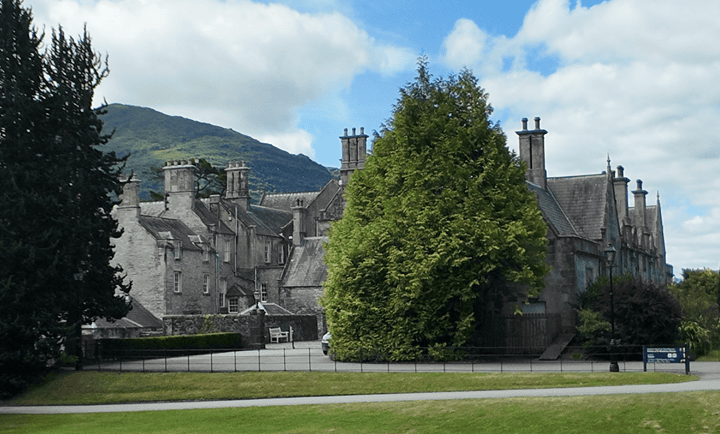
Muckross House stands beside Muckross Lake in Killarney National Park and is one of the most important historic houses in County Kerry.
The present house was built between 1839 and 1843 for Henry Arthur Herbert and his wife, the watercolourist Mary Balfour Herbert. Designed by Scottish architect William Burn, it later hosted Queen Victoria, became home to the Bourn Vincent family and ultimately formed the centre of the estate gifted to the Irish State in 1932—the beginning of what became Ireland’s first National Park.
For visitors today, Muckross is really several experiences in one place.
You can explore the nineteenth-century house, walk through historic gardens free of charge, visit the separate Muckross Traditional Farms, continue towards Muckross Abbey or simply spend time beside the lake.
Understanding those different options makes it much easier to decide how long you should allow.
What Is Muckross House?
Muckross House is a nineteenth-century country house built for the Herbert family, who had occupied successive houses at Muckross for almost two centuries.
Henry Arthur Herbert commissioned the present house with his wife, Mary Balfour Herbert, and construction began in 1839.
The architect was William Burn, a prominent Scottish architect known for country houses and estate buildings.
The house was completed in 1843.
It originally appears to have been intended as a larger and more elaborate building. Plans for an expanded servants’ wing, stable block, orangery and summer house were reduced, reportedly at Mary’s request.
That detail is useful because Muckross should not simply be viewed as a grand Victorian mansion.
It was a family home, an estate headquarters and a workplace supporting a substantial household and surrounding lands.
Henry Arthur and Mary Balfour Herbert
The Herbert family had a long connection with Muckross before the present house was constructed.
Henry Arthur Herbert was a member of the Anglo-Irish landed class, while Mary Balfour Herbert was an accomplished watercolourist.
Mary’s role is worth remembering because the story of Muckross is too often reduced to the men who owned the estate.
The official history suggests she may have influenced changes to William Burn’s original plans for the house, while her surviving artistic work provides another window into nineteenth-century Muckross.
Together, Henry and Mary created the house and began developing the gardens visitors recognise today.
Inside a Victorian Country House
The interior of Muckross House is presented in period style to help visitors understand the lifestyle of a nineteenth-century landowning family.
That wording matters.
The experience should not be interpreted as every room surviving exactly as it appeared in the Herbert period with all original furniture intact.
Instead, the rooms have been furnished and interpreted to represent the character and social world of the Victorian country house.
The principal rooms reveal the more formal side of estate life.
Visitors can consider how guests were received, how family status was expressed and how houses of this scale were designed for both private living and public display.
But the lower parts of the building are just as interesting.
Upstairs and Downstairs at Muckross
A house such as Muckross depended on a large amount of work that visitors to the formal rooms were never expected to see.
The basement areas help explain that hidden part of estate life.
Servants prepared food, maintained fires, cleaned rooms, carried supplies and kept the household functioning.
That creates an important contrast.
Upstairs, the house represented wealth, hospitality and status.
Downstairs, staff supported the daily operation that made that lifestyle possible.
Looking at both sides gives a much more complete picture of nineteenth-century Muckross than concentrating solely on furniture and decoration.
Queen Victoria’s Visit to Muckross House
One of the best-known episodes in the house’s history came in August 1861, when Queen Victoria visited Killarney and spent two nights at Muckross House as a guest of the Herbert family.
The visit required extensive preparation.
During the years leading up to her arrival, the gardens and estate were carefully improved. Paths were opened through the grounds, seating and viewing areas were created and additional late-summer flowering plants were introduced.
The royal visit has sometimes attracted exaggerated stories about its financial consequences for the Herbert family.
It is safer to treat it for what the evidence clearly establishes: a major social event in the history of Muckross that influenced the presentation and development of the estate.
The Gardens During the Great Famine
The history of Muckross Gardens also intersects with one of the darkest periods in Irish history.
The present gardens began taking shape after completion of the house in 1843, just before the Great Famine.
Official Muckross research states that the garden works may have provided paid employment during the Famine years.
A local newspaper reported in April 1846 that an additional fifty men were being employed at Muckross at increased wages, apparently working on the construction of garden terraces.
The evidence supports a cautious conclusion.
It would be too strong to describe the entire garden as a formal Famine-relief project.
But contemporary records suggest that estate improvements provided at least some local employment during an extraordinarily difficult period.
The Bourn Vincent Family
Muckross entered another important phase during the early twentieth century.
In 1910 the estate was leased to wealthy American industrialist William Bowers Bourn.
His daughter Maud subsequently married Arthur Rose Vincent, and Bourn purchased Muckross as a wedding gift for the couple.
Maud and Arthur made Muckross their family home.
Between 1911 and 1932, the Bourn Vincent period brought substantial investment to the estate.
More than £110,000 was spent on improvements, an enormous sum at the time.
The gardens in particular were transformed.
Muckross Gardens
The gardens should not be treated merely as attractive surroundings to the house.
They have their own history.
The Herbert family began developing them during the nineteenth century, including major work in preparation for Queen Victoria’s visit.
Later, the Bourn Vincent family created several of the features visitors can still explore today.
These include the:
- Sunken Garden
- Rock Garden
- Stream Garden
The Sunken Garden was developed in 1915 to designs associated with Wallace & Co. of Colchester, while the Rock Garden used a natural limestone outcrop. The Stream Garden was developed partly to improve drainage through the southern grounds.
What Flowers and Plants Can You See?
Muckross is particularly well known for its collections of rhododendrons and azaleas.
Historical accounts were already praising these plants during the nineteenth century, and many varieties continue to produce strong displays from spring into early summer.
Hydrangeas are another long-established feature.
Muckross hydrangeas won first prize at the Tralee Flower Show in 1868, and the present Hydrangea Border remains one of the garden’s notable late-summer displays.
There are also camellias, mature trees, an arboretum and planting associated with the Stream and Rock Gardens.
For visitors primarily interested in gardens, the experience changes noticeably through the year.
How Muckross Became Ireland’s First National Park
This is one of the most important parts of the Muckross story.
Muckross House is not simply an old mansion that happens to stand inside Killarney National Park.
The estate was fundamental to the creation of the park itself.
The Bourn Vincent estate was presented to the Irish State in 1932 as the Bourn Vincent Memorial Park.
National Parks of Ireland describes this gift as Ireland’s first National Park, while official educational material records the establishment of the park from 1 January 1933.
Killarney National Park later expanded far beyond the original Muckross estate.
Today it covers around 10,000 hectares and includes mountains, lakes, native woodland, waterfalls and historical sites including Ross Castle, Muckross Abbey and Killarney House.
That makes Muckross nationally significant.
The estate did not simply become part of a National Park.
It helped create Ireland’s first one. The wider Killarney National Park guide explains how the estate fits into the park’s larger landscape.
Muckross House or Muckross Traditional Farms?
Visitors sometimes assume the House and Traditional Farms are one attraction.
They are separate experiences.
Muckross House
Choose the House if you are interested in:
- Victorian interiors
- architecture
- the Herbert family
- Queen Victoria
- estate life
- the origins of Killarney National Park
Muckross Traditional Farms
Choose the Traditional Farms if you are more interested in:
- rural Irish life
- traditional farming
- farm animals
- crafts
- domestic life
- family-friendly activities
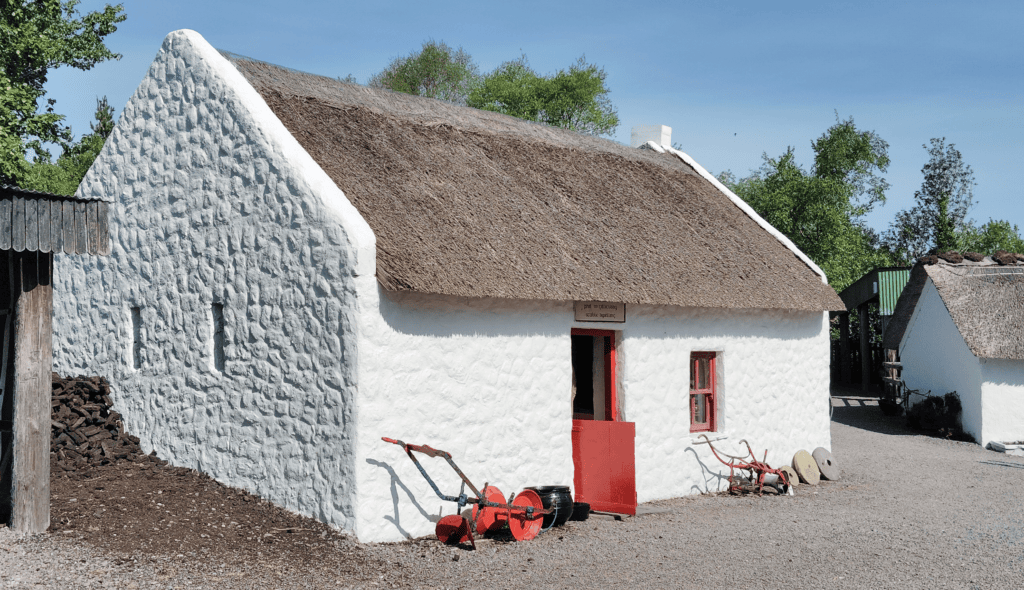
The Traditional Farms recreate aspects of rural Irish life in the 1930s and 1940s, with small, medium and large farm holdings, a labourer’s cottage, carpenter’s workshop, blacksmith’s forge and schoolhouse. Visitors can also encounter farm animals and demonstrations such as traditional bread and butter making.
Should You Visit Both?
If you have half a day and both social history and rural life interest you, yes.
If time is limited, choose according to your interests rather than rushing through both.
Visitors interested in comparing different interpretations of rural life may also find the Kerry Bog Village useful when travelling around the Ring of Kerry.
Visiting Muckross House Today
Admission to Muckross House is currently by self-guided tour only.
No advance booking is required for ordinary individual visitors; tickets can be purchased on arrival. Groups of twenty or more require advance arrangements.
This makes the visit relatively flexible.
You can explore the house at your own pace rather than being tied to a scheduled guided tour.
Muckross House Opening Hours
For 2026, current house hours are:
- January–March: 9.15am–5.30pm
- April–June: 9.15am–6pm
- July–August: 9.15am–7pm
- September–October: 9.15am–6pm
- November–December: 9.15am–5.30pm
Last admission is earlier than closing and varies by season.
Opening arrangements can change, so check Muckross House directly before making a special journey.
Muckross House Tickets
Current 2026 admission to Muckross House is:
- Adult: €9
- Senior or student: €7.50
- Child aged 3–5: free
- Child aged 6–18: €6
- Family 2+2: €26
- Family 2+3: €30
Joint House and Traditional Farms tickets are also available.
There is no admission charge for Killarney National Park or Muckross Gardens.
That distinction is useful if you want to visit the estate but do not have time for the house interior.
When Are Muckross Traditional Farms Open?
The Farms operate on a more seasonal schedule than the House.
For 2026, they are currently listed as:
- Mid-March: weekends
- April and October: weekends and Bank Holidays
- May and September: daily
- June–August: daily
- November–February: closed
If the Farms are an important part of your visit, check the current schedule rather than assuming they operate year-round.
How Long Should You Allow?
The answer depends entirely on what you intend to see.
House Only
Allow approximately 60–90 minutes for a comfortable self-guided visit.
House and Gardens
Allow roughly 2–3 hours.
House, Gardens and Traditional Farms
Allow at least half a day.
House, Gardens and Muckross Abbey
Again, allow a half day if you want to walk rather than rush.
Muckross can easily occupy much more time than visitors expect because the attractions are spread across a large estate.
Is Muckross House Worth Going Inside?
If you are interested in architecture, Victorian history or social history, yes.
The interior gives context that you cannot get from the gardens alone.
You begin to understand who lived here, how the house functioned and the contrast between formal family rooms and working service areas.
If your visit to Killarney is extremely short and your main priority is landscape, you may reasonably choose to spend your time outdoors instead.
The gardens and National Park can still be enjoyed without purchasing house admission.
There is no single correct choice.
Accessibility
Muckross House and Traditional Farms are described as mostly accessible, but these are historic sites and there are limitations.
The House includes stairs and challenging steps, while some areas of historic buildings are naturally harder to adapt.
A transit wheelchair is available for use within Muckross House.
Visitors with specific mobility requirements should check the latest accessibility arrangements directly before travelling.
The gardens provide a broader outdoor experience, but individual paths and walking distances should still be considered according to mobility.
Parking at Muckross House
Parking within Killarney National Park is free.
Muckross House and Gardens have several parking areas, including a large car park close to Muckross School House that can accommodate larger vehicles such as campervans.
Current National Park information lists access to the Muckross car park between 8am and 9pm and states that overnight parking or camping is not permitted.
Once parked, I would leave the vehicle there and explore the estate on foot.
Facilities
Muckross has considerably more visitor infrastructure than many historical attractions in Kerry.
Current facilities include:
- parking
- toilets, including accessible facilities
- baby-changing facilities
- restaurant
- craft shopping
- visitor information
- the separate House and Traditional Farms attractions
That makes it particularly practical for families and for visitors spending several hours in the National Park.
Walking Around Muckross
Do not feel that you need to leave immediately after seeing the house.
Several of Killarney National Park’s walking routes connect with the wider Muckross area.
A 5 km Lakeside Walk runs towards Muckross House with the option of visiting Muckross Abbey, while the Old Boathouse Trail is approximately 1 km and leads towards Dundag Point and Dundag Beach with views across the Killarney lakes.
These shorter walks can add considerably more to the visit than simply moving from the house back to the car park.
Muckross Abbey
Muckross Abbey is one of the strongest historical sites to combine with the House.
The two attractions tell very different stories.
Muckross House represents nineteenth-century estate life.
The Abbey takes you back centuries earlier to the Franciscan history of Killarney.
If history is one of your main interests, combining them makes much more sense than treating them as unrelated sightseeing stops. The detailed Muckross Abbey guide explains the foundation, architecture and later history of the friary.
Torc Waterfall
Torc Waterfall is another natural continuation of a Muckross visit.
It lies within Killarney National Park and can be combined with the House as part of a broader day exploring the Muckross and Torc area.
During busy periods, however, parking and traffic around Torc can become congested.
Walking or using another suitable transport option within the park can sometimes be more pleasant than repeatedly moving the car.
Ross Castle
Ross Castle belongs to another part of Killarney National Park but pairs naturally with Muckross from a historical perspective.
Ross is a fifteenth-century Gaelic tower house.
Muckross is a nineteenth-century country estate.
Seeing both helps demonstrate how dramatically power, architecture and society changed in Kerry over several centuries.
When Is the Best Time to Visit Muckross?
Every season offers something different.
Spring
Spring is particularly good for rhododendrons and azaleas, with displays developing from April onwards.
Summer
The gardens are at their most active, days are long and the Traditional Farms operate daily.
This is also the busiest period.
Late Summer
Hydrangeas become particularly noticeable and provide one of the estate’s characteristic seasonal displays.
Autumn
The woodland and gardens change colour and the estate can feel considerably quieter.
Winter
Muckross House continues to operate, but the Traditional Farms are closed from November through February under the current 2026 schedule.
If gardens are your main reason for visiting, spring through early autumn generally provides the widest variety.
Is Muckross House Good for Families?
Yes, although families should choose the experience that best matches the age and interests of the children.
Older children interested in history may enjoy exploring the House.
Younger children may find the Traditional Farms more immediately engaging because they include animals, working buildings and demonstrations of rural life.
The gardens and park also provide plenty of space to balance indoor visits with time outside.
You do not necessarily need to take young children through every part of the House to have a worthwhile Muckross visit.
Is Muckross House Worth Visiting?
Yes—particularly if you want to understand Killarney rather than simply drive through its scenery.
Muckross brings together several different layers of history.
The House tells the story of nineteenth-century landowners and servants.
The gardens reveal changing ideas about estate design and horticulture.
Queen Victoria’s visit connects Muckross with Victorian society at its most ceremonial.
The Traditional Farms interpret a very different form of Irish rural life.
And the estate’s donation to the State explains how Ireland’s first National Park began.
That is what makes Muckross significant.
It is not simply a large house beside a lake.
What Else Is Nearby?
Muckross sits within one of the richest concentrations of attractions in Killarney National Park.
Strong nearby choices include:
Muckross Abbey
For medieval and Franciscan history.
Torc Waterfall
For a short woodland and waterfall experience.
Muckross Lake
For walking and lakeside scenery.
Dinis
For longer exploration around the lake.
Ross Castle
For Gaelic medieval history.
Killarney Town
Killarney Town provides the main accommodation, restaurant and transport base for exploring the National Park.
You do not need to visit everything in one day.
Choose according to your interests and leave enough time to enjoy the places you do select.
Continue Exploring Killarney and the Ring of Kerry
Muckross House can form the centre of a full day in Killarney National Park or the beginning of a longer journey through southwest Kerry.
From Muckross, the scenic road continues towards Ladies View and Moll’s Gap before meeting the Ring of Kerry.
The guide to the top sites on the Ring of Kerry can help visitors choose the strongest onward stops without attempting to fit the entire peninsula into an already full Muckross day.
If you are deciding whether to spend more time in this part of Kerry or on the western peninsula, the comparison of Dingle and Killarney explains the different experiences offered by each base.
Steve’s Peninsula Tours’ private Killarney National Park tour can combine Muckross House and Gardens with selected historical and landscape stops, with the route adjusted around the interests and walking ability of the group.
Frequently Asked Questions About Muckross House
When was Muckross House built?
Construction began in 1839 and was completed in 1843 for Henry Arthur Herbert and Mary Balfour Herbert.
Who designed Muckross House?
The house was designed by Scottish architect William Burn.
Did Queen Victoria stay at Muckross House?
Yes. Queen Victoria stayed at Muckross House for two nights during her visit to Killarney in August 1861.
Can you go inside Muckross House?
Yes. The house is currently visited by self-guided tour.
Do you need to book Muckross House in advance?
Ordinary individual visitors currently do not need to pre-book. Tickets are purchased on arrival. Large groups require advance arrangements.
Are Muckross Gardens free?
Yes. There is currently no charge to enter Killarney National Park or Muckross Gardens.
How long do you need at Muckross House?
Allow around 60–90 minutes for the House alone and roughly 2–3 hours if including the gardens. A visit including the Traditional Farms can easily take half a day.
What are Muckross Traditional Farms?
They are a separate visitor attraction interpreting rural Irish life of the 1930s and 1940s through farmhouses, workshops, animals and traditional activities.
Are Muckross House and Traditional Farms the same ticket?
They have separate admission charges, although joint tickets are currently available.
Is there parking at Muckross House?
Yes. Parking within Killarney National Park is free, and several car parks serve Muckross House and Gardens.
Is Muckross House accessible?
The site is mostly accessible, but the historic House includes challenging steps and stairs. Visitors with mobility requirements should check current arrangements before travelling.
Why is Muckross House important to Killarney National Park?
The Muckross estate was presented to the State in 1932 as the Bourn Vincent Memorial Park and became the foundation of Ireland’s first National Park.