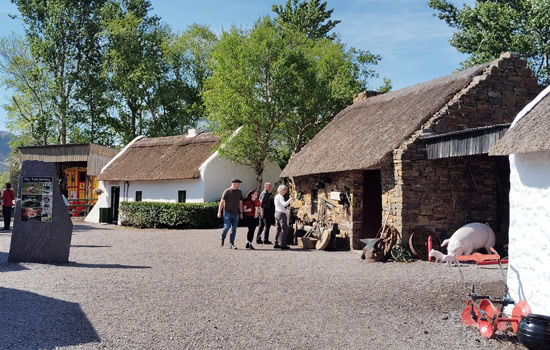
The Kerry Bog Village, between Killorglin and Glenbeigh on the Ring of Kerry, offers something quite different from the castles, grand houses and dramatic viewpoints found elsewhere around the route. Its focus is the everyday lives of ordinary rural families, using period thatched cottages, domestic interiors, farm equipment and traditional animals to interpret life in nineteenth-century Kerry.
For visitors interested in Irish social history, it provides useful context for understanding how generations of people lived and worked in a landscape shaped by farming, peat bogs and limited resources.
What Is the Kerry Bog Village?
Kerry Bog Village is an open-air heritage attraction recreating aspects of rural Irish life during the nineteenth century, including the difficult years surrounding the Great Famine and the decades that followed.
The village contains period thatched cottages furnished with antiques, interpretive displays and examples of equipment once used by farmers and turf cutters. Rather than concentrating on famous historical figures, the experience looks at domestic life, work and the practical realities of surviving in rural Ireland.
That is what makes it an interesting complement to places such as Muckross House or Ross Castle. There, much of the surviving story concerns landowners, estates and political power. At Kerry Bog Village, the emphasis is on people who cooked over turf fires, worked the land and raised families in comparatively simple homes.
Life in a Traditional Kerry Cottage
The cottages are perhaps the most memorable part of a visit.
Their interiors help visitors understand how much of family life once took place within a small number of rooms. Furniture and household objects were practical rather than decorative, heating and cooking revolved around the fire, and possessions were far fewer than most of us would consider normal today.
Walking through these spaces gives scale to something that can be difficult to appreciate from a history book. The cottages were not quaint holiday homes; they represent a way of life in which the house, farm, livestock and surrounding landscape were closely connected.
The attraction uses authentic antiques together with displays, figures and sound effects to interpret the period. Look beyond the general appearance of each room and consider the individual objects: where food was prepared, how a family kept warm, where people slept and how little separation there could be between domestic work and farm life.
Turf Cutting and Kerry’s Boglands
The surrounding bog landscape is an important part of the story.
For generations, peat – usually called turf in Ireland – was cut from bogs and dried for use as domestic fuel. At Kerry Bog Village, historic farming and turf-cutting equipment helps explain how local families worked these landscapes and how important turf was for heating homes and preparing food.
Cutting turf was physically demanding and closely connected with the seasons. Once cut, it had to be turned, dried and transported before it could be stored for winter. The work required knowledge of the bog and cooperation between family members.
Today we understand peatlands differently as well. Ireland’s bogs are valuable natural habitats and significant stores of carbon, so the historical relationship between people and bogland provides an interesting contrast with modern conservation.
Understanding both perspectives makes the landscape more meaningful as you continue through the Iveragh Peninsula. Stretches of bog that can initially appear empty were once working landscapes connected with fuel, farming and survival.
The Kerry Bog Pony
One of the most distinctive residents of the village is the Kerry Bog Pony, a small native Irish breed particularly associated with County Kerry.
These hardy ponies were traditionally used as pack and cart animals, carrying turf and other loads across difficult ground. Their relatively small size, strength and ability to travel across soft terrain made them useful in a landscape where larger animals could struggle.
Mechanisation and changes in rural farming brought the breed close to disappearing during the twentieth century. A conservation effort beginning in the 1990s helped rebuild the population, and visitors can now see Kerry Bog Ponies at the village.
They are more than simply an attraction for children. The ponies provide another connection with how people once worked, transported materials and travelled through rural Kerry.
What Will You See?
A visit is self-guided, allowing you to move between the cottages, traditional equipment and outdoor displays without following a fixed guided-tour schedule.
The interest lies in the details: domestic interiors, old farming implements, methods of turf working and the contrast between different aspects of nineteenth-century rural life. The village also keeps Kerry Bog Ponies and Irish Wolfhounds, adding another dimension to the experience.
It works particularly well for visitors who enjoy social history because the emphasis is not simply on looking at old buildings. The displays help explain how people actually lived within them.
As parts of the attraction are outdoors, bring a waterproof layer in unsettled weather. Comfortable footwear is also sensible, particularly after rain.
Is Kerry Bog Village Worth Visiting?
I think Kerry Bog Village is most worthwhile when you treat it as a heritage stop rather than simply another attraction to tick off the Ring of Kerry.
It suits visitors interested in rural history, traditional buildings, Irish farming heritage and the lives of ordinary people. Families may also enjoy the animals and the opportunity to move freely between the different displays.
If you have a tightly packed Ring of Kerry itinerary and your priority is purely scenery, you may prefer to spend that time at the coast or one of the major viewpoints. However, if you want to understand more about the people who lived within the landscapes you are travelling through, the village adds a useful layer to the journey.
The experience can also help place Kerry’s castles and large estates in a broader social context. Visiting both rural cottages and places associated with wealthy landowners provides a more balanced picture of life in nineteenth-century Ireland.
Where Is Kerry Bog Village?
Kerry Bog Village is located at Ballincleave near Glenbeigh, between Killorglin and Glenbeigh on the northern section of the Ring of Kerry.
That makes it particularly convenient when travelling west from Killorglin towards Glenbeigh, Rossbeigh Strand and Cahersiveen.
Rather than requiring a major detour, it fits naturally into the route and provides an opportunity to break up the driving before continuing towards the Atlantic coast.
Facilities and Parking
The attraction has parking for cars and coaches. The Red Fox Inn is immediately beside the village, providing a convenient option for food or refreshments, and retail facilities are also available.
Opening hours, admission prices and visitor arrangements can change, so I recommend checking the official Kerry Bog Village visitor information before travelling rather than relying on older guidebook details.
If you have particular accessibility requirements, contact the attraction directly before visiting. The site includes outdoor areas and traditional-style buildings, so access may not be identical throughout the experience.
How Long Should You Allow?
For most visitors, approximately 45 minutes to an hour should provide enough time to explore the cottages, examine the displays and see the animals without rushing.
Allow longer if you are particularly interested in social history, travelling with children or planning to stop for food beside the attraction. On a full Ring of Kerry journey, keeping the visit within a clear time allowance will help protect enough daylight for the western coastline and later stops.
Combining Kerry Bog Village with the Ring of Kerry
Its location makes Kerry Bog Village particularly easy to combine with the western section of the Ring of Kerry.
After visiting, you can continue towards Glenbeigh and Rossbeigh Strand before travelling onwards to Cahersiveen, Valentia Island, the Skellig Ring and Waterville.
This creates an interesting progression through the day. Kerry Bog Village introduces the human story of rural life before the journey opens onto some of the Iveragh Peninsula’s larger coastal landscapes.
If time allows, Portmagee provides a natural gateway to Valentia Island and the Skellig Ring. Farther around the coast, the Kerry Cliffs offer a very different experience, with exposed Atlantic views replacing the enclosed domestic world of the cottages.
Visitors often underestimate the amount of time needed for this circuit. The guide explaining how long the Ring of Kerry takes can help you build a realistic itinerary rather than trying to fit too many stops into one day.
My Local Tip
Do not rush through the cottages looking only for the main displays.
Spend a little time examining the everyday objects inside the houses. The beds, cooking equipment, tools and simple furnishings often tell you more about rural life than the larger exhibits.
Then, when you continue driving through Kerry and see old cottages, fields and stretches of bogland from the road, you will have a much better understanding of the lives once lived within that landscape.
Frequently Asked Questions About Kerry Bog Village
What period does Kerry Bog Village represent?
The attraction primarily interprets rural Irish life during the nineteenth century, including living conditions around the Great Famine and during the later nineteenth century.
Is Kerry Bog Village on the Ring of Kerry?
Yes. It is situated between Killorglin and Glenbeigh and fits naturally into a clockwise journey around the Ring of Kerry.
Can you see Kerry Bog Ponies there?
Yes. Kerry Bog Ponies are kept at the village and form part of its interpretation of traditional rural work and transport.
Is there parking?
Yes. Parking is available for cars and coaches. During busy periods, follow the on-site signs and instructions.
Is there somewhere to eat nearby?
Yes. The Red Fox Inn is immediately beside Kerry Bog Village and provides food and refreshments. Check current opening arrangements if you are relying on it for a meal.
How long does a visit take?
Allow approximately 45 minutes to an hour for a typical visit. History enthusiasts and families may prefer to spend longer exploring the displays and seeing the animals.
Is Kerry Bog Village suitable for children?
Families may enjoy the traditional cottages, outdoor setting and animals. Parents should check current visitor information and supervise children throughout the attraction.
Continue Exploring the Ring of Kerry
Kerry Bog Village provides an introduction to the everyday lives of the people who once worked this landscape, but it is only one chapter in the wider story of the Iveragh Peninsula.
The guide to the best stops on the Ring of Kerry can help you choose the strongest historical, coastal and scenic locations for the rest of your journey. If you are deciding how the route compares with West Kerry, the guide to the Ring of Kerry versus the Dingle Peninsula explains the different character of each experience.
As the circuit turns back towards Killarney, the lakes, woodlands and mountain viewpoints of Killarney National Park provide another important part of the region’s story.
If you would rather concentrate on the landscape and history without managing the route yourself, a private Ring of Kerry and Skellig Ring tour combines the peninsula’s coastal scenery, historic places and villages within a flexible full-day journey.