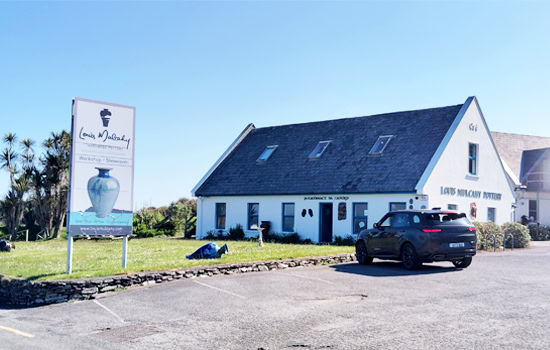
Louis Mulcahy moved his pottery workshop from Dublin to the Dingle Peninsula in 1975 after winning first prize for pottery in the National Crafts Competition. He and his wife Lisbeth brought their young family west, left secure employment behind and established the workshop at Clogher near Ballyferriter.
More than fifty years later, the pottery is still made here.
Visitors today can browse the showroom, see a working pottery through a booked workshop tour or sit at the wheel and make a small piece of their own. That combination of craft, local history and a genuine working workshop makes Louis Mulcahy Pottery one of the more interesting cultural stops on the western Dingle Peninsula.
Who Is Louis Mulcahy?
Louis Mulcahy’s relationship with pottery began before the move to Kerry.
His wife Lisbeth had taken pottery classes when they were young, and Louis later became deeply interested in the craft himself. By the 1970s he was working from Dublin and developing the skills that would eventually lead him to establish a permanent pottery on the Dingle Peninsula.
The decisive moment came in 1975, when he won first prize for pottery in the National Crafts Competition.
Louis and Lisbeth then moved their workshop and family from Dublin to West Kerry, establishing the business near Clogher on the western side of the peninsula.
At the time, creating a substantial craft business in this relatively remote part of Kerry was a considerable undertaking.
That decision is an important part of the story.
Louis Mulcahy Pottery did not begin as a visitor attraction placed conveniently beside Slea Head Drive. It developed as a working pottery, and the visitor experience grew around the craft itself.
More Than Fifty Years of Pottery in West Kerry
The workshop has remained in Clogher since 1975.
Over the following decades, Louis continued developing forms, clay bodies and glaze recipes while the business expanded from individual pottery pieces into tableware, lighting, homeware and larger decorative work.
In 2004, Louis became the first Irish craftsperson to receive an honorary degree from the National University of Ireland, awarded in recognition of his craft and his contribution to the community in West Kerry. The Design & Crafts Council of Ireland later described him as the “godfather of Irish craft”.
Those recognitions help explain why Louis Mulcahy Pottery deserves more attention than a simple shopping stop.
Its story is now part of the modern craft history of the Dingle Peninsula. The wider history of the Dingle Peninsula provides useful context for the communities and cultural traditions within which that modern craft movement developed.
How Louis Mulcahy Pottery Is Made
One of the most interesting things about visiting a working pottery is understanding how much happens between raw clay and the finished piece on a shelf.
Louis Mulcahy Pottery uses stoneware and porcelain clay bodies, while the workshop’s glazes have been developed to Louis’s own recipes rather than simply purchased ready-made.
Pieces are formed and allowed to dry before moving through the glazing and firing process.
Depending on the design, glazes can be dipped or sprayed onto the pottery, while decorative details and motifs are applied by hand.
The result is not complete uniformity.
Handmade pottery naturally contains small differences between individual pieces. That is part of the distinction between something made in a working craft studio and ceramics produced in very large industrial runs.
The Glazes
Colour is one of the most recognisable aspects of Louis Mulcahy pottery.
Over decades, Louis developed his own glaze recipes using silica, fluxes and colouring minerals, producing a palette that includes shades known as Navy, Green, Russet, Smoilin and Tenmoku, alongside brighter blues, reds, yellows and turquoise.
Rather than simply describing those colours as being “inspired by Kerry”, it is more interesting to look at how they work on the finished pottery.
Deep blues appear differently depending on the shape of a bowl or vase. Darker glazes can settle into variations across the surface. Hand-painted pieces introduce motifs including birds, fish and traditional Irish boats.
Because the glazing and decoration form part of the workshop process, the surface is as important to the final piece as the shape beneath it.
Is Louis Mulcahy Pottery Functional or Decorative?
Both.
The showroom includes everyday tableware as well as lamps, vases, homeware and larger individual pieces.
Louis Mulcahy’s functional tableware is designed to be used rather than treated solely as display pottery. The workshop states that its tableware is suitable for oven, microwave and dishwasher use.
That practical philosophy is an important part of the appeal.
You can buy something made by hand on the Dingle Peninsula and still use it as an ordinary cup, bowl or plate when you return home.
Visiting Louis Mulcahy Pottery at Clogher
The pottery is located at Clogher near Ballyferriter, close to Clogher Strand on the western Dingle Peninsula.
Its current address is:
Louis Mulcahy Pottery
Clogher
Ballyferriter
County Kerry
V92 NV04
The workshop sits naturally within a day exploring the western peninsula, particularly if you are travelling between Ballyferriter, Clogher, Dún Chaoin and the historical sites farther east.
The shop and showroom display the workshop’s current range, so you can visit simply to browse without committing to a pottery experience.
Workshop Tours
If you are genuinely interested in craft, I think the workshop tour offers a more meaningful experience than simply walking around the showroom.
The tour takes visitors behind the scenes to learn how the pottery is made and decorated, meet members of the workshop team and understand some of the techniques involved.
Because this is a functioning workplace rather than a permanent demonstration room, workshop tours currently operate Monday to Friday, take approximately 45–60 minutes, and must be booked in advance.
Allow extra time afterwards if you want to browse the showroom properly.
Tour days, times and formats can change, so confirm the current arrangements directly with the pottery before travelling.
Make Your Own Pot
Visitors can also book a hands-on pottery experience.
With help from an experienced potter, you make a small pot or vase on the wheel. The piece is then allowed to dry before being fired and glazed by the workshop.
Delivery options are available for the finished piece.
This is particularly worthwhile if you want to understand how difficult throwing a pot actually is.
Watching an experienced potter centre and shape clay can make the process look effortless.
Sitting at the wheel yourself usually changes that impression fairly quickly.
How Long Should You Allow?
It depends on what you want from the visit.
If you simply want to browse the showroom, allow approximately 20–30 minutes.
For a more relaxed visit, including time to look carefully at the different pottery and designs, 45–60 minutes is more comfortable.
A booked workshop tour itself currently lasts around 45–60 minutes, with additional time recommended for the shop.
If you are booking the make-your-own-pot experience, follow the duration given with your reservation rather than trying to squeeze it into a short roadside stop.
Is It Suitable for Children?
The showroom itself is straightforward for families, but the pottery experience is where children who enjoy making things are likely to get much more from the visit.
The chance to work at the wheel turns the stop from shopping into an activity.
As with any working pottery and shop containing breakable objects, younger children obviously need supervision.
If the family is primarily interested in beaches and scenery, you may prefer a shorter visit.
If one of your children enjoys art, craft or making things, allow more time.
Craft, Employment and the Gaeltacht
The pottery’s importance to West Kerry extends beyond the objects produced in the workshop.
Louis Mulcahy Pottery says supporting local employment, maintaining craft skills and facilitating the use of the Irish language have been part of the business since its establishment in 1975.
That matters because the workshop operates within Corca Dhuibhne, a peninsula containing one of Ireland’s Gaeltacht regions.
Local employment can help people remain within communities where Irish continues to be spoken, rather than craft production being separated from the cultural landscape in which it developed.
The pottery therefore provides an interesting modern counterpart to the ancient sites visitors encounter around Slea Head Drive.
The peninsula’s heritage is not confined to ruins.
Craft is still being practised here.
Lisbeth Mulcahy and a Wider Family Craft Story
Louis’s story is also closely connected with that of his wife, Lisbeth Mulcahy.
Lisbeth originally introduced Louis to pottery. She later developed her own career as a weaver and established Siopa na bhFíodóirí in Dingle, where her scarves, throws, stoles and other woven work have been sold.
Together, their work represents a significant strand of the modern craft tradition that developed on the peninsula during the later twentieth century.
It is a useful reminder that West Kerry’s creative culture includes much more than painting picturesque landscapes for visitors.
Pottery, weaving, music, literature and other forms of craft have all found a home here.
Other Local Makers on the Dingle Peninsula
Louis Mulcahy Pottery is not the peninsula’s only independent craft business.
Holden Leathergoods produces handmade leather bags and accessories from its workshop between the Dingle and Ventry area. Like the pottery, it gives visitors an opportunity to encounter products close to where they are designed and made.
The peninsula’s independent business community also includes food producers and specialist shops such as The Little Cheese Shop in Dingle.
These businesses show that contemporary culture on the peninsula is created not only through festivals and performances, but through the daily work of designers, makers and producers.
Sustainability at the Workshop
The pottery has also been developing its environmental practices.
Louis Mulcahy Pottery is currently involved in the Circular Economy for Regenerative Tourism programme, delivered by Munster Technological University, and says it has introduced measures aimed at reducing energy consumption and improving environmental performance.
The workshop has installed a 30kW solar system and reports planting more than 1,500 native trees on its grounds since 2020.
These details are more useful than simply describing the business as “sustainable”.
They show what is actually being done.
Current Opening Hours
The pottery currently advertises the Clogher shop as being open seven days a week.
Its own website presently contains conflicting closing times of 5.30pm and 6pm, so I recommend checking Louis Mulcahy Pottery directly before making a special journey late in the day.
Workshop tours are separate and require advance booking.
Is Louis Mulcahy Pottery Worth Visiting?
If you are interested in Irish craft, ceramics, design or buying something actually made on the Dingle Peninsula, yes.
I would give it more time if you book a workshop tour or pottery experience because that is where the craft becomes easier to understand.
If your only priority on Slea Head is coastal scenery and you have a very short visit, you may prefer to spend your limited time outdoors.
There is no reason every visitor has to make every stop.
But for someone interested in how things are made, Louis Mulcahy Pottery provides something quite different from the archaeological sites, beaches and viewpoints found elsewhere around the peninsula.
That contrast is exactly what makes it worthwhile.
What Else Is Nearby?
Louis Mulcahy Pottery sits in a particularly useful part of the western peninsula for continued exploration.
Clogher Strand
The nearby Clogher Strand faces directly into the Atlantic and offers a very different experience from the sheltered beaches elsewhere around the peninsula.
Clogher Head provides a wider perspective across this coastline, including views towards the Three Sisters and the surrounding western headlands.
Ballyferriter
Ballyferriter is one of the principal villages of the Corca Dhuibhne Gaeltacht and provides useful cultural and geographical context for the pottery’s location.
Dún Chaoin
Continue west towards Dún Chaoin for views towards the Blasket Islands and access to the Blasket Centre.
Nearby Dunquin Pier provides another striking example of the connection between the mainland and the islands offshore.
Gallarus Oratory and Kilmalkedar
Heading back towards Dingle, Gallarus Oratory and Kilmalkedar Church introduce visitors to the peninsula’s much older religious and archaeological landscape.
Riasc Monastic Settlement offers another worthwhile connection for visitors with a strong interest in early Christianity.
Combined thoughtfully, these places show very different periods of life in West Kerry—early Christianity, Irish-language communities and a modern working craft tradition.
Continue Exploring West Kerry Craft and Culture
Louis Mulcahy Pottery fits naturally into a day exploring the western peninsula, but it deserves enough time to be understood as a working craft business rather than treated as a hurried retail stop.
Visitors staying for several days can use the three-day Dingle Peninsula itinerary to combine local craft with Slea Head, Dún Chaoin, the Blasket story and the peninsula’s archaeological sites.
Steve’s Peninsula Tours’ private full-day Dingle Peninsula tour can sometimes incorporate a pottery visit when opening arrangements, advance bookings and the interests of the group allow.
Frequently Asked Questions About Louis Mulcahy Pottery
Where is Louis Mulcahy Pottery?
The workshop is at Clogher near Ballyferriter on the Dingle Peninsula, County Kerry, close to Clogher Strand. The postcode is V92 NV04.
When did Louis Mulcahy Pottery begin?
Louis Mulcahy moved his workshop from Dublin to the Dingle Peninsula in 1975 after winning first prize in the National Crafts Competition.
Is the pottery actually made in Dingle?
Yes. Louis Mulcahy Pottery states that its pottery is made at the workshop in Clogher on the Dingle Peninsula.
Can you tour the workshop?
Yes. Booked workshop tours take visitors behind the scenes to see how pottery is made and decorated and to meet the makers. Tours currently operate during the working week and booking is essential.
Can you make your own pottery?
Yes. The make-your-own-pot experience allows visitors to create a small pot or vase on the wheel with help from an experienced potter. The workshop later fires and glazes the finished piece.
How long should I allow?
Allow around 20–30 minutes for a quick showroom visit and closer to 45–60 minutes if you want to browse properly. A booked workshop tour currently lasts approximately 45–60 minutes.
Is Louis Mulcahy tableware dishwasher safe?
The pottery states that its functional tableware is suitable for oven, microwave and dishwasher use.
Do workshop tours need to be booked?
Yes. The current booking information states that advance booking is essential for behind-the-scenes workshop tours.
Is Louis Mulcahy Pottery on Slea Head Drive?
It is located at Clogher near Ballyferriter on the western Dingle Peninsula and fits naturally into a wider journey around the Slea Head area.
Is Louis Mulcahy Pottery worth stopping at?
If you are interested in Irish craft, ceramics or locally made products, yes. For the strongest experience, consider booking a workshop tour or pottery-making session rather than treating it purely as a retail stop.