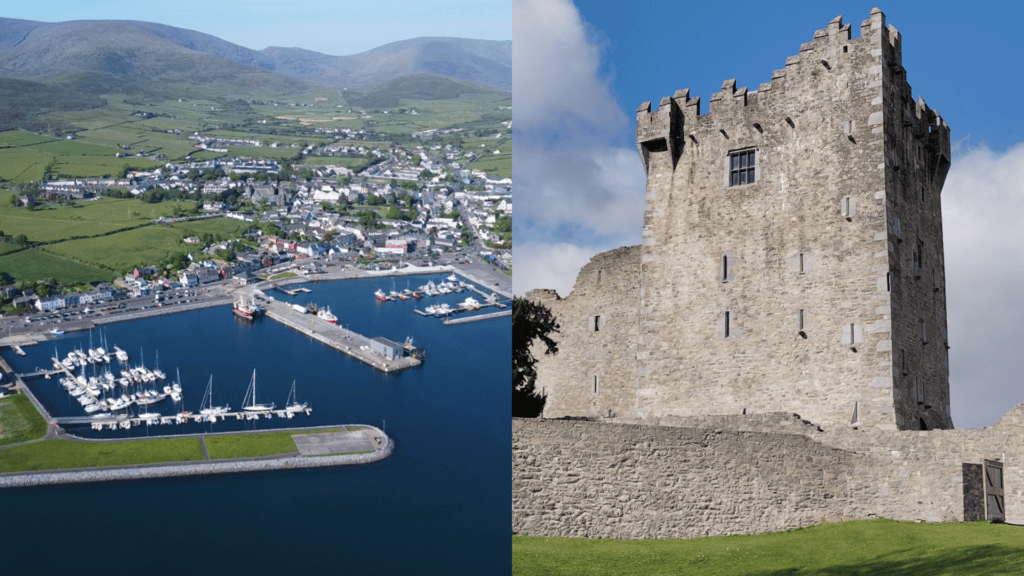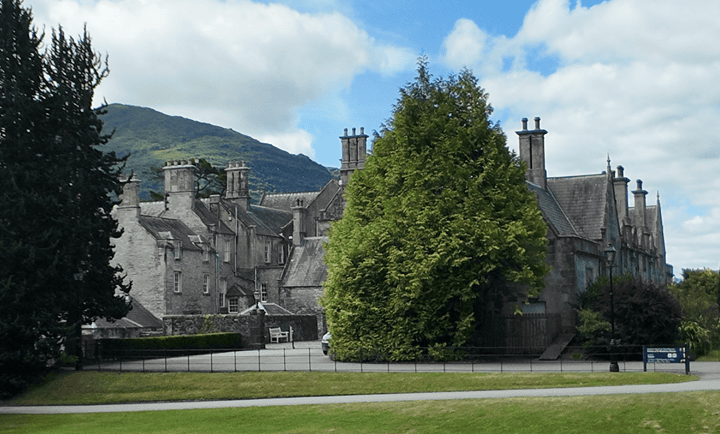

A Dingle Peninsula private tour is the best way to experience more than just the famous coastal road. From the Atlantic scenery of Slea Head to mountain passes, early Christian sites, beaches and Gaeltacht communities, the peninsula contains far more than most visitors realise when they first arrive in Dingle.
What to Expect from a Private Tour of the Dingle Peninsula
My private Dingle Peninsula tours are designed for small groups of up to four guests and are personally guided by me. The aim is not simply to drive around a list of attractions. I want you to understand how the landscape, archaeology, Irish language, local history and communities of West Kerry connect.
The peninsula can be explored in several different ways depending on the time you have available. A focused Slea Head Drive private tour concentrates on the famous western coastline, while my Dingle Peninsula half-day tour gives us more time to combine Slea Head with additional historic and scenic locations. For visitors who want to see the peninsula as a complete journey, the full-day Dingle Peninsula private tour allows us to travel considerably further.
The difference between those experiences is not simply how many places we can fit into the vehicle’s route. More time means we can slow down, spend longer at places that interest you and explore parts of the peninsula that many visitors never reach.
Why Choose a Private Dingle Peninsula Tour?
The Dingle Peninsula is ideal for private touring because different visitors are interested in completely different aspects of it.
Some people have travelled to Ireland primarily for scenery. Others want archaeology, Irish history, early Christian sites, photography, film locations or the story of the Blasket Islands. Some guests want to walk regularly, while others would rather enjoy most viewpoints close to the vehicle.
A private experience allows those differences to shape the day.
You are not joining another booking and there is no coach timetable dictating how long you can remain somewhere. If a viewpoint is particularly clear, we can give it more time. If archaeology becomes the subject that interests you most, we can explore that more deeply. If Kerry weather changes our plans, I can adjust the journey rather than rigidly following a sequence decided before we left Dingle.
Starting Your Tour in Dingle
Dingle is the natural base for exploring the peninsula. The harbour town sits close enough to the western coast that you can be surrounded by Atlantic scenery within a relatively short time of leaving your accommodation.
At the beginning of the tour, I normally explain the basic geography of the peninsula. This helps because an international visitor may recognise names such as Slea Head, Conor Pass and Inch Beach without necessarily understanding where they sit in relation to one another.
The Dingle Peninsula stretches far beyond the town itself. The mountains divide parts of the peninsula, Atlantic bays shape its northern and southern coastlines, and the western end reaches into one of Ireland’s most important Gaeltacht regions.
Once you understand that geography, the rest of the journey makes much more sense.
Slea Head Drive
Slea Head Drive is usually the first priority for visitors exploring the Dingle Peninsula for the first time.
Travelling west from Dingle, the road passes through Ventry before reaching the archaeological landscape around Fahan and then following the Atlantic coastline towards Dún Chaoin.
Slea Head works so well because it concentrates many of the peninsula’s defining features into one journey: coastline, stone-walled fields, archaeological sites, Gaeltacht communities, the Blasket Islands and several of West Kerry’s most recognisable viewpoints.
If you are planning to drive the route independently, my guide explaining why Slea Head Drive is normally travelled clockwise is useful before setting out.
The Ancient Landscape Around Fahan
West Kerry contains an extraordinary concentration of archaeological remains, and the Fahan area is one of the clearest examples.
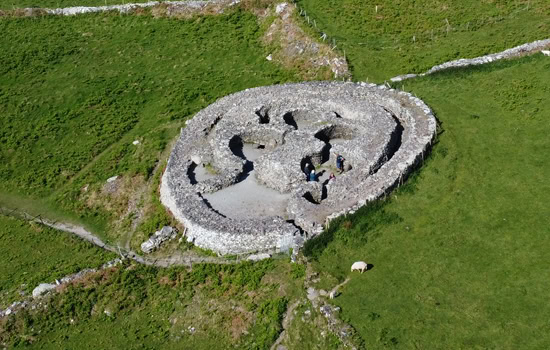
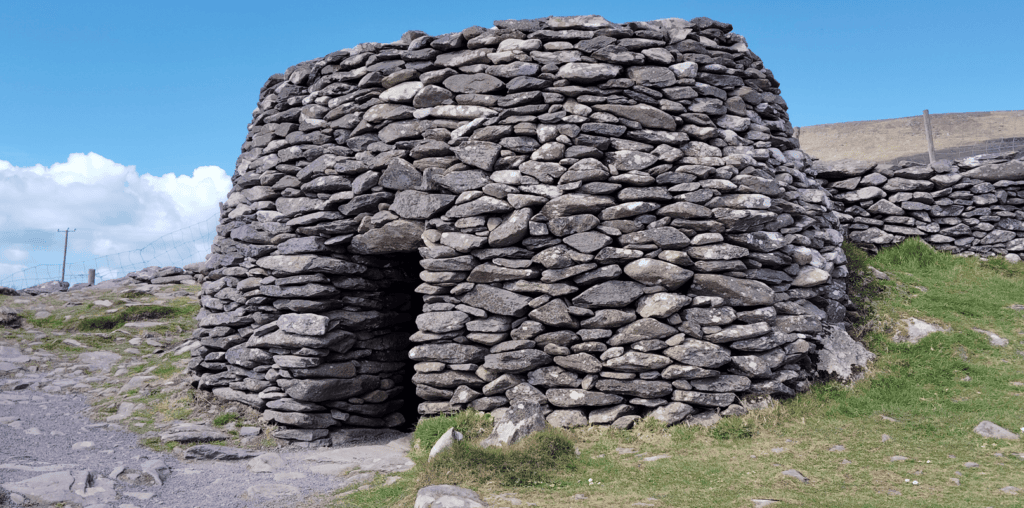
The Beehive Huts, more accurately described as clocháns, demonstrate the tradition of corbelled dry-stone building associated with the peninsula. Nearby forts, field systems and stone enclosures show that these structures belonged to a much larger settled landscape.
This is something that is easy to overlook when self-driving. A visitor may see one stone structure beside the road and treat it as an isolated attraction.
With context, you begin to see how the individual monuments relate to generations of settlement, farming and land use across the western peninsula.
Dún Beag Promontory Fort
Another important archaeological site along this part of the peninsula is Dún Beag Promontory Fort.
The fort occupies a striking position on the Atlantic coast and demonstrates how natural topography could form part of a defensive site.
Promontory forts are particularly interesting because the landscape itself becomes part of the archaeology. Cliffs and steep coastal ground provided natural protection, while constructed defences controlled access from the landward side.
Visitors who are particularly interested in this side of Kerry can explore the broader collection of historical and archaeological sites in Kerry.
Coumeenoole and the Atlantic Coast
The landscape becomes increasingly dramatic as we continue around Slea Head.
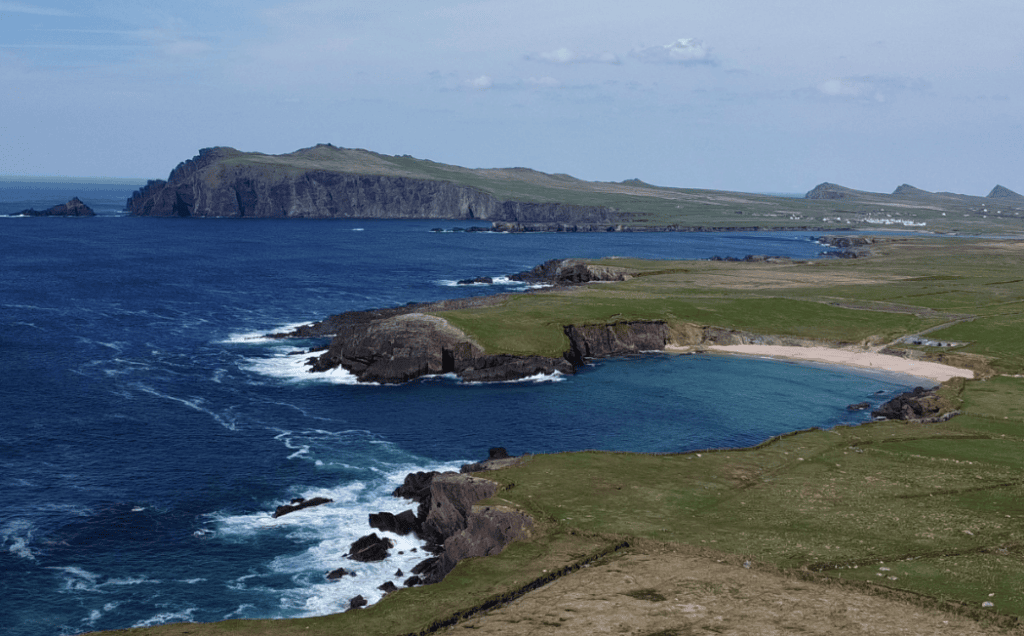
One of the most recognisable locations is Coumeenoole, where the Atlantic meets a small beach beneath steep coastal slopes.
This western edge of the peninsula feels completely different from the more sheltered landscape closer to Dingle. Here the influence of the Atlantic is immediate. Wind, swell and rapidly changing light can completely alter how the coastline appears from one visit to another.
It is also one of the places where I remind visitors that Kerry weather should not automatically be viewed as an inconvenience. Broken cloud can produce extraordinary light across the coastline and islands.
Dún Chaoin and the Blasket Islands
Continue around the western peninsula and we reach Dún Chaoin, one of the most culturally important areas of West Kerry.
The famous descent towards Dunquin Pier is immediately recognisable, but the story behind the view is more important than the photograph.
Dún Chaoin was closely connected with the community of the Blasket Islands. From several viewpoints around this part of the peninsula, the islands sit prominently offshore and appear remarkably close to the mainland.
Knowing that families once lived there changes the view. The islands stop being distant geographical features and become part of a human landscape.
The Blasket community produced several important Irish-language writers whose accounts documented life on the islands. Visitors interested in that story can explore it further through the Blasket-related material elsewhere within the Steve’s Peninsula Tours travel guide.
The Gaeltacht and Irish Language
The western Dingle Peninsula forms part of Corca Dhuibhne, one of Ireland’s Gaeltacht regions where Irish remains a living community language.
You will encounter place names such as Dún Chaoin, Ceann Trá and Baile an Fheirtéaraigh during the journey. These names are not simply decorative translations for visitors. They are part of the cultural identity of the peninsula.
Place names can also reveal information about geography, settlement and the way earlier generations understood particular locations.
When relevant, I explain those connections as we travel. This adds another layer to the peninsula because language and landscape are closely connected in West Kerry.
Clogher and the Northern Atlantic Coast
After travelling around the western end of the peninsula, the scenery changes again near Clogher and Ballyferriter.
The headlands of Ceann Sibéal and the Three Sisters become dominant, while the northern Atlantic coastline feels very different from the more famous southern side of Slea Head.
This part of the journey is useful because it demonstrates that the peninsula is not one continuous version of the same coastal scenery. The direction of the coastline, mountains and Atlantic exposure continually alter the landscape.
Visitors interested in exploring Kerry’s natural attractions can browse more of the places to see around County Kerry.
Gallarus Oratory
The western peninsula also contains an exceptional concentration of early Christian and medieval heritage.
Gallarus Oratory is one of the best-known examples. The compact stone building survives with its corbelled roof intact and demonstrates remarkable skill in medieval stone construction.
Its precise date remains uncertain, and modern interpretation is more cautious than some older visitor descriptions that presented Gallarus as an extremely early Christian church.
That uncertainty makes the site more interesting rather than less. Archaeology continually develops as evidence is reassessed, and Gallarus is a good example of why we should distinguish between established evidence and traditions repeated over generations.
Kilmalkedar Church
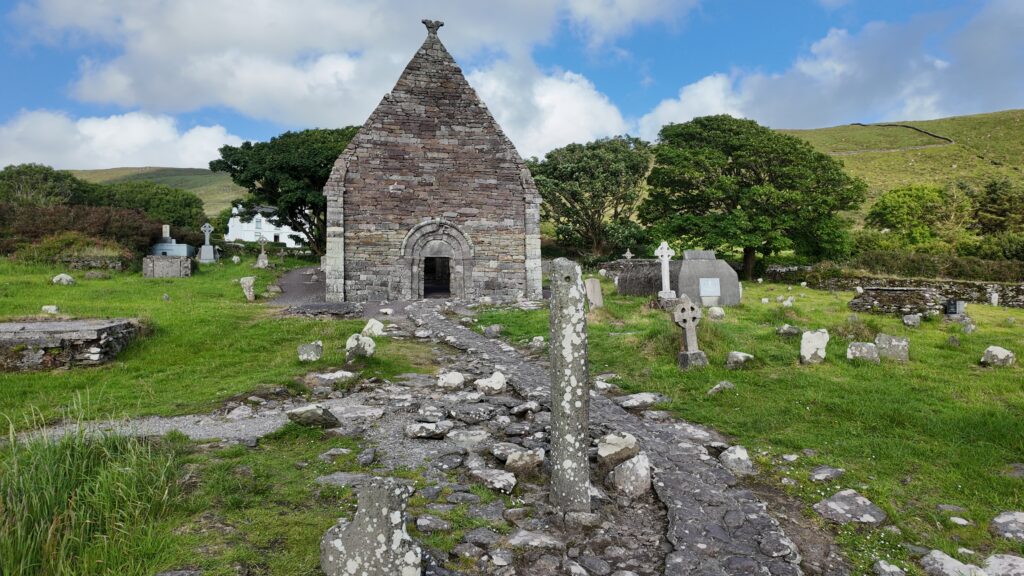
Kilmalkedar Church provides another important perspective on the religious landscape of the peninsula.
The surviving medieval church stands within a much older ecclesiastical setting containing carved stones and an important ogham stone.
Ogham is particularly significant in West Kerry because the peninsula contains one of Ireland’s greatest concentrations of surviving ogham inscriptions.
Kilmalkedar therefore brings several historical periods together within a relatively small space. Early Irish writing, Christian worship, medieval architecture and later burial traditions all remain visible within the same landscape.
Riasc Monastic Settlement
Riasc Monastic Settlement is another site that helps explain the religious history of West Kerry.
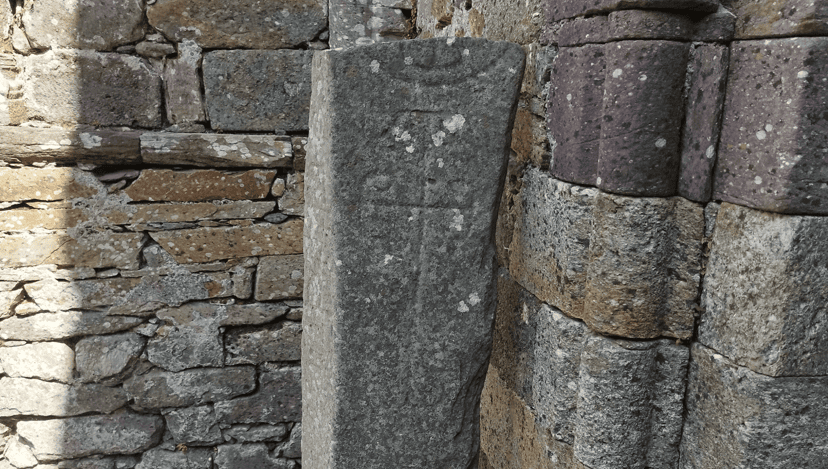
Archaeological investigation has revealed evidence of an early medieval ecclesiastical community, including stone structures, burial areas and distinctive carved cross-slabs.
Riasc, Gallarus and Kilmalkedar are particularly useful when considered together because they represent different stages and forms of religious settlement.
Rather than treating them as three similar old stone sites, I prefer to explain how each contributes something different to our understanding of Christianity and community life on the peninsula.
Conor Pass
A longer Dingle Peninsula tour allows us to leave the western coastal landscape and move into the mountains.
Conor Pass is one of the most dramatic ways of crossing the Brandon Mountains between Dingle and the northern side of the peninsula.
The elevated road provides a completely different type of scenery from Slea Head. Instead of Atlantic islands and coastal cliffs, you encounter steep mountain slopes, glacial lakes and broad views across the surrounding landscape when visibility is good.
Weather matters considerably here. Low cloud can reduce visibility within minutes, while clear conditions can open views across both sides of the peninsula.
This is one reason I would not insist on travelling a fixed route in a fixed order regardless of conditions. A private tour gives us more flexibility.
Inch Beach and the Eastern Peninsula
A full-day journey can also include the eastern and southern landscapes of the peninsula.
Inch Beach is very different from the smaller Atlantic coves around Slea Head. The long sandy strand stretches into Dingle Bay and gives you a much broader sense of the scale of the surrounding coastline.
This part of the peninsula connects naturally with journeys towards Killarney, making Inch useful both as a destination and as part of a scenic route between different areas of Kerry.
The eastern peninsula also demonstrates again why Slea Head should not be mistaken for the entire Dingle Peninsula. The landscapes become progressively different as you travel away from the western Atlantic coast.
Minard and the Southern Coast
The southern coastline offers another quieter side of the peninsula.
Minard Castle stands above Minard Bay and provides a strong example of the relationship between historical ruins and the landscape around them.
The ruined tower house has connections with the conflicts of the seventeenth century, while the bay and surrounding coastline create a completely different atmosphere from the exposed western headlands.
This is the type of place that becomes much easier to include when you have a full day available rather than trying to force it into a short Slea Head circuit.
Half-Day or Full-Day Dingle Peninsula Tour?
This is one of the most common decisions visitors need to make.
A half-day private Dingle Peninsula tour works very well if you want the major western landscapes, important archaeological sites and some mountain scenery while keeping part of your day free.
The full-day private tour is better if you want the peninsula to feel like a complete journey rather than a collection of highlights.
With a full day, we can include additional landscapes, allow more time for individual stops and adapt the route more freely around your interests.
I would not automatically recommend the longer tour simply because it is longer. The right choice depends on your available time and what you want from the experience.
Is a Dingle Peninsula Private Tour Worth It?
If you enjoy independent driving and researching destinations, you can certainly explore the peninsula yourself.
A private tour offers a different value.
Nobody in your group needs to concentrate on narrow roads or navigation. You do not have to research every historical site before arriving. You also have someone beside you who can explain the places as they appear rather than trying to remember what you read the night before.
For many visitors, the greatest difference is context.
A viewpoint is still beautiful without a guide. But knowing why the islands offshore matter, understanding why Irish is still spoken here or recognising the history behind a ruined church turns the view into something you are much more likely to remember.
Private Tour or Self-Drive?
If you enjoy self-driving, the Dingle Peninsula is one of Ireland’s most rewarding areas to explore independently.
The important thing is to allow enough time. Driving distances can appear relatively short on a map, but narrow roads, viewpoints, photography and historical stops make journeys much slower than the raw distance suggests.
If you want to drive Slea Head yourself while still receiving location-based commentary, my GPS Dingle Peninsula Audio Tour offers a self-guided alternative.
That gives visitors three different ways to experience the peninsula: completely independently, with GPS commentary or personally with me on a private tour.
Photography on the Dingle Peninsula
The peninsula is particularly rewarding for photographers because the landscape changes so continuously.
Within one day you can photograph beaches, islands, mountain roads, archaeological monuments, churches, stone fields and small villages.
Weather also changes the visual character of the peninsula. Clear conditions are excellent for long-distance views, but broken Atlantic cloud can produce much more interesting light.
If photography is a priority, let me know. The flexibility of private touring means we can spend more time at a location when conditions are particularly good.
What Happens if the Weather Changes?
West Kerry weather can change quickly.
A clear morning in Dingle does not guarantee identical conditions around Conor Pass or Slea Head. Likewise, cloud on the mountains does not necessarily mean poor visibility along the Atlantic coast.
That variability is one of the reasons I prefer flexible private touring.
We can use clearer conditions for viewpoints and exposed landscapes while giving more time to historical or lower-level locations if cloud temporarily moves across the mountains.
I recommend comfortable footwear and a waterproof layer regardless of how settled the morning looks.
Who Does a Private Dingle Peninsula Tour Suit?
The experience works particularly well for couples, families and groups of friends who value privacy and flexibility.
History enthusiasts can spend more time at archaeological sites. Photographers can prioritise viewpoints. Guests interested in the Blasket Islands or Irish culture can give those stories more attention.
The amount of walking can also be adjusted significantly.
You do not need to undertake long hikes to enjoy the peninsula. Many excellent viewpoints can be reached close to the vehicle, while visitors who enjoy walking can naturally spend more time exploring selected locations on foot.
How Long Should You Spend on the Dingle Peninsula?
If the peninsula is one of the main reasons you are visiting County Kerry, I would avoid trying to compress everything into a few hours.
A focused Slea Head tour provides an excellent introduction. Half a day allows more depth. A full day lets you begin connecting the western coast with the wider peninsula.
If you are staying in Dingle for several nights, you can explore at a much more relaxed pace and allow the weather to influence your plans.
The important thing is not to measure your visit by how many locations you can tick off.
Allow time to stop, ask questions and enjoy the landscape.
Continue Exploring the Dingle Peninsula
The Dingle Peninsula forms one of the strongest regional sections within the wider Explore Kerry travel guide.
If you are planning independently, start with the Places to See in Kerry collection and the site’s Historical Sites in Kerry resources. Together they help connect scenic places with the archaeological and cultural landscape surrounding them.
For a first visit, I would prioritise Slea Head and then decide how much further you want to explore. If your interests extend beyond the famous coastal drive, the mountains, early Christian sites, eastern beaches and quieter southern side of the peninsula can easily justify a longer day.
If you want me to show you the peninsula personally, you can compare the Dingle Peninsula half-day private tour with the more extensive full-day Dingle Peninsula private tour and choose the experience that best suits your time in Kerry.
Frequently Asked Questions About a Dingle Peninsula Private Tour
Is the Dingle Peninsula tour completely private?
Yes. My private tours are for your own group, with a maximum of four guests. You are not combined with another booking.
Who will guide the tour?
I personally drive and guide my private Dingle Peninsula tours, allowing the experience to remain consistent and personal from collection through to the end of the journey.
How long does a Dingle Peninsula private tour take?
There are several options. A focused Slea Head experience takes a few hours, a half-day tour gives more time to explore, and a full-day journey allows us to see the peninsula much more comprehensively.
Where does the tour start?
Dingle is the normal starting point for private tours of the peninsula, with collection arrangements confirmed when organising your experience.
What is included on a Dingle Peninsula tour?
The precise route depends on the tour length, conditions and your interests. Slea Head, Atlantic viewpoints, archaeological sites, Gaeltacht landscapes and historic places are central to most first-time experiences, while longer tours can extend into the mountain, northern, eastern and southern parts of the peninsula.
Is a half-day enough for the Dingle Peninsula?
A half day provides an excellent introduction, particularly for first-time visitors. If you want to experience the peninsula beyond its main highlights, a full day gives considerably more flexibility.
Can the private tour be customised?
Yes. Within the time and practical constraints of the route, I can place greater emphasis on subjects that interest you, including archaeology, history, photography, scenery, Irish culture or the Blasket Islands.
Is there a lot of walking?
No. The amount of walking can be adjusted. Many important views and attractions can be enjoyed with relatively short walks, while more active guests can spend additional time exploring on foot.
What should we bring?
Comfortable footwear and a light waterproof layer are sensible. Weather can change quickly on the Dingle Peninsula even when conditions in town appear settled.
Should we book a private tour or drive ourselves?
Both can work well. Self-driving gives complete independence, while a private tour allows everyone in your group to enjoy the scenery and gives you local interpretation of the history, archaeology and culture behind the places you are seeing.