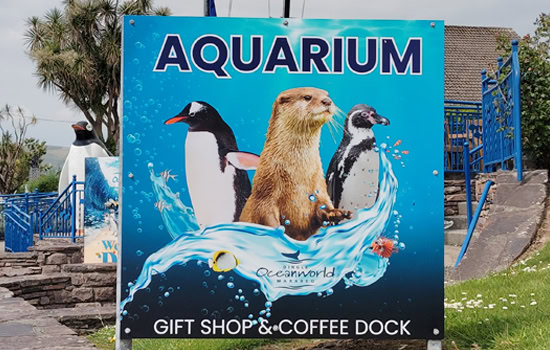
Dingle Oceanworld Aquarium is one of the main indoor attractions in Dingle and an especially useful place to know about when travelling with children or when West Kerry’s weather makes outdoor plans less appealing.
Located beside Dingle Marina, the aquarium brings together marine life from Irish waters with species from much farther afield. Current exhibits include sand tiger sharks, Gentoo and Humboldt penguins, Asian short-clawed otters, jellyfish, tropical fish and an immersive experience exploring marine life off the Kerry coast.
For families it is an easy attraction to include in a day around Dingle. But Oceanworld isn’t exclusively for children. The sharks, penguins, marine interpretation and conservation work give adults plenty to explore as well.
What Is Dingle Oceanworld Aquarium?
Oceanworld opened in Dingle in 1996 and has since developed into Ireland’s largest aquarium.
Its location beside a working harbour is particularly appropriate. Dingle has a long relationship with the Atlantic through fishing, maritime activity and marine wildlife, and Oceanworld provides an opportunity to look beneath the surface at some of the species and ecosystems that are otherwise difficult for visitors to experience.
Not everything inside is local. The aquarium also houses species from South America, Asia and other parts of the world’s oceans and freshwater environments.
The result is a mixture of aquarium, family attraction and marine education centre rather than simply a collection of fish tanks.
What Animals Can You See at Dingle Oceanworld?
The collection changes over time, so it is always worth checking Oceanworld’s current exhibits before visiting.
Several animals and exhibits, however, form the core of the present experience.
Sand Tiger Sharks
The Shark Tank is Oceanworld’s largest exhibit, containing more than 440,000 litres of water.
Its most imposing residents are the sand tiger sharks.
Despite their appearance—particularly the rows of protruding teeth—sand tiger sharks are generally slow-moving animals. Watching them move through the large tank gives visitors an opportunity to observe a species most of us would otherwise only encounter through wildlife documentaries.
The exhibit also contains other marine species, including Molly, a loggerhead turtle.
For many visitors, particularly children, this is likely to be one of the highlights of the aquarium.
Gentoo and Humboldt Penguins
Oceanworld is home to two different species of penguin: Gentoo penguins and Humboldt penguins.
The contrast between them provides an interesting reminder that penguins are not exclusively Antarctic animals.
Humboldt penguins originate from the Pacific coast of South America, while Gentoo penguins are associated with colder southern waters.
Watching the birds swim can be as interesting as seeing them on land. Penguins may appear slightly awkward when walking, but underwater they become remarkably agile swimmers.
Asian Short-Clawed Otters
Another popular exhibit is home to Asian short-clawed otters.
These are the smallest of the world’s otter species and, as their name suggests, have relatively short claws compared with other otters.
They are not the same species as the Eurasian otter found in Ireland, but their presence provides an opportunity to compare them with the wild otters that inhabit Irish rivers, lakes and coastal environments.
Jellyfish
Jellyfish are among the aquarium’s quieter exhibits, but they are worth spending time with.
Their bodies are largely composed of water, and rather than swimming in the conventional sense, much of their movement is influenced by currents.
Oceanworld currently displays moon jellyfish among its marine collection.
For children accustomed to thinking of marine wildlife mainly as fish, dolphins, whales and sharks, jellyfish provide a very different example of how animals have adapted to life in the ocean.
Tropical and Freshwater Species
Not everything at Oceanworld comes from the Atlantic.
The aquarium also includes exhibits representing environments such as the Amazon River and Lake Malawi, introducing visitors to fish and other species from freshwater ecosystems far removed from County Kerry.
These exhibits provide useful contrast with the marine environments elsewhere in the aquarium.
Deep Atlantic: Discovering the Ocean off Kerry
One of Oceanworld’s most relevant exhibits for visitors to Dingle is Deep Atlantic, an immersive digital experience exploring the marine environment off the Kerry coast.
This is where the aquarium connects particularly well with its location.
Standing beside Dingle Harbour, it is easy to look across the Atlantic without appreciating how much is happening beneath the surface.
The waters around Ireland support an extraordinary range of marine life, from tiny organisms and fish to seals, dolphins and some of the world’s largest whales.
Deep Atlantic helps introduce visitors to that underwater environment and provides useful context for the wildlife associated with Ireland’s Atlantic coast.
For anyone interested in the natural history of the Dingle Peninsula rather than simply seeing aquarium animals, this is one of the sections worth taking time to explore.
Butterfly Oasis
Oceanworld also operates a seasonal Butterfly Oasis, normally available from April until October.
This is quite different from the marine exhibits elsewhere in the aquarium and introduces visitors to tropical butterflies in a warm, planted environment.
Because this exhibit is seasonal, don’t assume it will be available throughout the year.
If seeing it is important to your visit, check with Oceanworld beforehand.
Interactive Exhibits and Touch Tanks
Some areas of Oceanworld allow visitors to get closer to marine life through designated interactive exhibits.
Touch-tank experiences can be particularly interesting for younger visitors because they transform marine biology from something viewed behind glass into something more immediate.
However, interaction with animals is controlled, and visitors should only touch species where aquarium staff or signage specifically indicate that it is permitted.
Displays and participating species can change, so it is better to discover what is available during your visit rather than arriving expecting to handle a particular animal.
Feeding Times and Aquarist Talks
One of the best ways to get more from a visit is to check whether your time at Oceanworld coincides with one of its animal feeding sessions or aquarist talks.
These give visitors an opportunity to learn more about individual species, their behaviour, feeding and care rather than simply walking from exhibit to exhibit.
For children with a particular interest in sharks, penguins or other animals, this can make the visit considerably more engaging.
Check the current feeding and talk schedule when you arrive, as timings and activities can change.
Is Dingle Oceanworld Good for Children?
Yes. Oceanworld is one of the easiest Dingle attractions to recommend for families.
There is enough variety to keep younger visitors interested, with sharks, penguins, otters, colourful fish and interactive elements providing frequent changes of focus.
It is also a manageable attraction.
You are not committing the family to an entire day, and its location in Dingle means you can easily combine it with lunch, a walk around the harbour or time exploring the town.
Older children who are interested in animals, wildlife or the ocean can get more from the educational and conservation elements rather than treating the aquarium purely as entertainment.
Families planning a wider stay can also explore the guide to things to do in Dingle, which includes beaches, historical sites and other indoor and outdoor activities.
Is Oceanworld Worth Visiting Without Children?
Yes—particularly if you have an interest in marine life.
Oceanworld is understandably marketed strongly towards families, but it shouldn’t be regarded solely as a children’s attraction.
The shark exhibit, penguins, Deep Atlantic experience and interpretation of marine ecosystems can all be interesting for adults.
Whether you should prioritise it depends on your interests and the amount of time you have in Dingle.
If you have one clear afternoon and good weather, I would generally encourage a first-time visitor to spend that time exploring the Dingle Peninsula outdoors.
If you have more time, enjoy marine wildlife or need an indoor activity, Oceanworld becomes a much easier recommendation.
Is Dingle Oceanworld Good on a Rainy Day?
Yes. This is probably when Oceanworld becomes most useful to visitors.
Much of what draws people to the Dingle Peninsula is outdoors: coastal scenery, beaches, historical sites, mountain views and scenic drives.
Heavy rain and low cloud can change those plans considerably.
Oceanworld provides a substantial indoor alternative without requiring you to leave Dingle Town.
Rather than losing a wet morning or afternoon, you can spend part of it at the aquarium and combine the visit with Dingle’s cafés, shops, restaurants and harbour.
It is worth remembering, however, that Kerry weather can change quickly.
A wet morning does not necessarily mean a lost day. The guide to the best time to visit Dingle explains how weather, daylight and seasonal opening affect the wider visitor experience.
How Long Should You Allow?
For most visitors, around 60–90 minutes is a sensible amount of time to allow.
Families with younger children or visitors who stop for talks and feeding sessions may spend longer.
If you prefer to read the interpretation and spend time observing individual exhibits rather than walking straight through, allow additional time.
The aquarium’s central location means you don’t need to build an entire day around it.
That flexibility is one of its advantages.
Tickets and Booking
Oceanworld offers advance online ticketing as well as admission on arrival, subject to availability.
Online tickets currently receive a small discount and must be purchased at least two hours before visiting.
Prices and booking arrangements can change, so I recommend checking Dingle Oceanworld’s official website before your visit rather than relying on prices reproduced in older travel guides.
During particularly busy holiday periods, booking ahead can also remove uncertainty from a family itinerary.
Opening Hours
Oceanworld currently lists daily opening from 10.00am until 7.00pm, with last admission at 5.45pm.
Opening arrangements can change seasonally or for operational reasons, so check the aquarium directly before travelling, particularly outside the main visitor season.
Where Is Dingle Oceanworld Aquarium?
Dingle Oceanworld Aquarium is located at:
The Wood
Dingle
County Kerry
V92 Y193
It sits beside Dingle Marina, within easy walking distance of the harbour and central Dingle.
That location makes it particularly easy to combine with other activities rather than treating it as a separate excursion.
Afterwards, you can continue along the waterfront towards Dingle Harbour or walk into town for food, shopping or another attraction.
Visiting Oceanworld Without a Car
Oceanworld is one of the easiest Dingle attractions to visit without your own transport because it is beside the marina and close to the town centre.
Visitors staying in central Dingle can normally reach it on foot without needing to arrange a taxi or rural transport connection.
This differs from many of the peninsula’s beaches, archaeological sites and viewpoints, which are spread across a much wider rural area. The guide to visiting Dingle without a car explains the practical options for exploring beyond the town.
Conservation and Marine Education
An aquarium should offer more than an opportunity to look at unusual animals.
Oceanworld identifies conservation, research and environmental education as important parts of its work, with a particular emphasis on increasing understanding of marine biodiversity.
That role is especially relevant in Dingle.
The peninsula extends into an Atlantic environment rich in marine life, and visitors regularly encounter the sea as part of their experience here—whether looking across Dingle Bay, walking beaches, travelling around Slea Head Drive or taking a wildlife trip from the harbour.
Understanding what lives beneath that water adds another dimension to those experiences.
For families, it also creates an opportunity to connect a day at the aquarium with conversations about wildlife, habitats, pollution and the protection of marine ecosystems.
Marine Wildlife Beyond the Aquarium
Oceanworld introduces visitors to marine species in a controlled indoor setting, but Dingle Harbour also provides access to the natural Atlantic environment.
Boat trips can offer views of the coastline and possible encounters with dolphins, seals, seabirds and other wildlife. Sightings are never guaranteed, and every route remains dependent on sea and weather conditions.
Visitors interested in seeing the peninsula from the water can learn more about a Dingle Sea Safari and the type of coastal experience it provides.
Is Dingle Oceanworld Aquarium Worth Visiting?
For families, marine-life enthusiasts and anyone looking for a substantial indoor activity in Dingle, Oceanworld is easy to recommend.
Its strongest advantage is the variety packed into a relatively manageable visit: sharks, penguins, otters, jellyfish, tropical species and interpretation of the Atlantic environment can all be experienced without leaving Dingle.
Whether I would prioritise it over exploring the peninsula outdoors depends on the circumstances.
On a clear day during a short first visit to Dingle, I would make the landscape and coastline the priority.
On a wet day, when travelling with children, or if marine life is one of your interests, Oceanworld becomes one of the most useful attractions in town.
That’s a much better reason to visit than simply adding it to a checklist.
Food and Treats Nearby
Oceanworld’s position close to the town centre makes it easy to find food before or after your visit.
The Dingle food guide provides a useful introduction to the town’s seafood, cafés and local produce.
For a simple family treat, Murphys Ice Cream has two locations in Dingle, including one close to the pier and marina. Bean in Dingle is another independent option for visitors looking for coffee or a café stop in town.
What Else Can You Do Nearby?
Oceanworld’s position beside the marina makes it easy to continue exploring Dingle Harbour after your visit.
The centre of Dingle Town is also close by, with cafés, pubs, restaurants, shops and other places to explore on foot.
There is another connection worth remembering while walking along the waterfront.
For almost four decades, Dingle Harbour was home to Fungie the Dolphin, whose story became closely intertwined with the town’s relationship with the sea.
Taken together, Oceanworld, the working harbour, Dingle’s fishing heritage and the story of Fungie offer different ways of understanding how strongly life in Dingle has been shaped by the Atlantic.
Continue Exploring Dingle
Oceanworld can form part of a relaxed day in town or provide a useful indoor stop within a longer peninsula itinerary.
If the weather improves, visitors can continue towards nearby coastal locations or use the aquarium as the starting point for a harbour walk. Families with more time can also explore beaches such as Ventry Beach or Inch Beach, depending on the direction of travel.
The guide to planning a perfect day in Dingle can help balance town-based attractions with the wider peninsula.
Steve’s Peninsula Tours’ private Dingle half-day tour can explore selected places beyond town before returning guests to Dingle, where Oceanworld and the harbour can be visited independently.
Frequently Asked Questions About Dingle Oceanworld Aquarium
What animals can you see at Dingle Oceanworld?
Current exhibits include sand tiger sharks, Gentoo and Humboldt penguins, Asian short-clawed otters, jellyfish and numerous marine and freshwater species. Exhibits can change over time.
Does Dingle Oceanworld have sharks?
Yes. Sand tiger sharks live in Oceanworld’s Shark Tank, its largest exhibit.
Does Dingle Oceanworld have penguins?
Yes. Oceanworld currently has both Gentoo and Humboldt penguins.
Is Dingle Oceanworld suitable for young children?
Yes. Sharks, penguins, otters, colourful marine life and interactive elements make it particularly suitable for families with children.
Is Dingle Oceanworld only for children?
No. Adults interested in marine wildlife, sharks, penguins, conservation or the marine environment around Kerry can also get plenty from a visit.
How long do you need at Dingle Oceanworld?
Allow approximately 60–90 minutes for a typical visit. You may want longer if attending animal talks or exploring the exhibits in more detail.
Is Dingle Oceanworld good when it rains?
Yes. It is one of the main indoor visitor attractions in Dingle and is particularly useful when rain or low cloud makes outdoor sightseeing less appealing.
Do I need to book Dingle Oceanworld in advance?
Advance booking is not always essential, but it can be useful during busy periods. Online tickets currently need to be purchased at least two hours before visiting.
Is Dingle Oceanworld open all year?
Oceanworld currently operates daily, although hours and individual exhibits can change. Check directly with the aquarium before travelling for the latest information.
Where is Dingle Oceanworld?
Oceanworld is beside Dingle Marina at The Wood, Dingle, County Kerry, within walking distance of the town centre and harbour.