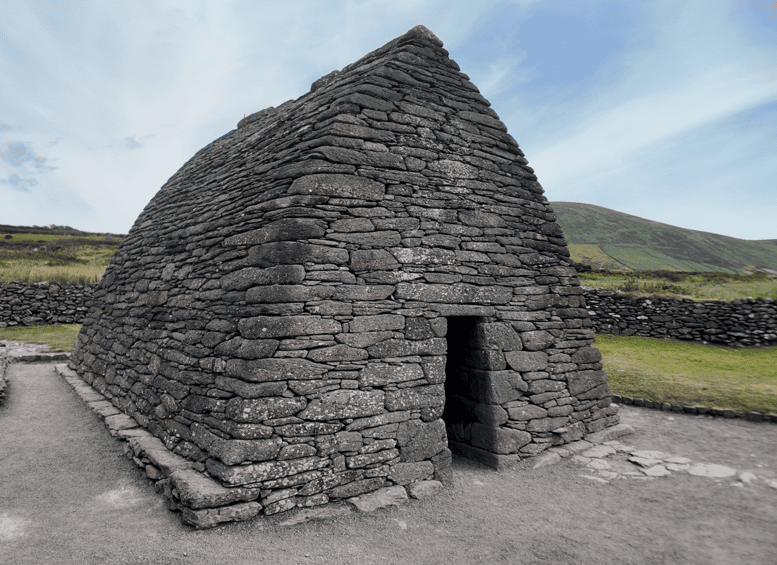
Gallarus Oratory is one of the most recognisable historic buildings on the Dingle Peninsula. Standing in the countryside of West Kerry, its small stone form looks deceptively simple, yet the building has survived for centuries with its corbelled stone roof still intact.
The Story and History Behind One of West Kerry’s Best-Known Stone Buildings
For generations Gallarus was commonly described as an early Christian church, sometimes with very early dates attached to it. Modern interpretation is more cautious. The building has never been scientifically dated, and the strongest current working interpretation places its construction somewhere around the eleventh or twelfth century, although earlier dates have also been proposed.
That uncertainty actually makes Gallarus more interesting. We know we are looking at an exceptionally well-preserved medieval ecclesiastical building, but questions remain about exactly when it was constructed and the community that originally used it.
If you are planning a visit, my permanent Gallarus Oratory visitor guide contains the essential site information. This article looks more closely at the story behind the building, why its construction is so remarkable and how Gallarus fits into the much wider religious landscape of the western peninsula.
Where Is Gallarus Oratory?
Gallarus lies in the townland of Gallarus, or Gallaras, in the civil parish of Kilmalkedar on the western Dingle Peninsula. It is situated between the Ballyferriter area and the northern side of the peninsula, within the Corca Dhuibhne Gaeltacht.
The location is important. Gallarus does not stand in isolation from the peninsula’s other historic places. Nearby are Kilmalkedar Church, the archaeological remains at Riasc Monastic Settlement and numerous other monuments associated with centuries of settlement and Christian worship.
This concentration of sites is one reason I encourage visitors to think of the western peninsula as a historic landscape rather than a collection of individual attractions. Gallarus is much easier to understand when you see it as one piece of that larger story.
What Does Gallarus Oratory Look Like?
Gallarus is a compact rectangular building constructed almost entirely from carefully laid local sandstone. Its walls slope progressively inward as they rise, with each successive course of stone projecting slightly towards the centre until the two sides meet to form the roof.
This technique is generally described as corbelling. Rather than constructing separate vertical walls and placing a conventional timber roof above them, the walls and roof effectively form one continuous stone shell.
The result has often been compared to an upturned boat. Seen from the side, that description makes immediate sense. The building narrows as it rises and finishes along a strong stone ridge.
There is a simple entrance in the western gable and a small window in the eastern wall. The interior is plain, enclosed and considerably darker than visitors sometimes expect after seeing photographs taken outside.
Why Has Gallarus Survived So Well?
The preservation of Gallarus is one of its most remarkable qualities.
West Kerry is exposed to Atlantic rain and wind, yet the stone roof has remained intact. The inward angle of the walls and the way the stonework was laid help water run away from the structure rather than penetrate directly through it.
It is tempting to describe this simply as primitive dry-stone building, but that seriously understates the level of skill involved. The builders needed to select suitable stone, control the angle of each course and understand how the weight of the structure would behave as the walls gradually closed above the interior.
Standing beside Gallarus, I often find the workmanship more impressive than its size. It is not a huge monument. Its impact comes from the precision of the stonework and the fact that the original roof has survived.
How Old Is Gallarus Oratory?
This is one of the most important questions about Gallarus, and it is also one of the easiest places for visitor information to become misleading.
You will still encounter descriptions giving Gallarus a very precise early Christian date. The evidence does not justify that level of certainty.
Older interpretations frequently placed the building around the eighth century or even earlier. During the twentieth century, however, archaeologists questioned whether the architectural evidence required such an early date. An eleventh- or twelfth-century construction is now regarded by the Office of Public Works as the stronger working interpretation.
No scientific dating has established an exact construction year. The most responsible way to describe Gallarus is therefore as a medieval stone oratory whose precise date remains uncertain.
For visitors, this is a useful reminder that archaeology is not a finished story. Our interpretation of historic sites changes as researchers reconsider evidence and challenge assumptions that may have been repeated for generations.
Was Gallarus an Early Christian Church?
Gallarus has traditionally been described as an early Christian church or oratory. Its small rectangular plan, east-facing window and location within a landscape rich in ecclesiastical archaeology strongly support an ecclesiastical interpretation.
What we should avoid is turning that interpretation into a more detailed story than the surviving evidence allows. We do not know the precise circumstances of its foundation, the identity of its builders or exactly how its religious community was organised.
The word oratory generally describes a relatively small place of prayer or worship rather than a large parish church. Gallarus would therefore have served a very different scale of community from the larger medieval church that survives at nearby Kilmalkedar.
Gallarus and the Early Christian Landscape of West Kerry
Gallarus becomes particularly interesting when you compare it with other ecclesiastical sites on the peninsula.
At Riasc, archaeological excavation revealed an enclosed early medieval community containing an oratory, clocháns, burial areas and evidence of everyday activities such as food processing and craftwork.
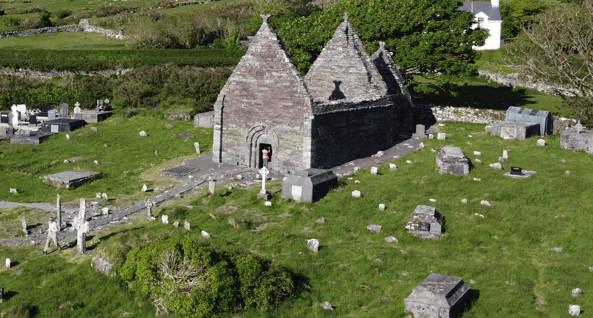
At Kilmalkedar, the surviving Romanesque church forms the centrepiece of a much larger ecclesiastical complex containing an ogham stone, sundial, crosses, carved stones and centuries of burials.
These places help demonstrate that Christianity on the Dingle Peninsula was not concentrated in one large religious centre. Sacred sites developed throughout the landscape over many centuries, sometimes incorporating older traditions and sometimes remaining places of worship or burial long after their original buildings had changed or disappeared.
Visitors interested in this deeper layer of Kerry’s past can explore more of the county’s historic and archaeological sites through the wider Explore Kerry collection.
Gallarus and Saint Brendan
Saint Brendan the Navigator is one of the figures most closely associated with the religious landscape of the Dingle Peninsula. Later tradition connects a number of places around West Kerry with Brendan and the pilgrimage landscape surrounding Mount Brandon.
It is important, however, to distinguish tradition from established archaeological evidence. There is no secure evidence that Brendan personally founded Gallarus Oratory or worshipped in the surviving building.
The official interpretation does acknowledge a possible symbolic relationship between the boat-like form of these stone churches and traditions surrounding Saint Brendan, but that should not be confused with proof of a direct historical connection.
Nearby Kilmalkedar has stronger associations with the pilgrimage tradition linked to Brendan and provides a useful next stop for visitors interested in how religious tradition developed across the peninsula.
The West Doorway
The entrance to Gallarus is positioned in the western gable. It is narrow and relatively low by modern standards, immediately reminding visitors that this was a small medieval building rather than a modern church.
The doorway is topped by a large stone lintel. There is no elaborate Romanesque carving of the type visible at Kilmalkedar. Gallarus derives its character from proportion and masonry rather than decoration.
Walking through the entrance also changes your perception of the building. From outside, attention tends to focus on the elegant stone profile. From inside, the thickness of the walls and the restricted light become much more noticeable.
The East Window
A small window pierces the eastern end of the oratory. Its position is consistent with Christian church orientation, with the altar traditionally placed towards the east.
The opening is small but carefully formed, allowing limited daylight into an otherwise enclosed interior. When you stand inside Gallarus, that small source of light becomes much more significant than it appears from outside.
It is one of the details I encourage visitors not to overlook. Gallarus is best appreciated by examining individual elements rather than simply taking the familiar side-on photograph and leaving.
What the Building Tells Us About Medieval Craftsmanship
Gallarus is valuable because so much of the original structure survives. At many medieval sites, archaeologists and architectural historians have to reconstruct missing roofs and upper walls from fragments. Here, the relationship between walls and roof can still be examined directly.
The builders understood local stone extremely well. The masonry had to be strong enough to carry its own considerable weight while closing progressively over the interior space.
There is also a practical response to weather built into the structure. That matters on a peninsula where Atlantic rain is not an occasional inconvenience but a fundamental environmental condition.
In this sense Gallarus belongs to a much broader tradition visible across West Kerry, where stone became the principal building material for field walls, forts, clocháns, churches and other structures.
Gallarus Is Not a Beehive Hut
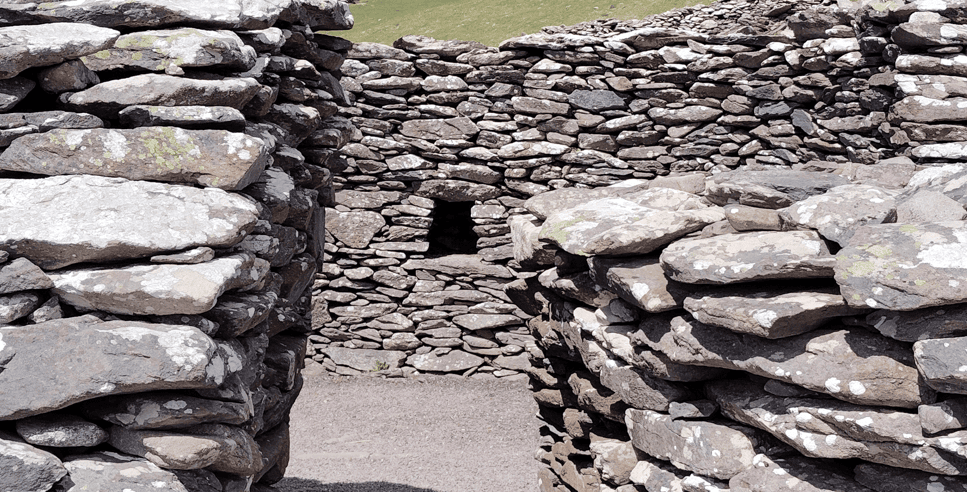
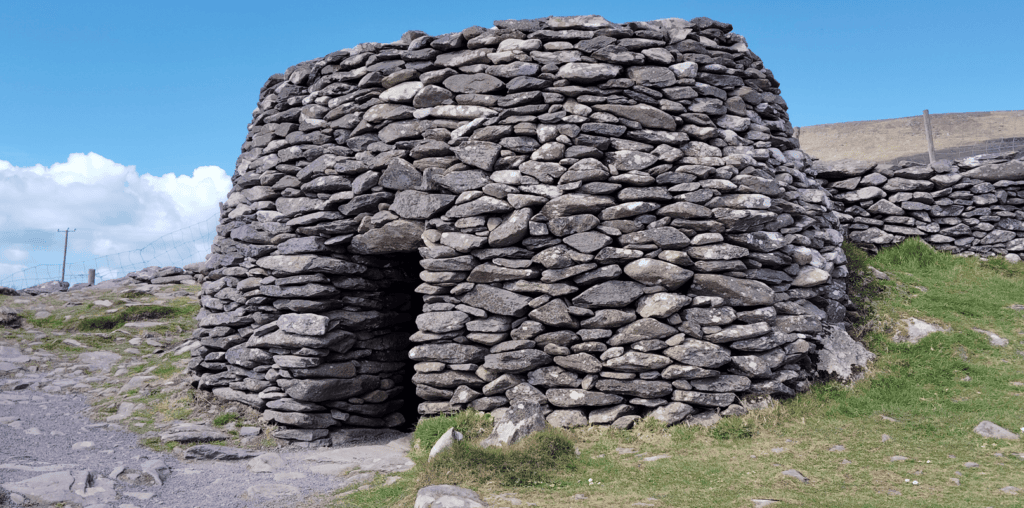
Visitors sometimes confuse Gallarus with the famous stone clocháns or Beehive Huts found elsewhere on the Dingle Peninsula because both use corbelled stone construction.
They are not the same type of building.
The clocháns are generally circular or roughly circular domestic or settlement structures, while Gallarus is a rectangular ecclesiastical building with a clearly defined west doorway and east window.
The comparison is still useful because both demonstrate the sophisticated use of dry-stone construction in western Ireland. But their forms and functions should not be treated as interchangeable.
Visiting Gallarus Oratory Today
Gallarus Oratory is a state-owned National Monument in the care of the Office of Public Works.
There is free public access directly to the monument using the OPW public right of way. A separate privately operated visitor centre also provides access, interpretation and visitor facilities for a charge. As arrangements and prices can change, visitors who specifically want the visitor-centre facilities should check current information before travelling.
The distinction is worth understanding because visitors occasionally assume an entrance fee is required simply to see Gallarus itself. The monument can be reached through the free state access route.
The permanent Gallarus Oratory guide is the better place to check the practical details of visiting the site before you travel.
How Long Should You Allow at Gallarus?
For a straightforward visit, around 30 minutes will be enough for many people. That allows time to walk to the monument, examine the exterior, step inside and look at some of the architectural details.
History and architecture enthusiasts may naturally spend longer. Gallarus rewards close observation, particularly if you take time to look at how the courses of stone progressively move inward towards the ridge.
I would not rush the site simply because the building itself is small. The physical dimensions tell you very little about how much history is contained within it.
Gallarus in Different Weather
Gallarus is one of those historic sites that works particularly well in changing Kerry weather.
Clear conditions provide views across the surrounding countryside, while grey skies can emphasise the texture and colour of the sandstone. Rain also makes the stone considerably darker and can make the construction more visually pronounced.
The site is exposed enough that a waterproof layer is sensible whenever the forecast is uncertain. Ground conditions may also be wet after prolonged rain, so practical footwear is preferable to dressing purely for photographs.
Photography at Gallarus Oratory
The classic photograph is the side profile that shows the gradual slope of the walls and roof. It is a useful image because it immediately communicates the building technique.
I would also look more closely.
Photograph the stone courses, the western doorway and the small eastern window. Move far enough away to include the surrounding fields and hills so that the building is placed back into its West Kerry landscape.
Changing light can make a substantial difference. Strong sunshine creates deep shadows between stones, while softer overcast conditions reveal more detail across the entire surface.
Gallarus, Kilmalkedar and Riasc
If history is one of the main reasons you are visiting the Dingle Peninsula, I would not experience Gallarus completely on its own.
Combine it with Kilmalkedar Church and Riasc Monastic Settlement and you begin to see three quite different expressions of religious life in West Kerry.
Riasc provides archaeological evidence for an enclosed working ecclesiastical community. Gallarus preserves an unusually complete stone oratory. Kilmalkedar displays the architecture and monuments of a substantial medieval ecclesiastical complex.
They should not be treated as three versions of the same site. Together they illustrate how religious settlement and architecture changed over centuries.
Gallarus as Part of a Dingle Peninsula Journey
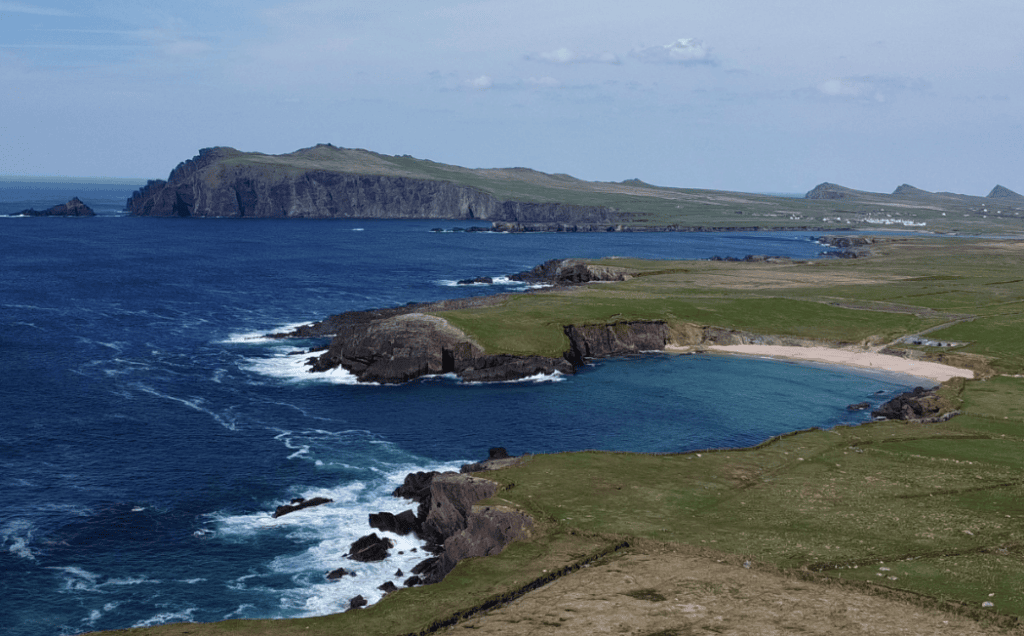
Most visitors encounter Gallarus while exploring the western peninsula, often as part of a longer journey that also includes Slea Head, Dún Chaoin, the Blasket views and Ballyferriter.
That works particularly well because the monument adds historical depth to a route that could otherwise be experienced mainly for scenery.
The famous Slea Head Drive combines Atlantic landscape with archaeology, Gaeltacht culture and the history of settlement in West Kerry. Gallarus belongs naturally within that broader story even though it sits away from the most dramatic section of coastline.
If you have limited time, my guide to whether Slea Head Drive is worth it in one day helps explain how the western peninsula can fit into a short visit.
Seeing Gallarus with a Local Guide
Gallarus is easy to look at but more difficult to interpret properly if you arrive with only the simplified story that it is an ancient church built more than a thousand years ago.
The more interesting version includes the uncertainty. Why has the building survived? How does corbelling work? Why did earlier generations assign it such an early date? Why has modern scholarship become more cautious? How does Gallarus compare with Riasc and Kilmalkedar?
Those are the connections I enjoy explaining when I bring visitors through this part of the peninsula.
Gallarus can be incorporated naturally into my private half-day Dingle Peninsula tour, where it can be experienced alongside Slea Head, the Blasket landscape and other historic places without reducing the day to a succession of isolated stops.
Continue Exploring West Kerry
Gallarus is an excellent starting point for exploring the deeper history of Corca Dhuibhne. Continue to Kilmalkedar Church to see one of the peninsula’s finest Romanesque churches and a remarkable collection of carved stones, or visit Riasc to examine the excavated remains of an early medieval ecclesiastical settlement.
Further west, the landscape opens towards the Blasket Islands and the Atlantic coast. Visitors interested in the wider cultural story can explore the history of the Blasket Islands, while those planning a broader visit can use the Explore Kerry collection to connect West Kerry with other destinations around the county.
The important thing is not to treat Gallarus as a single photograph stop. It belongs within a landscape containing centuries of religious activity, settlement, Irish-language culture and remarkable stone craftsmanship. Once you begin making those connections, the small building becomes one of the most revealing historic places on the Dingle Peninsula.
Frequently Asked Questions About Gallarus Oratory
How old is Gallarus Oratory?
Its exact date is unknown. Earlier interpretations often placed it around the eighth century, but current official interpretation considers an eleventh- or twelfth-century date more likely. No scientific dating has yet established a precise construction date.
Is Gallarus Oratory an early Christian church?
It has traditionally been described as an early Christian oratory, but its likely medieval date means that description should be used carefully. It is best understood as a medieval ecclesiastical building whose exact origins remain uncertain.
Was Gallarus Oratory built without mortar?
Gallarus is famous for its carefully fitted stone construction and corbelled roof. Its survival demonstrates highly sophisticated stone-building techniques rather than a simple or crude method of construction.
Why does Gallarus Oratory not leak?
The walls incline inward and the stone courses are arranged so that water is directed away from the interior. The shape and quality of construction have contributed significantly to the building’s exceptional preservation.
Do you have to pay to visit Gallarus Oratory?
Free public access to the state-owned monument is available through the Office of Public Works public right of way. A separate privately operated visitor centre also provides facilities and interpretation for a charge.
How long should I spend at Gallarus Oratory?
Around 30 minutes is sufficient for many visitors, although anyone particularly interested in architecture, archaeology or photography may want longer.
What historical sites are near Gallarus Oratory?
Kilmalkedar Church and Riasc Monastic Settlement are two of the most important nearby sites. Visiting them alongside Gallarus gives a much better understanding of the ecclesiastical history of the western Dingle Peninsula.
Is Gallarus Oratory on Slea Head Drive?
Gallarus is commonly incorporated into a wider journey around the western Dingle Peninsula. It lies away from the most exposed coastal section of Slea Head but fits naturally into a circuit through Ballyferriter and the northern side of the peninsula.
Is Gallarus Oratory worth visiting?
Yes, particularly if you are interested in Irish history, architecture or archaeology. Its importance comes not from its size but from the exceptional survival of its stone roof, the quality of its construction and its place within the wider medieval religious landscape of West Kerry.